
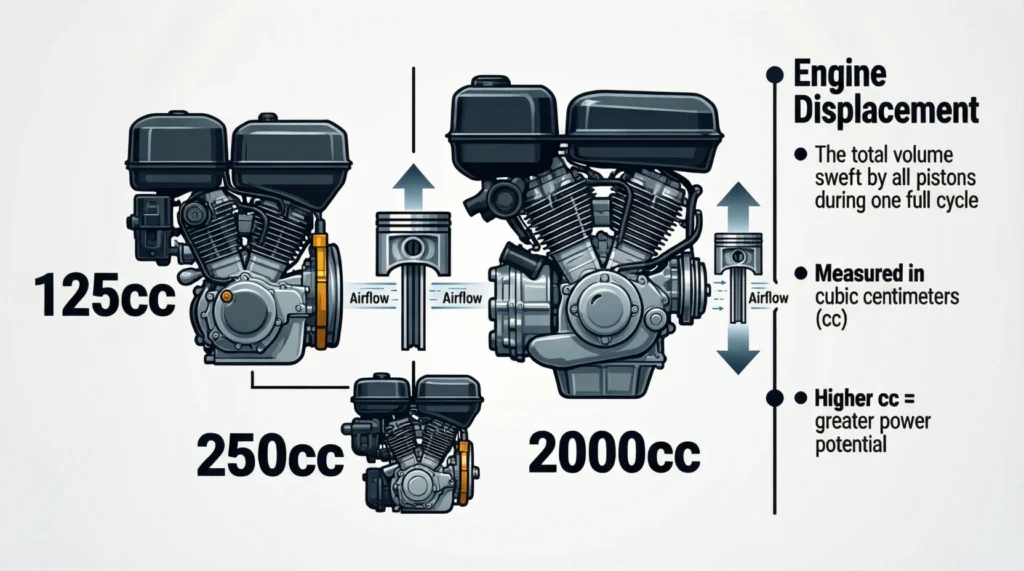
Definition: CC in engines stands for cubic centimeters, a unit of measurement that describes the engine’s displacement, or the total volume of air and fuel an engine’s cylinders can hold. In simple terms, CC tells you how big an engine is and how much power it can potentially produce.
If you’ve ever wondered why bikes are labeled 125cc, 250cc, or cars are described as 2000cc engines, you’re already halfway to understanding it.
Whether you’re buying a motorcycle, comparing cars, or just trying to understand engine specs, CC is one of the first numbers you’ll see. It often gets thrown around casually “It’s a 150cc bike” or “That car has a 3000cc engine”—but the meaning behind it is more important than most people realize.
CC affects:
- Engine power
- Fuel consumption
- Performance and speed
- Legal licensing requirements (especially for motorcycles)
Understanding what CC means in engines helps you make smarter, safer, and more cost effective decisions not just sound knowledgeable at the garage 😄
Let’s break it all down, step by step.
What Does CC Mean in Engines?
CC (cubic centimeters) measures the total internal volume of an engine’s cylinders.
Think of it like this:
- An engine is like a set of pumps
- Each pump (cylinder) pulls in air and fuel
- CC measures how much air and fuel all cylinders can hold combined
👉 Higher CC = more air + fuel = more power potential
Origin of the Term CC
The term cubic centimeter comes from the metric system, where volume is measured in cubic units.
- 1 cubic centimeter = 1 cm × 1 cm × 1 cm
- Engineers adopted CC because it provides precise engine size measurements
- Over time, CC became the global standard for motorcycles and smaller engines
In some countries (like the US), engine size is also expressed in liters or cubic inches, but CC remains widely used worldwide.
How Engine CC Is Calculated
Engine displacement (CC) is calculated using this formula:
CC = π × (Bore ÷ 2)² × Stroke × Number of Cylinders
Don’t worry—you don’t need to calculate this yourself. Manufacturers do it for you. But knowing this helps you understand why two engines with the same CC can behave differently.
Real-World Usage of CC in Engines
CC is used across many vehicles and machines:
Common Applications
- Motorcycles and scooters
- Cars and trucks
- Lawn mowers and generators
- Boats and jet skis
How People Use It in Conversation
- Friendly: “It’s just a 125cc bike—easy to handle 😊”
- Neutral: “This model comes with a 2000cc engine.”
- Dismissive: “Only 70cc? That won’t go far.”
Does Higher CC Always Mean Faster?
Not necessarily.
While higher CC usually means more power, speed depends on several other factors:
- Engine tuning
- Vehicle weight
- Gear ratios
- Turbochargers or superchargers
A 1500cc turbo engine can outperform a 3000cc naturally aspirated engine in some cases.
CC vs Horsepower vs Torque
Many people confuse CC with horsepower. Here’s how they differ:
| Term | What It Measures | Why It Matters |
|---|---|---|
| CC | Engine size | Power potential |
| Horsepower (HP) | Speed & output | Top speed |
| Torque | Pulling force | Acceleration & towing |
👉 CC influences horsepower and torque—but doesn’t equal them
Labeled Example Table: CC and Vehicle Types
| Engine CC | Vehicle Type | Typical Use |
|---|---|---|
| 50–110cc | Scooters | City commuting |
| 125–150cc | Motorcycles | Daily riding |
| 250–400cc | Sports bikes | Highway & touring |
| 600–1000cc | Superbikes | Racing & performance |
| 1500–2500cc | Cars | Family & sedans |
| 3000cc+ | SUVs & trucks | Heavy loads |
CC in Motorcycles vs Cars
Motorcycles
- CC strongly impacts speed and acceleration
- Higher CC = heavier bike + higher fuel use
- Licensing laws often depend on CC
Cars
- CC affects power, but modern tech matters more
- Turbocharged small CC engines are common
- Fuel efficiency varies widely
CC vs Liters: Are They the Same?
Yes—just expressed differently.
- 1000cc = 1 liter
- A 2.0L engine = 2000cc
Quick Conversion Table
| CC | Liters |
|---|---|
| 1000cc | 1.0L |
| 1500cc | 1.5L |
| 2000cc | 2.0L |
| 3000cc | 3.0L |
Alternate Meanings of CC
While this article focuses on engines, CC has other meanings depending on context:
- Email: Carbon Copy
- Medical: Cubic Centimeters (fluid volume)
- Social media: Closed Caption
⚠️ In automotive discussions, CC almost always means engine displacement
Is Higher CC Better? Pros and Cons
Advantages
- More power and acceleration
- Better load handling
- Smoother highway driving
Disadvantages
- Higher fuel consumption
- Increased maintenance costs
- Higher insurance and taxes in some regions
Professional Alternatives to Saying “CC”
In technical or formal writing, you may see:
- Engine displacement
- Engine capacity
- Cylinder volume
Example:
“This vehicle features a 2.0-liter engine displacement.”
How CC Affects Fuel Efficiency
Generally:
- Lower CC engines → better mileage
- Higher CC engines → higher fuel use
But modern innovations like:
- Turbocharging
- Hybrid systems
- Direct fuel injection
…can make small CC engines surprisingly efficient and powerful.
Buying Tips: Choosing the Right CC Engine
Ask yourself:
- Is it for city or highway use?
- Do I need speed or fuel efficiency?
- What are local license or tax limits?
Quick Recommendations
- Beginners: 100–150cc
- Daily commuters: 150–250cc
- Touring & highways: 400cc+
- Family cars: 1500–2000cc
FAQs
1. What does CC stand for in engines?
CC stands for cubic centimeters, measuring engine displacement.
2. Is higher CC always more powerful?
Usually yes, but tuning and technology also matter.
3. Does CC affect fuel mileage?
Yes—higher CC engines typically use more fuel.
4. What CC is best for beginners?
For motorcycles, 100–150cc is ideal for beginners.
5. Is CC the same as horsepower?
No. CC measures size, horsepower measures power output.
6. Why do bikes use CC instead of liters?
Because CC offers more precise measurements for small engines.
7. Can two engines have the same CC but different power?
Absolutely. Design and tuning make a big difference.
8. Is CC important when buying a car?
Yes, but it should be considered alongside fuel efficiency and performance.
Conclusion:
Understanding what CC means in engines helps you make smarter and more confident decisions whether you’re choosing a motorcycle, comparing cars, or simply trying to understand vehicle specifications. CC, or cubic centimeters, measures an engine’s displacement and gives you a clear idea of its power potential, fuel usage, and overall performance behavior.
While higher CC engines generally offer more power and faster acceleration, they also tend to consume more fuel and cost more to maintain. On the other hand, lower CC engines are more fuel efficient, easier to handle, and ideal for daily commuting or beginners. The key takeaway is that CC alone doesn’t define how good an engine is factors like tuning, weight, technology, and intended use matter just as much.

Matthew Nelson is a professional content writer and blogger with a strong focus on creating high-quality and reader-centric content. He specializes in writing informative articles that help websites grow their online visibility while delivering real value to readers.