What does climax mean in a story?
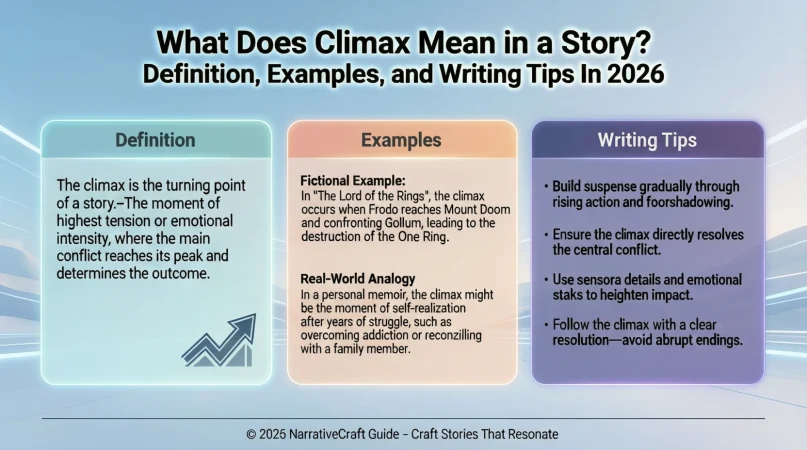
In a story, the climax is the most intense and important moment where the main conflict reaches its peak and the outcome becomes clear. It’s the turning point that determines how the story will end.
Climax is one of those storytelling words you’ve probably heard in school, movies, or writing guides but its true power often gets overlooked. Whether you’re a student analyzing a novel, a writer crafting a short story, or just a curious reader, understanding the climax of a story can completely change how you experience narratives.
Let’s break it down in a clear, friendly, and practical way, no confusing literature jargon, just real explanations, relatable examples, and tips you can actually use.
🌟 Why the Climax Matters So Much
Think of a story like a roller coaster 🎢:
- The beginning pulls you up slowly
- The middle builds tension
- The climax is the big drop fast, emotional, unforgettable
- The ending brings you safely back to the ground
Without a strong climax, a story can feel flat, unfinished, or unsatisfying. The climax is where readers lean in, hearts racing, desperate to know what happens next.
🧠 Understanding Climax in Story Structure
Most stories follow a classic structure, often called Freytag’s Pyramid. The climax sits right at the center.
📐 The Five Main Parts of a Story
- Exposition – Introduces characters, setting, and background
- Rising Action – Builds tension through conflicts and challenges
- Climax – The turning point and most intense moment
- Falling Action – Events that happen after the climax
- Resolution – The conflict is resolved and the story ends
👉 The climax is not the ending but it decides the ending.
📚 Origin of the Word “Climax”
The word climax comes from the Greek word klimax, meaning ladder or staircase.
- In ancient rhetoric, it described a series of ideas that increased in importance
- Over time, it evolved to represent the highest point of tension or intensity
- In storytelling, it became the term for the moment where everything finally comes together
This origin makes sense: a story climbs toward the climax step by step.
📈 Popularity and Real-World Usage
The term climax is widely used across:
- 📖 Literature and literary analysis
- 🎬 Movies and TV shows
- 🎮 Video games and interactive storytelling
- 📝 Creative writing classes and workshops
You’ll often hear phrases like:
- The climax of the novel
- That scene was the emotional climax
- The story builds toward a dramatic climax
It’s a core concept in storytelling, taught from elementary school all the way to advanced writing courses.
✍️ What Happens at the Climax?
At the climax, one or more of these things usually happen:
- The main character faces their biggest challenge
- A major decision is made
- A secret is revealed 😮
- A battle, confrontation, or emotional breakdown occurs
- The outcome of the central conflict becomes unavoidable
The key idea: after the climax, there’s no turning back.
🧩 Labeled Example Table: Climax in Famous Stories
| Story | Main Conflict | Climax Moment | Why It’s the Climax |
| Harry Potter and the Sorcerer’s Stone | Stop Voldemort | Harry confronts Voldemort | Determines who controls the stone |
| Cinderella | Escape oppression | The glass slipper fits | Confirms Cinderella’s identity |
| The Lion King | Reclaim the throne | Simba faces Scar | Decides the fate of Pride Rock |
| Romeo and Juliet | Forbidden love | Romeo kills Tybalt | Triggers tragic consequences |
🎭 Examples of Climax with Tone
😊 Friendly / Positive Tone
- The moment when the hero finally saves the day and everyone cheers is the climax of the story 🎉
😐 Neutral / Academic Tone
- The climax occurs when the protagonist confronts the antagonist, resolving the central conflict.
🙄 Negative / Dismissive Tone
- The climax was rushed and didn’t feel earned, making the story disappointing.
🔍 Climax vs. Related Story Terms
Many people confuse climax with other parts of a story. Let’s clear that up.
📊 Comparison Table
| Term | Meaning | How It’s Different from Climax |
| Rising Action | Builds tension | Happens before the climax |
| Falling Action | Events after climax | Shows the results |
| Resolution | Ending of the story | Wraps things up |
| Conflict | The problem | Exists throughout the story |
| Turning Point | A change in direction | Often happens at the climax |
👉 Climax = the biggest turning point, not just any exciting scene.
🔄 Alternate Meanings of “Climax”
While this article focuses on storytelling, climax has other meanings:
- General use: The highest or most intense point of something
- Example: The concert reached its climax during the final song 🎶
- Example: The concert reached its climax during the final song 🎶
- Scientific/biological context: A peak state in a process
- Adult context: A biological term (not used in literature analysis)
👉 In stories and writing, the meaning is always about narrative tension and turning points.
🧠 How Writers Create a Strong Climax
If you’re writing a story, here are practical tips to craft a powerful climax:
- Make sure it directly connects to the main conflict
- Let characters face real consequences
- Avoid sudden solutions that feel unrealistic
- Build tension gradually before the climax
- Keep the pacing tight and focused
✨ A good climax feels inevitable but still surprising.
🧑🏫 Polite or Professional Alternatives (When Needed)
In formal or academic writing, you might use alternatives like:
- Turning point
- Pivotal moment
- Peak of the narrative
- Moment of highest tension
These can be useful if you’re avoiding repetition or writing in a professional tone.
❓ FAQ: What Does Climax Mean in a Story?
1. Is the climax always the most exciting part of a story?
Usually yes, but excitement can be emotional, dramatic, or psychological, not just action-packed.
2. Can a story have more than one climax?
Most stories have one main climax, but complex narratives may include smaller climactic moments.
3. Is the climax the ending?
No. The climax happens before the ending and leads into the resolution.
4. How long should the climax be?
There’s no fixed length. It can be a single scene or several chapters, depending on the story.
5. Does every story need a climax?
Yes. Even very short stories have a moment where the main tension peaks.
6. What comes right after the climax?
The falling action, where the consequences of the climax unfold.
7. Can the climax be emotional instead of physical?
Absolutely. Many powerful climaxes involve emotional realization or moral choice.
8. How do I identify the climax in a story?
Ask yourself: Where does the main conflict reach its breaking point? That’s the climax.
Conclusion
In a story, the climax is the most intense and important moment where the main conflict reaches its peak. It’s the turning point that determines how the story will move toward its ending, often revealing the true strengths, choices, or flaws of the characters.
Without a strong climax, a story can feel flat or unfinished—making this moment essential for keeping readers engaged and giving the narrative real impact.

Michael Johnson is a seasoned Content Expert and digital communication specialist with a proven track record in content creation, strategy, and audience engagement. His work goes beyond writing he crafts meaningful, results driven content that helps businesses achieve growth, brand visibility, and audience trust.