
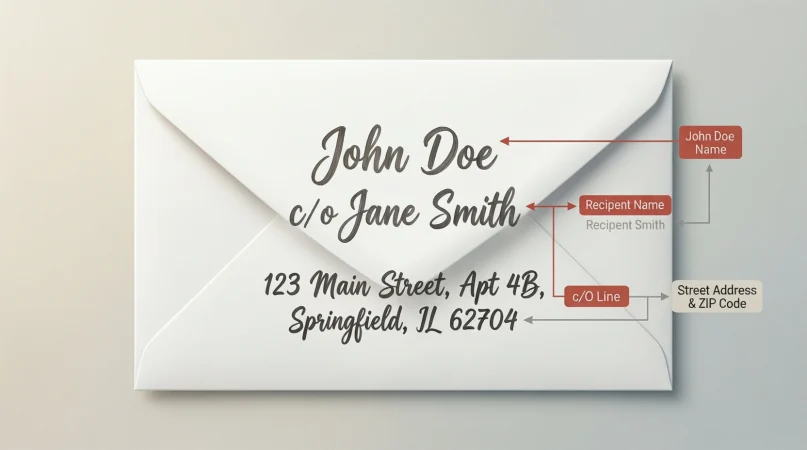
Quick Ans: C/O in mailing stands for “care of.”
It is used when sending mail to someone through another person or organization because the recipient does not receive mail directly at that address. The mail is delivered in care of the intermediary, who then passes it on to the intended recipient.
Ever seen “c/o” written on an envelope and wondered what it actually means or whether you’re using it correctly? You’re not alone. This tiny abbreviation shows up everywhere from formal letters and legal documents to packages and business mail, yet many people use it without fully understanding it.
Example:
John Smith
c/o Jane Doe
123 Main Street
New York, NY 10001
This tells the postal service to deliver the mail to Jane Doe’s address, but for John Smith.
Why “C/O” Still Matters Today
In an age of email and instant messaging, physical mail might feel old-school but c/o remains incredibly relevant for:
- Temporary living situations
- Business correspondence
- Legal and official documents
- Students, travelers, and guests
- Caregivers or shared addresses
Using c/o correctly can be the difference between mail arriving safely or getting lost entirely.
What Does “Care Of” Mean, Exactly?
The phrase “care of” literally means:
“Please deliver this item to this address, but it belongs to someone else.”
In practical terms, it tells the mail carrier:
- The address belongs to Person A
- The mail is intended for Person B
- Person A is responsible for passing it along
Think of it as a polite, official mail handoff system.
Origin of “C/O” in Mailing
The term “care of” dates back several centuries, long before modern postal systems existed.
A Brief History
- Used in handwritten correspondence as early as the 18th century
- Became standardized with the rise of organized postal services
- Shortened to “c/o” for efficiency and consistency
- Widely adopted in British and American mail systems
Even today, postal authorities worldwide recognize c/o as a standard addressing convention.
How to Use C/O Correctly in an Address
Using c/o is simple but placement matters.
Correct Address Format (Personal Mail)
Recipient’s Name
c/o Intermediary’s Name
Street Address
City, State, ZIP Code
Example
Sarah Khan
c/o Ali Ahmed
45 Garden Road
Lahore 54000
Pakistan
Correct Address Format (Business Mail)
Recipient’s Name
c/o Company or Department Name
Street Address
City, State, ZIP Code
Labeled Example Table: How C/O Works
| Situation | How to Use C/O | Why It’s Needed |
| Guest staying with a friend | c/o friend’s name | Guest has no permanent address |
| Employee at a large company | c/o company name | Ensures internal delivery |
| Student living in dorms | c/o dorm or housing office | Mail sorting accuracy |
| Legal notice | c/o legal guardian or firm | Official point of contact |
| Temporary housing | c/o host’s name | Short-term residence |
Common Real-World Uses of C/O
1. Temporary Living Arrangements
If someone is:
- Traveling
- Staying with relatives
- Living in temporary housing
c/o ensures the mail reaches them safely.
2. Business and Corporate Mail
Used when:
- An employee doesn’t have a personal mailbox
- Mail is routed through a department or office
- Sending documents to consultants or contractors
3. Legal and Financial Documents
Often used in:
- Court notices
- Insurance correspondence
- Power of attorney communications
4. Students and Dormitories
Colleges frequently require:
- Student name
- c/o housing office or residence hall
Examples of C/O in Context (With Tone Notes)
Friendly / Casual
Emma Lee
c/o Aunt Maria
78 Oak Street
Chicago, IL 60610
👉 Friendly, informal, commonly used for family or guests.
Neutral / Professional
David Chen
c/o Horizon Tech Solutions
410 Market Avenue
San Francisco, CA 94105
👉 Standard business tone. Very common in corporate mail.
Formal / Legal
Michael Brown
c/o Smith & Partners Law Firm
1200 Justice Blvd
Washington, DC 20001
👉 Highly formal. Used for legal clarity and accountability.
Dismissive or Negative Tone?
Unlike text slang, c/o itself has no negative or dismissive tone.
Any perceived tone comes from context, not the abbreviation.
Does C/O Affect Mail Delivery?
Short answer: Yes in a good way.
Using c/o properly:
- Reduces returned mail
- Helps postal workers route items correctly
- Ensures accountability at shared addresses
However, misuse can cause:
- Delays
- Confusion
- Lost mail
Common Mistakes to Avoid
- ❌ Putting c/o before the recipient’s name
- ❌ Leaving out the intermediary’s name
- ❌ Using c/o when it’s not needed
- ❌ Mixing it up with “ATTN” (attention)
C/O vs. ATTN vs. C/O % (Comparison Table)
| Term | Meaning | Best Use Case |
| c/o | Care of | Deliver through another person or entity |
| ATTN | Attention | Direct mail to a specific person/department |
| % | In care of (older style) | Rare, outdated usage |
| C/O | Capitalized version | Same meaning, stylistic choice |
Tip:
- Use c/o when the recipient doesn’t control the address
- Use ATTN when the recipient works at that address
Are There Alternate Meanings of C/O?
Yes but not in mailing.
Other Contexts Where C/O Appears
- Finance: c/o as shorthand in care-of accounts
- Business directories: care-of listings
- Legal documents: responsibility routing
In mailing, however, the meaning is always taken care of.
Polite or Professional Alternatives to C/O
Sometimes, you may want to avoid abbreviations altogether.
Alternatives
- In care of (written out)
- Delivered via
- Hosted by (informal)
- Attention: (for workplaces)
Example (formal):
John Patel
In care of Finance Department
ABC Corporation
Usage Tips for Perfect Mail Delivery
- Always double-check spelling of both names
- Use c/o only when necessary
- Keep formatting clean and readable
- Match the tone to the situation (formal vs casual)
- When in doubt, ask the recipient how they receive mail
FAQs
1. What does c/o stand for in mailing?
It stands for care of, meaning the mail is delivered through another person or organization.
2. Is c/o still used today?
Yes. It’s widely used in personal, business, and legal mail worldwide.
3. Where do you write c/o on an envelope?
On the line below the recipient’s name and above the street address.
4. Can I use c/o for packages?
Absolutely. It’s commonly used for parcels, especially for temporary addresses.
5. Is c/o formal or informal?
It works in both. The tone depends on the context, not the abbreviation.
6. What’s the difference between c/o and ATTN?
c/o routes mail through someone else; ATTN directs mail to a specific person within an organization.
7. Can I write “care of” instead of c/o?
Yes. Writing it out is often more formal and equally correct.
8. Will mail be returned if I forget c/o?
It might be delayed or returned if the recipient doesn’t officially receive mail at that address.
Conclusion
Understanding what c/o means in mailing can save time, prevent lost mail, and make your communication look more professional. In simple terms, c/o (care of) is used when you’re sending mail to someone through another person or organization because the recipient doesn’t directly receive mail at that address.
Whether you’re mailing a letter to a guest, a student, an employee, or sending official documents, using c/o correctly helps postal services deliver your mail accurately and efficiently. Remember to place it after the recipient’s name, include the full and correct address, and choose the format that best fits the situation casual, professional, or formal.
When used properly, c/o is a small detail that makes a big difference in ensuring your mail reaches the right hands without confusion or delay.
Read More About:
- What Does DNS Mean in Track? Definition, Usage, Examples and Comparisons 2026
- What Does WYS Mean in Text? Definition, Examples, Usage & Alternatives In 2026

Michael Johnson is a seasoned Content Expert and digital communication specialist with a proven track record in content creation, strategy, and audience engagement. His work goes beyond writing he crafts meaningful, results driven content that helps businesses achieve growth, brand visibility, and audience trust.