
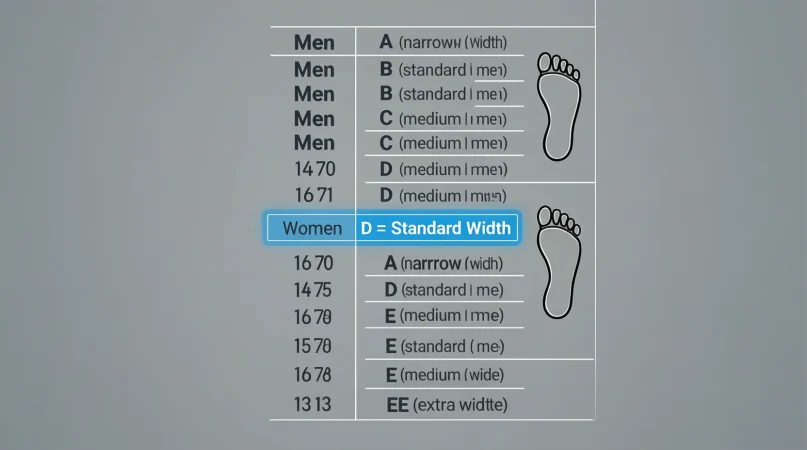
Definition: D in shoe size means a medium or standard width, primarily for men’s shoes. It describes the width of the shoe, not the length, and is the most commonly sold width in men’s footwear.
When shopping for shoes, letters like D in a shoe size can be confusing especially if you’re focused on comfort, fit, and foot health. The D width is one of the most commonly used shoe width indicators, particularly in men’s footwear, and understanding it can help you avoid discomfort, blisters, or long-term foot issues.
Backed by standard footwear sizing systems used by manufacturers and retailers, knowing what D means allows you to make more informed, confident buying decisions. Whether you’re choosing athletic shoes, formal footwear, or everyday sneakers, understanding shoe width is just as important as knowing your shoe length.
Why Shoe Width Letters Matter More Than You Think
Most people focus only on shoe length (8, 9, 10, etc.), but width is just as important.
A shoe that’s the wrong width can cause:
- Blisters
- Toe crowding
- Foot pain or numbness
- Faster shoe damage
- Long-term foot problems
That little letter like D plays a big role in comfort, posture, and foot health.
What Does “D” Mean in Shoe Size?
D = Medium Width
But here’s the important part 👇
The meaning of D depends on gender sizing standards.
✅ For Men
- D = Standard / Medium width
- Most men automatically wear D width shoes without realizing it
⚠️ For Women
- D = Wide
- Women’s standard width is usually B
- A women’s D is wider than average
So yes D is not universal. Context matters.
Labeled Shoe Width Example Table
👟 Shoe Width Chart (U.S. Sizing)
| Width Letter | Men’s Fit | Women’s Fit | Description |
| A | Narrow | Extra Narrow | Very slim fit |
| B | Narrow | Standard | Common women’s width |
| C | Narrow–Medium | Wide | Slightly wider |
| D | Standard (Medium) | Wide | Most common men’s width |
| E | Wide | Extra Wide | Broad feet |
| EE / 2E | Extra Wide | Extra Extra Wide | Very wide fit |
| EEE / 4E | Extra Extra Wide | Extremely wide |
Origin of the “D” Width System
The letter-based width system comes from early 20th-century American shoe manufacturing.
How it started:
- Shoe makers needed a standard way to fit different foot shapes
- Length alone wasn’t enough
- Letters were added to represent width increments
Why D became popular:
- The average adult male foot fit best in D width
- Manufacturers standardized around it
- Retailers stocked it the most
That’s why today, if a shoe doesn’t list a width, it’s almost always D for men.
How “D” Is Used in Real-World Shoe Shopping
In Stores 🏬
- If you ask for a men’s size 10 and don’t specify width → you’ll get 10D
- Width is often invisible unless you ask
Online 🛒
You’ll see options like:
- 9D
- 10.5D
- 11D
That D is the width, not a model or version.
Athletic Shoes 🏃
- Most running shoes default to D width for men
- Wide feet often need 2E instead of D
Friendly, Neutral, and Dismissive Usage Examples
Even though “D” is neutral, tone can change depending on context.
😊 Friendly / Helpful
“I usually wear a 10D standard width that fits me perfectly.”
😐 Neutral / Informational
“This shoe is available in D and 2E widths.”
😬 Mildly Dismissive (Retail Context)
“If you don’t have wide feet, D should be fine.”
How to Know If D Width Is Right for You
D width likely fits you if:
- Your shoes feel snug but not tight
- Your toes aren’t squished
- Your foot doesn’t spill over the sole
- You don’t need to size up for comfort
D width may NOT fit if:
- Your pinky toe rubs the side 😖
- You feel pressure across the ball of your foot
- You buy shoes “half a size bigger” just for space
👉 That’s usually a width problem, not a length issue.
Measuring Your Foot Width at Home
You don’t need fancy tools.
What you need:
- Paper
- Pen
- Ruler
Steps:
- Stand on paper (full weight)
- Trace your foot
- Measure the widest part
- Compare to a width chart
If your measurement is above average for your length → you might need 2E instead of D.
D vs Other Shoe Widths
D vs B
- D: Standard men’s width
- B: Standard women’s width
- Men wearing B = narrow feet
D vs C
- C is slightly narrower than D
- Often used for men with slim feet
D vs E / EE
- E or EE = wide
- Better for flat feet, high volume feet, or swelling
Alternate Meanings of “D” in Shoes
While rare, D can mean different things depending on context:
- Model variation (not width) uncommon
- Internal manufacturer code usually not shown to buyers
- Half-size marker in EU systems unrelated
👉 In 99% of retail cases, D = width.
Professional & Polite Alternatives (Retail & Communication)
Instead of saying:
- “Just get D, it’s normal.”
Try:
- “D is the standard width for men happy to check wider options if needed.”
More inclusive, more accurate 👍
Common Myths About D Shoe Width
❌ Myth: D means “large shoe”
✅ Truth: D is about width, not size
❌ Myth: Everyone wears D
✅ Truth: Many people need wider or narrower shoes
❌ Myth: Width doesn’t matter
✅ Truth: Width affects comfort, posture, and foot health
FAQs
1. Is D width normal?
Yes. D is the standard width for men’s shoes.
2. Is D width wide?
- For men: ❌ No (it’s medium)
- For women: ✅ Yes (it’s wide)
3. What does 10D mean in shoes?
It means size 10, standard width (D).
4. Is D wider than B?
Yes. D is wider than B.
5. What if D shoes feel tight?
You may need 2E (wide) instead of sizing up.
6. Do all brands use the same D width?
Mostly, but fit can vary slightly by brand.
7. Is D width good for flat feet?
Sometimes but many flat feet need E or EE.
8. Can women wear D width shoes?
Yes, especially if they have wider feet.
Conclusion:
In shoe sizes, the letter D refers to the width of the shoe, not the length. It is considered the standard or medium width for men, while for women it usually indicates a wide fit. Understanding width letters like D helps ensure better comfort, proper support, and a more accurate fit when choosing shoes.

Rachel King is a seasoned content expert with extensive experience in creating engaging, high-quality, and better content across multiple niches. She specializes in content strategy, digital storytelling, and content optimization for websites, blogs, and social media platforms. With a keen eye for detail and a deep understanding of audience behavior, Rachel crafts content that not only informs but also converts and drives engagement.