
Definition:
D3 in a car typically refers to “Drive 3,” a transmission gear setting that limits the automatic transmission to the first three gears.
It is commonly found in automatic vehicles and is used to improve control, engine braking, and performance in specific driving situations such as hills, towing, or city traffic.
Have you ever glanced at your car’s gear selector and wondered what D3 means? You’re not alone. Many drivers notice it next to D, D2, or L and aren’t sure when or if they should use it.
Understanding what D3 means in a car can help you drive more confidently, improve vehicle control, and even protect your transmission in certain situations. In this detailed guide, we’ll break down everything you need to know from its origin and real-world usage to comparisons, alternate meanings, FAQs, and practical tips.
Let’s shift into gear 🚗 and dive in.
What Does D3 Mean in a Car?
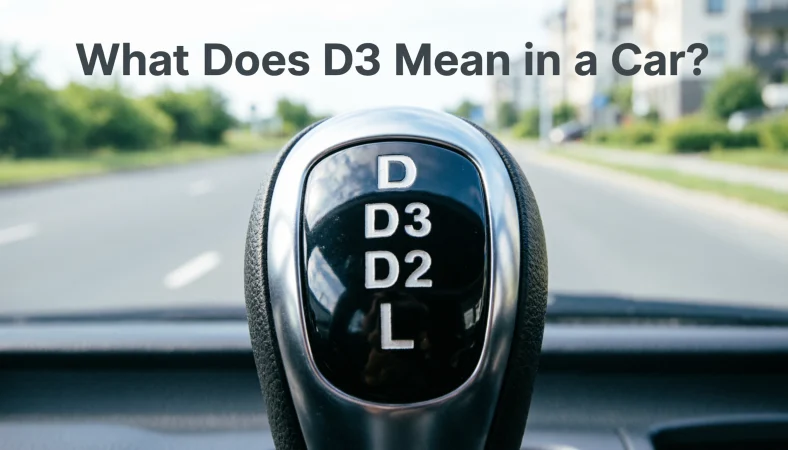
In most automatic vehicles, D3 stands for “Drive 3.” It allows the transmission to use only the first three gears (1st, 2nd, and 3rd), preventing it from shifting into higher gears like 4th, 5th, or overdrive.
In simple terms:
- D (Drive) = Uses all gears available
- D3 = Uses only the first three gears
- D2 = Uses only first and second gears
- L (Low) = Uses only first gear
When you select D3, your car:
- Won’t shift into overdrive
- Provides stronger engine braking
- Offers better torque at moderate speeds
- Maintains better control on hills
The Origin of D3 in Automatic Transmissions
To understand why D3 exists, we need to look at how automatic transmissions evolved.
Early automatic transmissions had:
- 3-speed gearboxes
- Simple gear selection options
- Limited driver control
As transmissions improved and added 4, 5, 6, or more gears, manufacturers kept intermediate gear options like D3 to allow drivers more control in specific driving situations.
Instead of fully automatic shifting at all times, D3 became a manual override-style feature letting drivers limit the highest gear.
It became especially popular in:
- Japanese cars
- American sedans from the 1990s and 2000s
- SUVs designed for mixed city and light off-road use
Today, some modern vehicles replace D3 with:
- Manual shift mode (+/-)
- Paddle shifters
- “S” (Sport) mode
But the function is still very similar.
When Should You Use D3?
You don’t need D3 for everyday highway driving. But it becomes extremely useful in certain conditions.
1. Driving Downhill ⛰️
Using D3 helps:
- Slow the vehicle without constant braking
- Reduce brake wear
- Prevent overheating brakes
This is called engine braking.
2. Driving Uphill
D3:
- Keeps RPMs slightly higher
- Prevents constant upshifting and downshifting
- Provides better power delivery
3. Towing a Trailer
When towing:
- D3 maintains better torque
- Prevents frequent gear hunting
- Improves transmission stability
4. Stop-and-Go Traffic
In city driving:
- D3 keeps the car responsive
- Prevents unnecessary overdrive shifts
- Offers smoother acceleration
Example Scenarios (With Tone & Context)
Here are practical examples of how D3 might be used in conversation:
Friendly Tone 🙂
“Hey, switch to D3 when we’re going down this hill—it’ll help control the speed.”
Neutral Informational Tone
“You may use D3 when towing to prevent the transmission from shifting into overdrive.”
Slightly Corrective Tone
“You shouldn’t stay in D3 on the highway—it’s meant for controlled driving, not cruising.”
D vs D3 vs D2 vs L – Clear Comparison Table
Here’s a simple breakdown:
| Gear Setting | What It Means | Best For | Speed Range |
|---|---|---|---|
| D | Full automatic (all gears) | Highway & normal driving | All speeds |
| D3 | Limits to first 3 gears | Hills, towing, city traffic | Low to medium speeds |
| D2 | Limits to 1st & 2nd gear | Steep hills, snow | Low speeds |
| L | First gear only | Very steep descents | Very low speeds |
Key Takeaway:
Use D for normal driving. Use D3 when you need extra control or power.
Does D3 Damage Your Car?
No if used properly, D3 does not damage your car.
However:
- Driving long distances at high speeds in D3 can increase engine RPM.
- Higher RPM means more fuel consumption.
- It can create unnecessary engine strain if used incorrectly.
When NOT to use D3:
- Highway cruising at 60+ mph
- Long-distance travel
- When fuel efficiency is your priority
D3 vs Sport Mode – Are They the Same?
Many modern cars have replaced D3 with “S” (Sport) mode.
Key Differences:
| Feature | D3 | Sport Mode |
|---|---|---|
| Gear Limiting | Yes (up to 3rd gear) | No fixed limit |
| RPM Behavior | Moderate increase | High RPM |
| Performance Focus | Control & torque | Aggressive acceleration |
| Fuel Economy | Slightly lower | Much lower |
Sport mode changes:
- Throttle response
- Shift timing
- Acceleration feel
D3 simply limits gear range.
Is D3 the Same in Every Car?
Not always.
Some vehicles:
- Label it as “3”
- Combine it with manual shifting
- Replace it with paddle shifters
Always check your owner’s manual for confirmation.
Alternate Meanings of D3
While D3 in cars usually means “Drive 3,” it can also mean:
- D3.js – A JavaScript data visualization library
- Vitamin D3 – A supplement
- Division III (D3) – College sports classification
- Audi A8 D3 – A generation of the Audi A8
For example, in the automotive world, the Audi A8 D3 refers to the third-generation Audi A8 model produced between 2002 and 2010.
So context matters.
Practical Driving Tips for Using D3
Here are some helpful tips:
- Use D3 before starting downhill—not halfway down.
- Switch back to D when returning to normal roads.
- Monitor RPM levels while driving.
- Don’t use D3 for fuel savings—it usually reduces efficiency.
- Combine D3 with smooth braking for better control.
FAQ:
1. Is it bad to drive in D3 all the time?
It’s not harmful short term, but it reduces fuel efficiency and keeps RPM higher than necessary.
2. Does D3 make my car faster?
Not exactly. It makes acceleration more responsive but doesn’t increase top speed.
3. Can I switch from D to D3 while driving?
Yes, in most automatic vehicles you can switch while driving at moderate speeds.
4. Is D3 good for snow?
It can help in mild snow by preventing overdrive shifts, but D2 or L may be better for slippery roads.
5. Does D3 save brakes?
Yes, especially on downhill roads due to engine braking.
6. What speed is D3 for?
Usually low to medium speeds—typically under highway cruising speeds.
7. Is D3 the same as overdrive?
No. D3 prevents overdrive. Overdrive is usually the highest gear.
8. Why does my car not have D3?
Newer cars use manual shift modes or sport mode instead of labeled D3.
Conclusion:
So, what does D3 mean in a car?
It simply means Drive 3, a gear setting that limits your transmission to the first three gears for better control, torque, and engine braking.
Key Takeaways:
- Use D for normal driving.
- Use D3 for hills, towing, and city traffic.
- Don’t use D3 for long highway trips.
- It’s safe when used correctly.
- Modern cars may replace D3 with sport or manual modes.
Understanding your gear settings helps you:
- Drive safer
- Protect your transmission
- Improve control in tough conditions
- Extend brake life
Now that you know what D3 means, you can use it confidently when the road demands it 🚗

Justin Young is a passionate Digital Creator and Content Writer who specializes in crafting engaging, informative, and results-driven content. He focuses on creating high-quality, blog posts, and digital content that capture attention and deliver real value to readers. With a strong interest in storytelling, trends, and online growth, Justin helps brands and individuals connect with their audiences through clear, impactful, and creative writing.