
Definition:
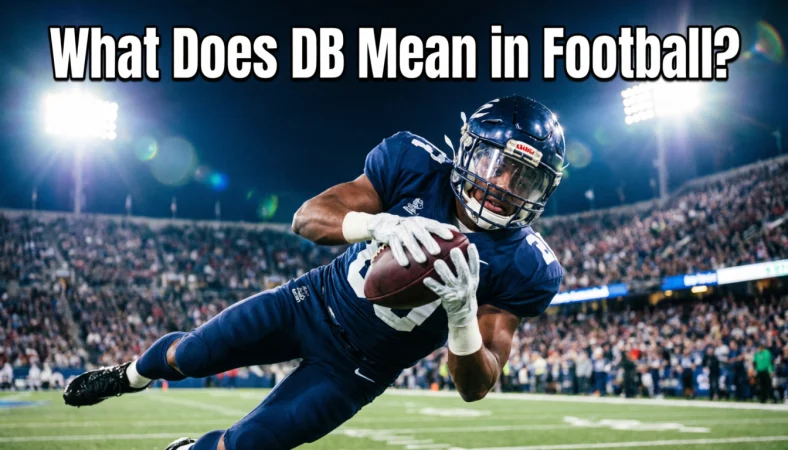
In football, DB stands for Defensive Back, a defensive player responsible for covering receivers, defending against passes, and preventing offensive plays. Defensive backs include positions such as cornerbacks and safeties, and they play a crucial role in pass defense and overall secondary coverage.
If you’ve ever watched a football game and heard an announcer say, “The DB made a great play on the ball,” you might have wondered what that meant. Whether you’re new to the sport or brushing up on football terminology, understanding the meaning of DB in football gives you better insight into defensive strategy, player roles, and game analysis.
In this complete guide, we’ll break down everything you need to know about DB in football including origin, usage, comparisons, examples, and even alternate meanings.
What Does DB Mean in Football?
In American football, DB is the abbreviation for Defensive Back. It’s not a single position but a group of positions within the defense.
Defensive backs typically include:
- Cornerbacks (CB)
- Safeties (S) – Free Safety (FS) and Strong Safety (SS)
- Nickelbacks
- Dimebacks
Together, these players form what is known as the secondary.
Main Responsibilities of a DB:
- Cover wide receivers
- Break up passes
- Intercept the ball
- Provide deep coverage
- Support run defense when needed
- Prevent touchdowns
Without strong DB play, even the best defensive line can struggle.
The Role of a Defensive Back in Modern Football
Football has evolved significantly over the years. Today’s game emphasizes passing more than ever, which makes the DB position even more important.
Why DBs Matter More Than Ever
Modern offenses rely heavily on:
- Spread formations
- Multiple receiver sets
- Quick passing attacks
- Play-action passes
Because of this, defensive backs must be:
- Fast
- Agile
- Smart readers of offensive schemes
- Strong tacklers
A single mistake by a DB can lead to a huge gain or touchdown. That’s why announcers often highlight the performance of the secondary.
Types of Defensive Backs Explained
Let’s break down each type of DB position clearly.
1. Cornerback (CB)
Cornerbacks line up near the sidelines and guard wide receivers.
Key duties:
- Man-to-man coverage
- Zone coverage
- Press coverage
- Breaking up passes
Example: “The DB locked down the receiver all game.”
Tone: Neutral, analytical
2. Free Safety (FS)
The free safety typically plays deep in the field.
Key duties:
- Deep coverage
- Reading the quarterback
- Providing help over the top
Example: “The DB read the quarterback’s eyes and intercepted the pass!”
Tone: Excited, positive 🎯
3. Strong Safety (SS)
The strong safety plays closer to the line of scrimmage.
Key duties:
- Run support
- Covering tight ends
- Blitzing occasionally
Example: “That DB delivered a big hit in the red zone.”
Tone: Strong, energetic 💥
4. Nickel and Dime Backs
These DBs enter during obvious passing situations.
- Nickelback = 5th defensive back
- Dimeback = 6th defensive back
They provide extra pass coverage flexibility.
Origin of the Term DB in Football
The term Defensive Back originated as football defenses became more structured in the early 20th century.
Initially, defenses were simple. But as passing became more common, teams needed players positioned “in the back” of the defense to guard against aerial attacks.
Over time:
- The term “defensive back” became standard.
- Abbreviations like DB became common in scouting reports and depth charts.
- Media and commentators adopted the shorthand.
Today, you’ll see “DB” used in:
- Player listings
- Draft analysis
- Fantasy football commentary
- Sports journalism
How DB Is Used in Real-World Football Context
You’ll see “DB” used in many football discussions.
In Sports Media:
- “The team drafted a talented DB in the first round.”
- “The DB corps looks strong this season.”
In Coaching and Strategy:
- “We need our DBs to tighten coverage.”
- “The DB rotation will change in nickel packages.”
In Player Profiles:
Position: DB
Height: 6’1
Weight: 195 lbs
Tone Variations
| Context | Tone | Example |
|---|---|---|
| Game Commentary | Excited | What a play by the DB! 🔥 |
| Analysis | Neutral | The DB struggled in man coverage. |
| Criticism | Negative | The DB blew the assignment. |
| Praise | Positive | That DB shut down the receiver all game. |
DB vs Related Football Terms
Understanding DB becomes easier when compared with similar abbreviations.
DB vs CB
| DB | CB |
|---|---|
| General term | Specific position |
| Includes CB & Safeties | Only cornerback |
| Used broadly | Used precisely |
All cornerbacks are DBs, but not all DBs are cornerbacks.
DB vs Safety
A safety is a type of DB. The term DB covers both safeties and cornerbacks.
DB vs Secondary
- Secondary = The group of defensive backs.
- DB = Individual player within that group.
Example:
“The secondary struggled” = The entire DB unit struggled.
DB vs LB (Linebacker)
Linebackers play closer to the line of scrimmage and focus more on run defense and short coverage.
DBs usually:
- Play deeper
- Focus on pass defense
- Match up with receivers
Alternate Meanings of DB
While DB in football means Defensive Back, it can mean other things in different contexts:
- Decibel (dB) – Measurement of sound
- Database (DB) – In computing
- Double (DB) – In baseball stats
- Douchebag (slang) – Informal negative slang term
Context is everything. In sports coverage, DB almost always refers to Defensive Back.
Skills Required to Be a Great DB
A strong DB needs:
- Speed
- Quick reaction time
- Hand-eye coordination
- Football IQ
- Physical toughness
- Confidence
Many elite DBs are known for “island mentality” especially cornerbacks who defend receivers one-on-one.
Example Scenarios Showing DB in Context
Example 1 – Friendly Tone
“The DB made an amazing diving interception! What a play! 🙌”
Example 2 – Neutral Tone
“The DB allowed three completions in the first quarter.”
Example 3 – Analytical Tone
“The DB struggled against bigger receivers in contested catches.”
Example 4 – Critical Tone
“That DB misread the coverage, resulting in a touchdown.”
Why DBs Are Crucial in Today’s NFL
The modern NFL emphasizes:
- High-powered passing offenses
- Elite quarterbacks
- Speedy wide receivers
Because of this:
- DB contracts are increasing.
- Teams draft DBs early.
- Defensive schemes revolve around secondary flexibility.
Without solid DB play, defenses collapse quickly.
Practical Usage Tips
If you’re writing or speaking about football:
✔ Use DB in informal or sports contexts.
✔ Use Defensive Back in professional writing.
✔ Specify CB or Safety when precision matters.
Example:
Less specific: “The team needs better DBs.”
More specific: “The team needs stronger outside cornerbacks.”
Labeled Example Table: DB in Football Breakdown
| Category | Explanation |
|---|---|
| Full Form | Defensive Back |
| Position Group | Secondary |
| Includes | Cornerback, Free Safety, Strong Safety, Nickelback |
| Main Role | Pass defense |
| Key Skills | Speed, coverage, awareness |
| Used In | NFL, College Football, High School Football |
| Popularity | Highly important in modern passing offenses |
Frequently Asked Questions
1. What does DB stand for in football?
DB stands for Defensive Back, a player in the secondary responsible for pass coverage and preventing big plays.
2. Is a cornerback the same as a DB?
A cornerback is a type of DB, but not all DBs are cornerbacks.
3. What does DB mean in NFL stats?
In NFL stats, DB refers to the defensive back position group.
4. What position is DB on defense?
DB plays in the secondary, typically lining up behind linebackers.
5. What is the difference between DB and safety?
Safety is a specific role within the DB category.
6. Why are DBs important?
They defend against passes and prevent touchdowns in a pass-heavy game.
7. How many DBs are on the field?
Typically four in base defense, but five or six in passing situations.
8. Can DBs blitz?
Yes, especially strong safeties or nickelbacks in certain schemes.
Conclusion:
So, what does DB mean in football?
It stands for Defensive Back, one of the most important position groups in modern football. DBs include cornerbacks and safeties, and they serve as the last line of defense against passing attacks.
Key Points:
- DB is a group term, not a single position.
- It includes CBs and Safeties.
- It’s crucial in pass-heavy offenses.
- Usage depends on context and tone.
- Precision matters in professional discussions.
Whether you’re analyzing NFL games, playing fantasy football, or simply learning football terminology, understanding DB gives you a clearer view of defensive strategy.

Michael Johnson is a seasoned Content Expert and digital communication specialist with a proven track record in content creation, strategy, and audience engagement. His work goes beyond writing he crafts meaningful, results driven content that helps businesses achieve growth, brand visibility, and audience trust.