
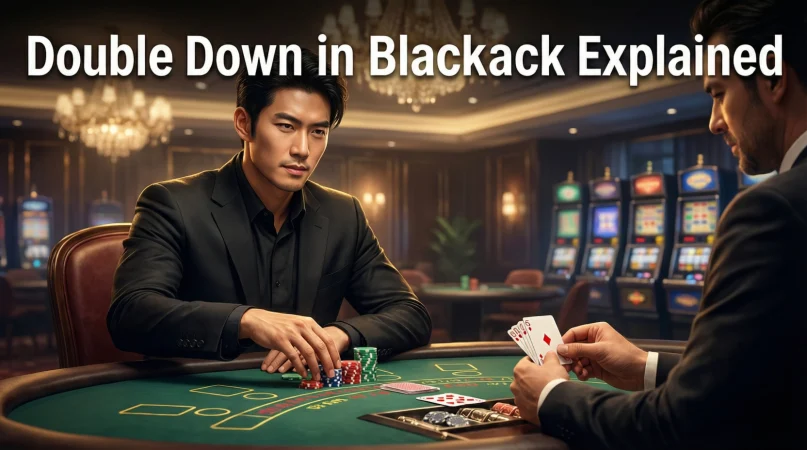
Definition: In blackjack, to double down means to double your original bet after receiving your first two cards, in exchange for committing to stand after receiving exactly one additional card.
It’s a strategic move used when the odds favor the player, allowing for higher potential profit with limited extra risk.
Double down is one of those blackjack moves that sounds bold and honestly, it is. If you’ve ever watched a blackjack table and seen a player confidently push extra chips forward mid-hand, you’ve probably witnessed a double down in action.
It’s exciting, strategic, and sometimes nerve-wracking… but when used correctly, it can seriously boost your winning potential.
This guide breaks it all down in plain English whether you’re brand new to blackjack or looking to sharpen your strategy.
Why “Double Down” Matters in Blackjack
Blackjack isn’t just about luck it’s about decision-making under probability. The double down option is powerful because:
- It lets you increase your wager when you have a strong hand
- It maximizes value when the dealer is likely to bust
- It’s a key part of basic blackjack strategy
Used wisely, doubling down can significantly reduce the house edge.
How Doubling Down Works (Step by Step)
Let’s walk through a typical scenario.
- You place your initial bet (say, $10).
- You receive your first two cards.
- Before taking any further action, you choose to double down.
- You place an additional $10 next to your original bet.
- You receive one and only one additional card.
- Your turn automatically ends (you must stand).
That’s it. Simple rules, big implications.
A Quick Example
You’re dealt:
- Your hand: 6 + 5 = 11
- Dealer’s upcard: 6
This is a classic double down situation.
Why?
- You have 11, one of the strongest totals to double on
- The dealer’s 6 is a weak upcard
- Your chances of drawing a 10-value card are high
You double down, get a 10, hit 21, and win double the payout 🎉
When Can You Double Down?
This depends on casino rules, but most allow doubling down:
- Only on your first two cards
- Before hitting or standing
- Sometimes only on specific hand totals
Common Rule Variations
| Casino Rule | What It Means |
| Double on any two cards | Most flexible and player-friendly |
| Double on 9, 10, or 11 only | Common in traditional casinos |
| Double after split allowed (DAS) | Advanced rule that improves odds |
| Double after split not allowed | Slightly higher house edge |
Always check the table rules before playing.
Best Times to Double Down (Basic Strategy)
Here’s where strategy comes in. Blackjack math shows that doubling down is optimal in specific situations.
Strong Double Down Hands
You should usually double down when:
- Your hand is 11, and dealer shows 2–10
- Your hand is 10, and dealer shows 2–9
- Your hand is 9, and dealer shows 3–6
Soft Hands (Ace Included)
Soft hands are flexible because the Ace can count as 1 or 11.
Good soft doubles include:
- A,7 (18) vs dealer 3–6
- A,6 (17) vs dealer 3–6
- A,5 (16) vs dealer 4–6
These plays take advantage of strong drawing potential.
When You Should NOT Double Down
Doubling down isn’t about bravado, it’s about probability.
Avoid doubling when:
- The dealer shows a 10 or Ace (strong upcards)
- Your hand total is 12 or higher
- You’re unsure of the rules or feeling tilted
Doubling down at the wrong time can magnify losses just as easily as wins.
Double Down Example Table
Here’s a labeled table to make decisions easier:
Common Double Down Situations
| Your Hand | Dealer Upcard | Double Down? | Reason |
| 11 | 6 | Yes | High chance to reach 21 |
| 10 | 9 | Yes | Strong drawing odds |
| 9 | 3 | Yes | Dealer likely to bust |
| 12 | 6 | No | Stand is safer |
| A,7 (18) | 5 | Yes | Strong soft hand |
| 16 | 10 | No | Poor odds |
Origin of the Term “Double Down”
The phrase “double down” comes directly from blackjack and other casino games.
- Literal meaning: Double your bet
- First usage: Early 20th-century gambling halls
- Core idea: Increase commitment when you believe you’re right
Over time, the phrase escaped the casino and entered everyday language.
How “Double Down” Is Used Outside Blackjack
Today, “double down” is used metaphorically in business, politics, and daily conversation.
Real-World Meaning
To double down means:
- To reinforce a decision
- To commit even more strongly
- To stick with a position despite risk or criticism
Examples in Everyday Language
- “After early success, the company doubled down on its marketing strategy.”
- “He ignored the feedback and doubled down on his original argument.”
The meaning keeps the same spirit as blackjack increasing commitment when the stakes are high.
Tone-Based Examples of “Double Down”
Friendly Tone 😊
“I had a good feeling about the project, so I doubled down and gave it my all.”
Neutral / Professional Tone
“Management decided to double down on long-term growth investments.”
Negative or Dismissive Tone 😬
“Instead of admitting the mistake, he doubled down and made things worse.”
Context matters: the phrase can sound confident or stubborn depending on usage.
Comparison: Double Down vs Similar Blackjack Terms
Let’s clear up some common confusion.
Double Down vs Hit
- Hit: Take another card, can continue hitting
- Double Down: Take one card only, but double your bet
Double Down vs Split
- Split: Divide two identical cards into separate hands
- Double Down: Increase bet on a single hand
Double Down vs Stand
- Stand: Keep your hand as is
- Double Down: Commit more money for one final card
Each move serves a different strategic purpose.
Alternate Meanings of “Double Down”
While blackjack is the origin, the phrase has expanded.
Common Alternate Uses
- Business: Investing more resources into a strategy
- Sports: Playing more aggressively
- Arguments: Refusing to back down from a stance
Despite different settings, the core idea remains the same: increase commitment.
Polite or Professional Alternatives to “Double Down”
If “double down” feels too aggressive, here are softer alternatives:
- Reinforce our strategy
- Increase our investment
- Commit further
- Strengthen our position
- Lean into this approach
These work well in formal or corporate settings.
Tips for Using Double Down Smartly in Blackjack
Here are practical, player-friendly tips:
- ✅ Follow basic strategy charts
- ✅ Learn table rules before playing
- ✅ Use double down as a calculated move, not a gamble
- ❌ Don’t double down out of frustration
- ❌ Don’t double just because others do
Remember: blackjack rewards discipline more than emotion.
FAQs
1. What does double down mean in blackjack exactly?
It means doubling your original bet after the first two cards and receiving only one more card before standing.
2. Is doubling down risky?
It increases risk slightly, but when used correctly, it improves long-term odds.
3. Can you double down after hitting?
No. You must decide to double down before taking any additional cards.
4. Can you double down after splitting?
Sometimes. This depends on whether the table allows double after split (DAS).
5. Is double down good for beginners?
Yes if you follow basic strategy and avoid emotional decisions.
6. What is the best hand to double down on?
Hard 11 is widely considered the strongest double down hand.
7. Can you double down in online blackjack?
Yes. Most online casinos support double down with the same rules.
8. Why is double down important in blackjack strategy?
Because it maximizes profit in high-probability situations and lowers the house edge over time.
Conclusion:
In blackjack, doubling down is a smart, calculated move that lets you increase your bet when the odds are in your favor, usually after receiving a strong starting hand against a weak dealer upcard.
By understanding when to double down, following basic strategy, and avoiding emotional decisions, players can reduce the house edge and make more confident, profitable choices at the table.
Whether you’re playing in a casino or online, mastering this single move can significantly improve your overall blackjack experience and long-term results.

Matthew Nelson is a professional content writer and blogger with a strong focus on creating high-quality and reader-centric content. He specializes in writing informative articles that help websites grow their online visibility while delivering real value to readers.