
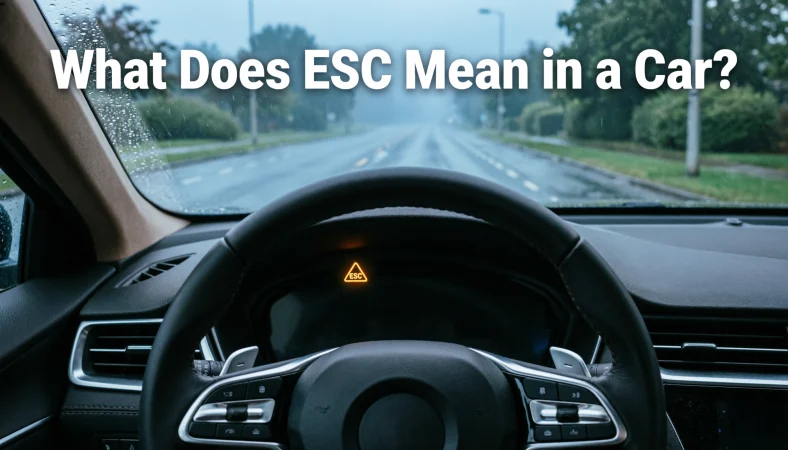
Definition:
ESC in a car stands for Electronic Stability Control. It is an advanced safety system that helps drivers maintain control of their vehicle during slippery conditions, sharp turns, or sudden maneuvers. ESC automatically applies brakes to individual wheels and may reduce engine power to prevent skidding or loss of control.
Have you ever seen the ESC light flash on your dashboard and wondered what it actually means? 🤔 Maybe it turned on while driving in heavy rain, or during a sharp turn. For many drivers, that little symbol can cause instant confusion or even panic.
The good news? ESC is one of the most important safety features in modern vehicles. In fact, it has saved thousands of lives worldwide.
In this complete guide, we’ll break down:
- What ESC means in a car
- How it works
- Why it matters
- What the ESC warning light means
- Differences between ESC and similar systems
- Real-world driving examples
- Frequently asked questions
Let’s dive in.
What Does ESC Mean in a Car?
ESC stands for Electronic Stability Control. It’s a computerized safety system designed to prevent your vehicle from losing traction and skidding out of control.
When your car detects that it’s not going in the direction you’re steering, ESC automatically:
- Applies brakes to specific wheels
- Reduces engine power if needed
- Helps correct the vehicle’s path
Think of ESC as a silent assistant working behind the scenes to keep your car stable especially during emergency situations.
How Electronic Stability Control Works
To understand ESC, imagine driving on a wet road and suddenly swerving to avoid an obstacle. Your car may start to slide sideways; this is called oversteer or understeer.
ESC constantly monitors:
- Steering wheel angle
- Wheel speed
- Vehicle rotation
- Lateral acceleration
If it detects a mismatch between your steering input and the vehicle’s actual movement, it instantly intervenes.
Step-by-Step Example:
- You turn the steering wheel sharply.
- The car begins to skid.
- ESC senses the loss of traction.
- It applies brake pressure to one or more wheels.
- The vehicle realigns with your steering direction.
All of this happens in milliseconds faster than any human reaction time.
Why ESC Is So Important for Safety
Electronic Stability Control has been called one of the greatest automotive safety advancements since seat belts.
According to global safety studies, ESC significantly reduces:
- Single-vehicle crashes
- Rollover accidents
- Wet-road accidents
- High-speed loss-of-control collisions
Because of its effectiveness, many countries now require ESC in new vehicles.
In the United States, the National Highway Traffic Safety Administration (NHTSA) mandated ESC in all new passenger vehicles starting in 2012.
This shows how crucial ESC is in preventing accidents and saving lives.
ESC Warning Light: What Does It Mean?
If you see the ESC light on your dashboard, it can mean a few different things.
1️⃣ Flashing ESC Light
A flashing light usually means:
- ESC is actively working
- You are driving on slippery terrain
- The system is correcting a skid
This is normal and often a good sign that the system is protecting you.
2️⃣ Solid ESC Light
A steady light may indicate:
- The system is turned off
- There is a malfunction
- A sensor issue
If the light stays on, it’s wise to have your vehicle inspected.
What Does ESC OFF Mean?
Some vehicles have an ESC OFF button.
Drivers might turn ESC off when:
- Driving in deep snow
- Off-roading
- Trying to rock a vehicle free from mud
However, turning ESC off for regular road driving is not recommended.
Pro Tip: Keep ESC on during normal driving conditions for maximum safety.
ESC vs. Traction Control vs. ABS
Many drivers confuse ESC with other safety systems like Traction Control (TCS) or Anti-lock Braking System (ABS).
Here’s a simple comparison:
| Feature | ESC | Traction Control (TCS) | ABS |
| Prevents skidding | ✅ Yes | ⚠️ Partially | ❌ No |
| Controls individual wheel braking | ✅ Yes | ❌ Limited | ✅ Yes |
| Reduces engine power | ✅ Yes | ✅ Yes | ❌ No |
| Helps during sharp turns | ✅ Yes | ❌ No | ❌ No |
| Works during braking | ✅ Yes | ❌ No | ✅ Yes |
Quick Breakdown:
- ABS prevents wheels from locking during hard braking.
- TCS prevents wheels from spinning during acceleration.
- ESC combines both and adds steering-based correction.
ESC is essentially the most advanced of the three.
Origin and Evolution of ESC
Electronic Stability Control technology was developed in the 1990s as an improvement over ABS and traction control systems.
It was first introduced in luxury vehicles before becoming widespread.
Some early development work came from automotive engineers at Mercedes-Benz and Bosch, who helped pioneer stability control technology.
Over time, ESC became standard in:
- Sedans
- SUVs
- Pickup trucks
- Electric vehicles
Today, it’s considered a non-negotiable safety feature in modern cars.
Real-World Examples of ESC in Action
Let’s look at how ESC works in everyday driving.
Example 1: Rainy Highway 🌧️
You hit a puddle while turning. The rear tires lose grip.
ESC applies brake pressure to stabilize the car.
Tone: Reassuring and protective.
Example 2: Icy Road ❄️
You brake suddenly on black ice.
ESC coordinates with ABS to prevent spinning.
Tone: Emergency safety support.
Example 3: Sharp Curve at High Speed 🏎️
You take a curve too fast.
ESC detects oversteer and brakes individual wheels.
Tone: Corrective intervention.
Can You Drive Without ESC?
Yes but it’s not advisable.
Without ESC:
- You’re more likely to lose control on slippery roads
- Recovery from skidding becomes harder
- Accident risk increases
Older vehicles (pre-2010 models in some regions) may not have ESC.
If buying a used car, checking for ESC is a smart safety decision.
Alternate Meanings of ESC
While ESC in a car usually means Electronic Stability Control, it can have other meanings in different contexts:
- Escape (ESC key) on a keyboard
- Electronic Speed Controller (used in RC vehicles)
- European Society of Cardiology
However, in automotive dashboard terms, ESC almost always refers to Electronic Stability Control.
When Should You Be Concerned About ESC?
You should check your vehicle if:
- The ESC light stays on continuously
- ESC activates frequently in dry conditions
- You notice braking inconsistencies
- The car feels unstable despite the system
Potential causes may include:
- Faulty wheel speed sensors
- Steering angle sensor issues
- Brake system problems
A professional inspection is recommended.
Polite or Professional Ways to Refer to ESC in Documentation
In professional writing or automotive documentation, ESC may also be referred to as:
- Stability Control System
- Vehicle Stability Assist (VSA)
- Dynamic Stability Control (DSC)
- Electronic Stability Program (ESP)
For example, BMW calls its system Dynamic Stability Control (DSC).
The function is similar only the name changes by manufacturer.
Frequently Asked Questions
1. Is it safe to drive with the ESC light on?
If it’s flashing, yes it’s working.
If it’s solid, have it checked soon.
2. Does ESC work in snow?
Yes. It’s extremely helpful in snowy and icy conditions.
3. What causes ESC to fail?
Common causes include sensor failure or wiring issues.
4. Can ESC prevent all accidents?
No. It reduces risk but does not replace safe driving.
5. Is ESC the same as traction control?
No. ESC is more advanced and includes traction control features.
6. Does ESC use the brakes?
Yes. It applies brakes individually to specific wheels.
7. Should I ever turn ESC off?
Only in specific situations like deep snow or off-roading.
8. When did ESC become mandatory?
In the U.S., it became mandatory for new vehicles in 2012 under regulations by the National Highway Traffic Safety Administration.
Practical Tips for Drivers
To maximize ESC effectiveness:
- Keep tires properly inflated
- Maintain brake systems regularly
- Avoid aggressive steering
- Do not disable ESC unnecessarily
- Pay attention to dashboard warning lights
Remember: ESC assists you; it doesn’t replace defensive driving.
Conclusion:
So, what does ESC mean in a car?
It means Electronic Stability Control, a life-saving safety system designed to prevent skidding and loss of control.
From rainy highways to icy roads, ESC quietly protects drivers every day. It monitors steering, braking, and traction in real time, making split-second adjustments that can prevent serious accidents.
If your vehicle has ESC, consider it a major safety advantage. Keep it maintained, understand the warning signs, and let it do its job.
Safe driving is a combination of smart technology and responsible habits and ESC is one of the best tools modern cars offer.

Matthew Nelson is a professional content writer and blogger with a strong focus on creating high-quality and reader-centric content. He specializes in writing informative articles that help websites grow their online visibility while delivering real value to readers.