Definition: FOMO is a slang acronym that stands for Fear Of Missing Out.
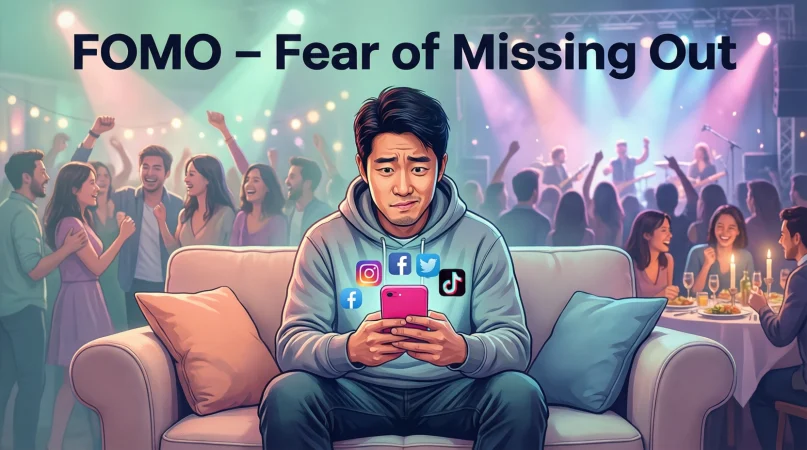
It describes the anxiety or uneasy feeling that others are having rewarding experiences while you are not, often triggered by social media, texts, or conversations.
FOMO is one of those slang terms that perfectly captures a very modern feeling. You’ve probably felt it scrolling through Instagram, watching friends post about a party you weren’t invited to, or seeing coworkers attend a conference you skipped. That little knot in your stomach? Yep that’s FOMO.
In this guide, we’ll break down what FOMO means in slang, where it came from, how people actually use it today, and how to respond to it online and offline. Whether you’re a casual texter, a social media pro, or just curious about modern slang, this article has you covered.
In simple terms: FOMO is the stress of feeling left out.
What Is FOMO?
FOMO isn’t just a word it’s an emotional response.
People use FOMO to describe:
- Feeling anxious about missing events, opportunities, or experiences
- The urge to join something just so you’re not left out
- Pressure caused by seeing others’ highlight reels online
You’ll hear it used casually, humorously, and sometimes seriously, depending on context.
Example in real life:
- “I didn’t even want to go, but I had major FOMO.”
The Origin of FOMO: Where Did the Term Come From?
Although it feels like a social media invention, FOMO actually predates Instagram.
Early Roots
- The term Fear of Missing Out appeared in the early 2000s
- Popularized by marketing strategist Dr. Dan Herman in 2000
- Later amplified by entrepreneur Patrick J. McGinnis in a 2004 Harvard Business School article
Rise in Popularity
FOMO truly exploded with:
- Facebook and Instagram
- Snapchat Stories
- TikTok trends
- Constant notifications and real-time updates
By the 2010s, FOMO became mainstream slang, used in memes, captions, texts, and even psychology discussions.
How FOMO Is Used in Modern Slang
Today, FOMO is used casually and widely, especially in digital communication.
Common Contexts
- Social media posts
- Group chats
- Event planning
- Marketing and sales
- Lifestyle conversations
It can describe:
- A feeling: “I have FOMO.”
- A reason: “I’m going because of FOMO.”
- A joke: “Bought the tickets FOMO got me 😅”
FOMO in Texting, Social Media, and Conversations
In Text Messages
- “Should I come? Kinda feeling FOMO.”
- “I skipped it, but now I have FOMO.”
On Social Media
- “Major FOMO seeing everyone travel this summer 🌍”
- “Weekend FOMO hitting hard”
In Conversation
- “I said yes mostly because of FOMO.”
- “That sale triggers serious FOMO.”
Tone Matters: Friendly, Neutral, and Negative Uses of FOMO
FOMO can sound very different depending on tone and context.
Friendly or Playful Tone 😊
Used jokingly or lightly.
- “I joined just because of FOMO 😂”
- “FOMO made me do it”
Neutral or Descriptive Tone 😐
Used to explain behavior.
- “FOMO influences people’s buying decisions.”
- “Social media increases FOMO among teens.”
Negative or Dismissive Tone 😒
Used critically.
- “That’s just FOMO talking.”
- “Don’t let FOMO control you.”
Understanding tone helps you know whether someone is joking, venting, or giving advice.
Real-Life Examples of FOMO With Context
Here are realistic examples showing how FOMO appears in everyday language:
- Social life:
“Everyone went out without me serious FOMO.” - Work:
“I attended the webinar due to FOMO, not interest.” - Shopping:
“Limited stock gives me FOMO every time.” - Travel:
“Seeing vacation pics gives me travel FOMO ✈️” - Gaming:
“Daily rewards exist purely to create FOMO.”
Example Table: How FOMO Is Used in Different Situations
| Situation | Example Sentence | Tone |
| Texting friends | “Should I come? Feeling FOMO.” | Casual |
| Social media caption | “Weekend FOMO 😩” | Playful |
| Workplace talk | “FOMO drives engagement.” | Professional |
| Shopping | “Flash sales rely on FOMO.” | Neutral |
| Advice | “Don’t act out of FOMO.” | Cautionary |
Why FOMO Is So Powerful
FOMO works because humans are wired for connection and belonging.
Key psychological triggers include:
- Social comparison – We compare our lives to others
- Scarcity mindset – Limited-time offers feel urgent
- Belonging needs – We don’t want to feel excluded
- Dopamine loops – Notifications reward curiosity
Social media amplifies all of these by showing everyone’s best moments not real life.
FOMO in Marketing, Sales, and Digital Culture
Businesses actively use FOMO as a strategy.
Common FOMO Marketing Tactics
- “Only 3 left in stock”
- “Offer ends tonight”
- “Join 10,000 others”
- “Don’t miss out”
Why It Works
- Creates urgency
- Reduces decision time
- Plays on emotional responses
That’s why FOMO is now both slang and a recognized marketing principle.
FOMO vs Related Slang Terms
FOMO isn’t alone. Here’s how it compares to similar slang and concepts.
FOMO vs JOMO
- FOMO: Fear of missing out
- JOMO: Joy of missing out (being happy staying out)
FOMO vs YOLO
- FOMO: Anxiety-driven
- YOLO: Risk-taking and impulsive fun
FOMO vs Anxiety
- FOMO: Situation-specific and social
- Anxiety: Broader mental health condition
Quick Comparison Table
| Term | Meaning | Emotion |
| FOMO | Fear of missing out | Anxiety |
| JOMO | Joy of missing out | Peace |
| YOLO | You only live once | Excitement |
| OMO | Objective missing out | Neutral |
Are There Any Alternate Meanings of FOMO?
In slang and pop culture, FOMO almost always means Fear of Missing Out.
However:
- In academic or technical fields, FOMO may appear as shorthand, but it’s rare
- No widely accepted alternate slang meanings exist
If you see FOMO, it’s safe to assume the standard meaning.
Polite and Professional Alternatives to FOMO
While FOMO is common, it’s not always suitable for formal settings.
Professional Alternatives
- “Concern about missing opportunities”
- “Social or professional pressure”
- “Fear of exclusion”
- “Motivated by urgency”
Example Rewrite
- Casual: “I joined because of FOMO.”
- Professional: “I didn’t want to miss a potential opportunity.”
How to Use FOMO Naturally (Without Sounding Forced)
Tips for using FOMO naturally:
- Use it in casual or conversational settings
- Avoid overusing it in professional writing
- Pair it with context for clarity
- Emojis work well in informal use 😅
Good:
- “That sale gave me FOMO.”
Awkward:
- “Due to FOMO, I executed attendance.”
FOMO in Different Age Groups
- Teens & Gen Z: Heavy use, often playful
- Millennials: Casual and reflective
- Professionals: More analytical or critical
- Older adults: Less slang, more descriptive language
Despite age differences, the feeling is universal.
FAQs
1. What does FOMO mean in slang?
FOMO means Fear of Missing Out, describing anxiety about being left out of experiences or opportunities.
2. Is FOMO a real psychological condition?
FOMO is not a medical diagnosis, but it is a recognized emotional response studied in psychology.
3. Is FOMO always negative?
Not always. It can motivate participation, but excessive FOMO can lead to stress and poor decisions.
4. How is FOMO used in texting?
It’s often used casually, like “I have FOMO” or “FOMO made me do it.”
5. What is the opposite of FOMO?
The opposite is JOMO, which means Joy of Missing Out.
6. Is FOMO professional language?
FOMO is informal slang and best avoided in formal writing unless explained.
7. Why does social media cause FOMO?
Because it shows curated highlights of others’ lives, triggering comparison and exclusion feelings.
8. Can FOMO affect decision-making?
Yes. FOMO often leads to rushed choices driven by emotion rather than logic.
How to Deal With FOMO in Real Life
While slang is fun, FOMO can be exhausting.
Helpful strategies include:
- Limiting social media time
- Practicing JOMO intentionally
- Focusing on personal priorities
- Remembering highlights aren’t reality
You don’t have to be everywhere to live fully.
Conclusion
FOMO short for Fear of Missing Out is more than just trendy slang; it’s a word that captures a very real, very modern feeling. Whether it shows up in a casual text, a social media caption, or a conversation about work or lifestyle choices, FOMO describes that uneasy sense that something exciting is happening without you.
Understanding what FOMO means, how it’s used, and the tone behind it helps you communicate more clearly and recognize when decisions are being driven by pressure rather than genuine interest.
Used playfully, FOMO can be harmless and relatable but being aware of it also makes it easier to step back, choose intentionally, and even embrace a little JOMO when it suits you better.

Megan Lewis is a passionate and experienced content writer specializing in creating engaging and well-researched content. She excels at producing clear, informative, and reader-focused content that not only ranks well on search engines but also delivers real value to audiences.