
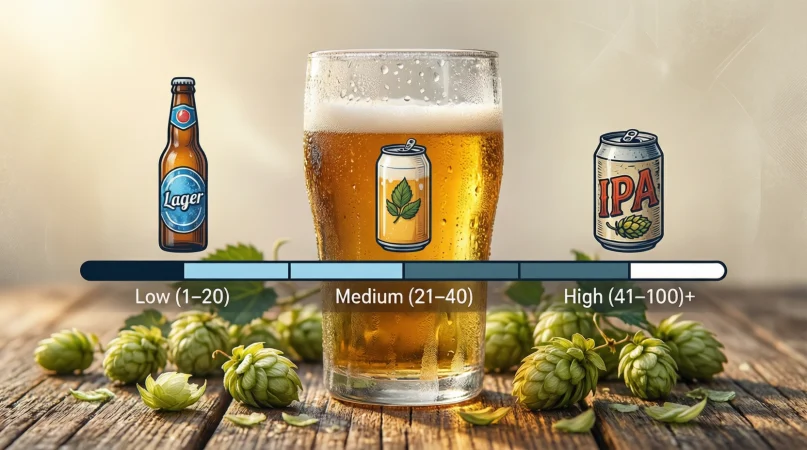
Definition: IBU stands for International Bitterness Units.
It is a numerical scale used to measure the bitterness of beer, specifically the amount of iso-alpha acids derived from hops during brewing. The higher the IBU number, the more bitter the beer is likely to be.
IBU is one of those beer terms you’ll see everywhere on bottles, tap lists, brewery websites but many drinkers still wonder what it actually means and whether it truly predicts how bitter a beer will taste.
Let’s fix that 🍺
This guide breaks down what IBU means in beer, where it came from, why brewers use it, how accurate it really is, and how you should (and shouldn’t) use it when choosing your next pint.
In simple terms:
👉 Low IBU = less bitter
👉 High IBU = more bitter
What Is IBU in Beer?
IBU is a scientific measurement, not a flavor promise.
- It measures hop bitterness, not sweetness, aroma, or overall flavor
- It focuses on alpha acids from hops that become bitter when boiled
- It does not account for malt sweetness, alcohol, or balance
That’s why two beers with the same IBU can taste completely different.
Origin of IBU: Where Did the Term Come From?
The concept of IBU was developed in the mid-20th century as brewing science advanced.
Why IBU Was Created
Before IBUs:
- Brewers relied on taste tests and tradition
- Consistency between batches was harder to achieve
- Comparing beers objectively was difficult
IBU gave brewers:
- A standardized bitterness scale
- A way to replicate recipes
- A method to compare beer styles globally
The term “International” reflects its goal: a global brewing standard.
How IBU Is Measured (Without the Lab Jargon)
IBU is calculated by measuring iso-alpha acids (the bitter compounds from hops) in parts per million (ppm).
The Simple Formula
- 1 IBU = 1 part per million of iso-alpha acids
But here’s the catch:
👉 Your tongue doesn’t measure bitterness in ppm.
Which leads to…
Why IBU Doesn’t Always Match What You Taste
This is where many beer drinkers get confused.
Factors That Affect Perceived Bitterness
Even if a beer has a high IBU, it may not taste bitter because of:
- Malt sweetness (balances bitterness)
- Alcohol content (can soften bitterness)
- Hop variety (some hops taste smoother)
- Carbonation
- Serving temperature
- Your personal palate
💡 Example:
A 60 IBU IPA may taste smoother than a 35 IBU pilsner because IPAs often have more malt and alcohol to balance the hops.
IBU Ranges by Beer Style
Here’s a labeled example table to help you understand typical IBU levels:
| Beer Style | Typical IBU Range | Bitterness Level |
| Light Lager | 512 | Very low |
| Wheat Beer | 1020 | Low |
| Pilsner | 2040 | Medium |
| Pale Ale | 3050 | Medium to high |
| IPA | 5070 | High |
| Double IPA | 70100+ | Very high |
| Stout | 3050 | Medium |
| Barleywine | 60100 | Very high |
⚠️ Note: These are guidelines, not rules.
Real-World Usage: How Brewers and Drinkers Use IBU
Brewers Use IBU To:
- Design balanced recipes
- Maintain consistency
- Classify beer styles
- Communicate bitterness expectations
Drinkers Use IBU To:
- Avoid beers that are “too bitter”
- Compare similar styles
- Explore new flavor profiles
But experienced drinkers know:
👉 IBU is only one piece of the puzzle.
Examples of IBU in Context
Friendly Tone 🍻
“This IPA is 65 IBUs, but it’s super smooth don’t worry!”
Neutral / Informative Tone
“The beer has an IBU of 45, placing it in the moderate bitterness range.”
Negative or Dismissive Tone 😬
“It’s 90 IBUs way too bitter for my taste.”
Notice how tone depends on the speaker, not the number itself.
Is Higher IBU Always Better?
Short answer: No.
High IBU Is Great If You:
- Love bold, hoppy beers
- Enjoy IPAs or double IPAs
- Want sharp bitterness
Low IBU Is Better If You:
- Prefer smooth or sweet beers
- Are new to craft beer
- Enjoy lagers, wheat beers, or stouts
🍺 The “best” IBU is the one you enjoy drinking.
IBU vs ABV vs SRM (Beer Terms Compared)
Let’s clear up common confusion.
| Term | Stands For | Measures |
| IBU | International Bitterness Units | Bitterness |
| ABV | Alcohol by Volume | Alcohol strength |
| SRM | Standard Reference Method | Color |
📌 These values work together, not alone.
A beer with:
- High IBU + High ABV = bold and intense
- Low IBU + High SRM = dark but not bitter
- Low IBU + Low ABV = light and easy-drinking
IBU vs Hop Flavor vs Hop Aroma
Many people assume hops = bitterness. Not always.
- IBU → bitterness
- Hop flavor → citrus, pine, tropical notes
- Hop aroma → smell, not taste
Modern IPAs often:
- Smell very hoppy
- Taste juicy or fruity
- Have lower perceived bitterness despite high IBU
Alternate Meanings of IBU (Outside Beer)
IBU can mean other things, depending on context:
- IBU (International Business Unit) corporate usage
- IBU (Indonesian term for “mother”)
- IBU (academic or organizational abbreviations)
In beer conversations, though, IBU almost always means bitterness.
Are There Polite or Professional Alternatives to Saying “High IBU”?
If you’re writing menus, reviews, or professional descriptions, consider phrases like:
- “Bold hop bitterness”
- “Pronounced hop profile”
- “Intensely hopped”
- “Balanced bitterness”
- “Hop-forward finish”
These sound more inviting than just listing a number.
Common Myths About IBU (Debunked)
❌ Myth: Higher IBU always tastes more bitter
✅ Truth: Balance matters more than numbers
❌ Myth: IBUs above 100 are meaningful
✅ Truth: Human taste usually can’t detect bitterness beyond ~100 IBUs
❌ Myth: Dark beers are always bitter
✅ Truth: Many dark beers are sweet and low-IBU
How to Use IBU When Choosing a Beer (Practical Tips)
If You’re New to Beer:
- Start with IBU under 30
- Explore wheat beers, blond ales, or lagers
If You Like Balance:
- Aim for 3050 IBU
- Pale ales and ambers are great choices
If You Love Hops:
- Try 5070+ IBU
- IPAs and double IPAs will shine
🍺 Always read tasting notes IBU alone won’t tell the full story.
FAQs:
1. What does IBU stand for in beer?
IBU stands for International Bitterness Units, a measure of hop bitterness.
2. Is higher IBU more bitter?
Usually yes, but perceived bitterness depends on balance.
3. What is a good IBU for beginners?
Most beginners enjoy beers in the 1030 IBU range.
4. Can a beer have too much IBU?
Yes, very high IBUs can taste harsh if not balanced.
5. Why do some high-IBU beers taste smooth?
Malt sweetness, alcohol, and hop choice can soften bitterness.
6. Are IBUs the same as hop flavor?
No. IBUs measure bitterness, not aroma or flavor.
7. Do dark beers have high IBU?
Not always. Many stouts and porters are moderate or low in IBUs.
8. Is IBU more important than ABV?
Neither is more important; they describe different aspects of beer.
Conclusion
Understanding what IBU means in beer gives you a powerful tool for choosing beers you’ll actually enjoy but it’s not the whole story. IBU (International Bitterness Units) measures hop bitterness, helping brewers maintain consistency and helping drinkers compare styles. However, bitterness on paper doesn’t always equal bitterness on the palate.
Malt sweetness, alcohol content, hop varieties, and overall balance all influence how bitter a beer tastes. That’s why two beers with the same IBU can feel completely different when you sip them.

Michael Johnson is a seasoned Content Expert and digital communication specialist with a proven track record in content creation, strategy, and audience engagement. His work goes beyond writing he crafts meaningful, results driven content that helps businesses achieve growth, brand visibility, and audience trust.