
Definition:
In baseball, “K” means a strikeout. It is used in scorekeeping and statistics to show that a batter was retired after accumulating three strikes. A backward “K” indicates a strikeout looking (the batter did not swing), while a regular “K” means a strikeout swinging.
Baseball has its own language. From RBIs and ERAs to OPS and WHIP, the sport is full of abbreviations that can confuse new fans. But one of the most iconic and most misunderstood symbols is a simple letter: K.
You’ve seen it on scoreboards. You’ve heard announcers say, “That’s his tenth K of the night.” You may have even noticed fans holding up giant K signs in the stands.
So what does K mean in baseball and why is it such a big deal?
Let’s break it down in simple, clear terms.
What Does K Mean in Baseball?
In baseball, K stands for strikeout.
A strikeout happens when:
- A batter gets three strikes during their at-bat
- The pitcher records an out without the ball being put into play (except in rare cases like dropped third strikes)
On a box score or stat sheet:
- K = Strikeout swinging
- ꓘ (backward K) = Strikeout looking
This small letter carries huge meaning in the game. For pitchers, Ks represent dominance. For hitters, too many Ks can be a weakness.
Why Does K Stand for Strikeout?
You might be wondering:
Why K? Why not S?
The answer goes back to the 19th century.
The Origin of K in Baseball
The use of “K” for strikeout was popularized by:
- Henry Chadwick
Henry Chadwick was a British-born baseball writer and statistician in the 1800s. He developed early box score systems and scoring methods still used today.
He chose K because:
- The word “strike” was already used frequently
- “S” could stand for many things
- The letter K is the last letter in “struck” (as in “struck out”)
So instead of writing “SO” or “S,” Chadwick used K and it stuck.
Over time, K became one of the most recognizable symbols in sports.
What Is a Strikeout in Baseball?
To fully understand what K means, you need to understand what a strikeout is.
A batter strikes out when:
- They swing and miss three times
- They don’t swing at three strikes
- They foul tip into the catcher’s glove for strike three
Types of Strikeouts
There are two main types:
- Strikeout swinging (K) – The batter swings and misses strike three
- Strikeout looking (ꓘ) – The batter does not swing at strike three
The backward K is used by scorekeepers to show that the batter was called out without swinging.
Example:
- A pitcher throws a fastball on the corner.
- The batter watches it go by.
- The umpire calls strike three.
- That’s a backward K.
How Is K Used in Baseball Statistics?
K is everywhere in baseball stats.
Here’s how it commonly appears:
| Stat | Meaning | Example |
| K | Total strikeouts | 8 K in a game |
| K/9 | Strikeouts per 9 innings | 10.5 K/9 |
| K/BB | Strikeout-to-walk ratio | 4.0 K/BB |
| K% | Strikeout percentage | 28% K rate |
Example in Context
- “He had 12 Ks tonight 🔥”
Friendly tone, praising the pitcher’s dominance. - “That’s 3 Ks already 😬”
Slightly negative tone, criticizing the batter.
Strikeouts are viewed very differently depending on whether you’re talking about a pitcher or hitter.
Why Are Strikeouts So Important?
Strikeouts are one of the clearest measures of pitcher dominance.
When a pitcher gets a strikeout:
- The defense cannot make an error
- The ball isn’t put into play
- The batter has no chance to advance runners (usually)
That’s why elite pitchers are often judged by their K totals.
For example:
- Nolan Ryan holds the MLB record for most career strikeouts.
- Randy Johnson and Pedro Martínez were famous for overpowering hitters with high strikeout rates.
Strikeouts are exciting. Fans often cheer loudly for a K especially in high-pressure situations.
Why Do Fans Hold Up K Signs?
If you’ve watched a game at:
- Major League Baseball
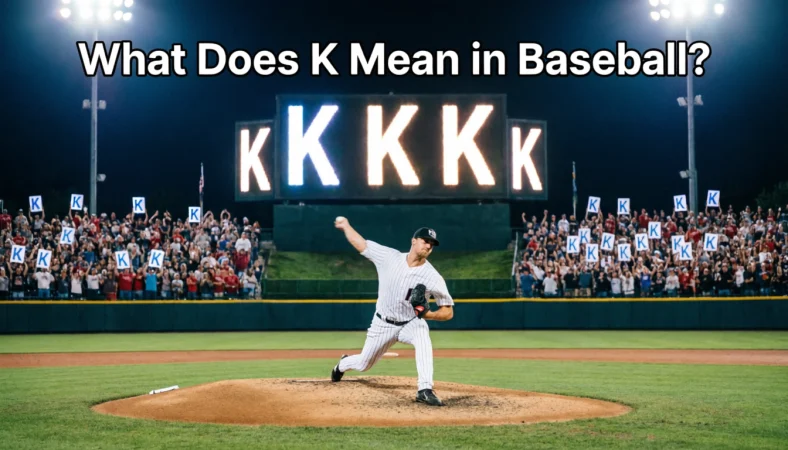
You may have seen fans holding up giant letter K signs after each strikeout.
This tradition started as a fun way to track pitcher performance during a game.
For example:
- If a pitcher has 5 strikeouts, fans might display five large K cards in a row.
It’s especially common during playoff games or when a pitcher is close to a career milestone.
Is a Strikeout Always Bad?
It depends on perspective.
For Pitchers: ✅ Great
Strikeouts are positive. More Ks usually mean:
- Better control
- Stronger stuff
- Higher dominance
For Hitters: 🤔 Mixed
Too many strikeouts can be seen as:
- A weakness
- Poor contact ability
- Trouble against certain pitches
However, in modern baseball:
- Power hitters often strike out more
- Teams accept higher K rates in exchange for home runs
For example:
A slugger might hit 40 home runs but strike out 180 times. Teams may accept that trade-off.
K vs Other Baseball Abbreviations
Baseball uses many abbreviations. Here’s how K compares:
| Abbreviation | Meaning | Role |
| K | Strikeout | Pitcher & hitter stat |
| BB | Base on balls (walk) | Batter earns first base |
| HR | Home run | Ball leaves park |
| RBI | Runs batted in | Offensive stat |
| ERA | Earned run average | Pitcher stat |
| SO | Strikeout (older abbreviation) | Same as K |
While SO is sometimes used in official stat sheets, K is more common in modern baseball culture.
What Does a Backward K Mean in Baseball?
A backward K (ꓘ) means:
- The batter struck out looking
- They did not swing at strike three
This can sometimes carry a slightly negative tone when discussing a hitter.
Example commentary:
- “He just froze on that curveball backward K.”
Neutral or analytical tone. - “That’s a tough backward K to take.”
Slightly critical tone.
For pitchers, though, a backward K can feel extra satisfying as it shows command and deception.
Real-World Usage Examples
Here’s how K is used conversationally:
Friendly & Excited Tone
- “That’s his 15th K tonight! What a performance! 🔥”
- “He’s racking up Ks like shocking!”
Analytical Tone
- “His K/9 has improved this season.”
- “He relies on high strikeout rates to escape jams.”
Negative or Critical Tone
- “He strikes out too much.”
- “Another K with runners on base.”
The tone depends on context whether you’re praising a pitcher or criticizing a hitter.
Does K Mean Anything Else in Baseball?
Yes, but rarely.
Alternate meanings:
- In some older scorecards, K and SO were used interchangeably.
- In youth baseball scorebooks, you may see variations for dropped third strikes.
Outside baseball, K can mean:
- 1,000 (financial shorthand)
- OK (in texting)
- Potassium (chemistry symbol)
But in baseball? It almost always means strikeout.
Advanced Metrics Related to K
For fans who love analytics, K plays a huge role in modern baseball evaluation.
Common advanced stats:
- K% (Strikeout Rate) – Percentage of plate appearances ending in strikeouts
- SwStr% (Swinging Strike Rate) – How often batters miss
- CSW% (Called Strikes + Whiffs) – Combines called and swinging strikes
These help teams evaluate pitchers beyond just ERA.
Modern analytics heavily value pitchers who can generate swings and misses.
FAQ:
1. What does K stand for in baseball?
K stands for strikeout.
2. Why is strikeout called K instead of S?
Henry Chadwick chose K because it is the last letter in struck, and S was already widely used.
3. What does a backward K mean?
It means the batter struck out looking (did not swing at strike three).
4. Is a strikeout good or bad?
Good for pitchers. Often negative for hitters but sometimes accepted in power hitters.
5. What does K/9 mean?
Strikeouts per nine innings pitched.
6. Who has the most strikeouts in MLB history?
Nolan Ryan holds the record for most career strikeouts.
7. Why do fans hold up K signs?
To celebrate and track a pitcher’s strikeouts during a game.
8. Is SO the same as K?
Yes. SO means strikeout, but K is more commonly used in scorekeeping and culture.
Conclusion
So, what does K mean in baseball?
It simply means strikeout but it represents so much more.
From 19th-century scorecards to modern MLB stadium scoreboards, K has become a symbol of pitching dominance. It tells a story of power, control, and competitive edge.
For pitchers, Ks are trophies. For hitters, they’re challenges to overcome.
Understanding this single letter helps you read box scores, follow commentary, and appreciate the strategy behind every pitch.
Now when someone says, “He had 10 Ks tonight,” you’ll know that’s not just a letter it’s a statement.

Matthew Nelson is a professional content writer and blogger with a strong focus on creating high-quality and reader-centric content. He specializes in writing informative articles that help websites grow their online visibility while delivering real value to readers.