
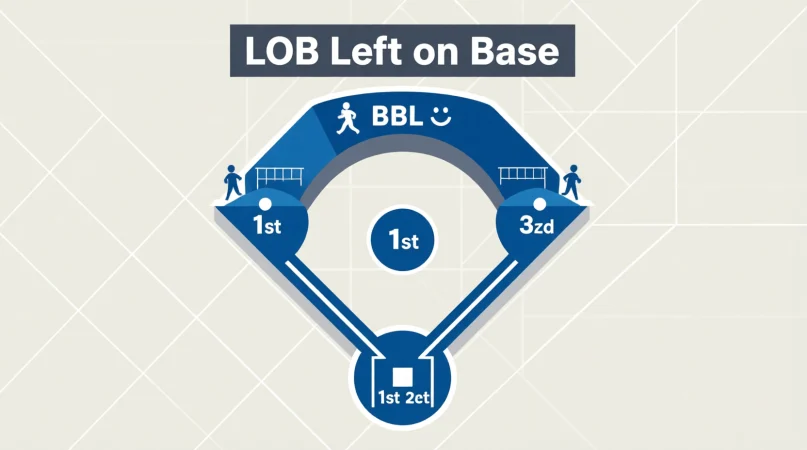
LOB in baseball stands for “Left on Base.”
It refers to the number of baserunners who remain on base at the end of an inning because they did not score.
In simple terms: LOB measures missed scoring opportunities.
LOB is one of those baseball abbreviations you’ll see everywhere from box scores to broadcast commentary but many fans nod along without fully knowing what it really means. If you’ve ever watched a game where the announcer says, “They left a lot of runners on base tonight,” you’ve already encountered LOB in action.
Let’s break it down clearly, simply, and completely.
Why LOB Matters in Baseball
Baseball is a game of opportunities. You can get plenty of hits, draw walks, and load the bases but if runners don’t cross home plate, none of that matters on the scoreboard.
That’s why LOB is such an important stat. It helps answer questions like:
- Why did a team lose despite getting lots of hits?
- Which players struggle in clutch situations?
- Did the pitcher escape trouble or did the offense waste chances?
Understanding LOB in Plain English
Here’s the easiest way to think about it:
- A runner reaches base
- The inning ends
- The runner never scores
➡️ That runner is counted as LOB
Example:
- Bases loaded
- Two outs
- Batter strikes out
All three runners are left on base, so the team records 3 LOB for that inning.
How LOB Is Calculated
LOB can be tracked in two main ways, which often causes confusion.
1. Team LOB
This is the total number of runners left on base by the entire team during the game.
- Appears in box scores
- Often listed as “LOB” near hits and runs
- High number = many missed chances
2. Individual Player LOB
This refers to how many runners were on base when a specific batter made the final out of an inning.
- Used to evaluate clutch hitting
- Not always shown in basic box scores
- Often cited in advanced stat breakdowns
Example Table: How LOB Works in a Game
| Situation | Result | LOB Count |
| Runner on 1st, inning ends | Runner stranded | 1 LOB |
| Runners on 2nd & 3rd, pop-out | Both stranded | 2 LOB |
| Bases loaded, strikeout | All stranded | 3 LOB |
| Runner scores on double | No one stranded | 0 LOB |
Origin of the Term “Left on Base”
The term Left on Base dates back to the early days of baseball scorekeeping in the late 1800s.
- Early box scores tracked runs, hits, and outs
- Statisticians wanted a way to measure missed scoring chances
- “Left on Base” became a natural descriptive phrase
- Eventually shortened to LOB for box score efficiency
As baseball analytics evolved, LOB remained relevant even as more advanced metrics emerged.
Why LOB Is So Popular in Baseball Stats
LOB persists because it’s:
- Easy to understand
- Immediately meaningful
- Useful for both casual fans and analysts
LOB helps explain:
- Why a team lost despite out-hitting the opponent
- Why a pitcher had a “gritty” performance
- Why a lineup feels dangerous but underperforms
Announcers love it because it tells a story without needing complex math.
Positive, Neutral, and Negative Uses of LOB
LOB isn’t inherently good or bad it depends on context.
Neutral Tone
Used factually in stats or summaries.
- “The team finished with 10 hits and left 9 runners on base.”
Negative or Critical Tone
Implies poor execution or wasted chances.
- “They stranded too many runners tonight.”
- “Leaving 12 men on base cost them the game.”
Positive (Pitcher-Focused) Tone
Highlights clutch pitching.
- “The pitcher worked out of trouble, leaving runners stranded.”
- “He escaped with two runners left on base.”
Same stat very different tone.
LOB and Pitchers: Two Sides of the Same Coin
What’s bad for hitters can be great for pitchers.
For Hitters:
- High LOB = failure to capitalize
- Suggests poor situational hitting
For Pitchers:
- High LOB = strong composure under pressure
- Often linked to clutch pitching
This dual meaning is what makes LOB especially interesting.
LOB vs Related Baseball Terms (Comparison Table)
| Term | Meaning | How It’s Different from LOB |
| LOB | Runners stranded on base | Focuses on missed chances |
| RISP | Runners in scoring position | Tracks opportunity, not result |
| OBP | On-base percentage | Measures reaching base, not scoring |
| BA | Batting average | Ignores walks and context |
| Runs | Actual scores | LOB shows what didn’t happen |
LOB vs RISP: A Common Confusion
Many fans mix these up, but they tell different stories.
- RISP asks: Did you have a chance?
- LOB asks: Did you waste it?
A team can have:
- Great RISP numbers but high LOB
- Or poor RISP but low LOB
Context matters.
Is a High LOB Always Bad?
Not necessarily.
High LOB might mean:
- The team is getting on base a lot
- The offense is active but unlucky
- Strong opposing bullpen pitching
Consistently high LOB over time may indicate:
- Poor clutch hitting
- Weak situational approach
- Bad lineup construction
Analysts always look at patterns, not single games.
Alternate Meanings of LOB
Outside of baseball, LOB can mean different things:
- LOB (finance): Line of Business
- LOB (networking): Large Object
- LOB (slang): A soft throw or pass
But in sports and especially baseball LOB almost always means Left on Base.
Professional or Polite Alternatives to Saying “They Left Too Many on Base”
If you’re writing or speaking professionally, here are softer options:
- “They struggled to capitalize on scoring opportunities.”
- “Runners were frequently stranded.”
- “Timely hitting was lacking.”
- “They couldn’t deliver in key moments.”
These sound analytical rather than critical.
Usage Tips for Fans, Writers, and Analysts
- Use LOB when discussing missed chances
- Pair it with context (hits, innings, RISP)
- Avoid overreacting to one game
- Great for recaps, previews, and analysis
If you’re writing baseball content, LOB adds credibility without overwhelming readers.
FAQs
1. What does LOB stand for in baseball?
LOB stands for Left on Base, meaning runners who didn’t score before the inning ended.
2. Is LOB a team stat or player stat?
Both. It’s commonly shown as a team stat, but individual player LOB is also tracked.
3. Is a high LOB bad?
It can be, but context matters. It often signals missed opportunities, not necessarily poor offense.
4. Do pitchers get credit for LOB?
Yes. Pitchers are praised for stranding runners, especially in tight situations.
5. What’s a normal LOB number in a game?
Most teams finish with 6 10 LOB in an average game.
6. How is LOB different from RISP?
RISP tracks opportunity; LOB tracks failure to score.
7. Is LOB used in advanced analytics?
Yes, though it’s often paired with deeper stats for better accuracy.
8. Can a team win with a high LOB?
Absolutely. If they score enough runs early, stranded runners later may not matter.
Conclusion
In baseball, LOB (Left on Base) is more than just a number in the box score it’s a snapshot of opportunity and execution. It tells the story of runners who reached safely but never made it home, highlighting where an offense came up short or where a pitcher rose to the moment under pressure.
A high LOB can point to missed scoring chances and a lack of timely hitting, while a low LOB often reflects efficiency and clutch performance. But like most baseball stats, LOB makes the most sense when viewed in context alongside hits, runs, RISP, and game situation.
Whether you’re watching a close game, breaking down stats, or writing about baseball, understanding LOB helps you see why games unfold the way they do not just what the final score says.
Discover More Articles About:
- TM in Messaging: What It Means and How to Use It In 2026
- What Does Chula Mean in Spanish? Definition, Usage And Cultural Context In 2026

Megan Lewis is a passionate and experienced content writer specializing in creating engaging and well-researched content. She excels at producing clear, informative, and reader-focused content that not only ranks well on search engines but also delivers real value to audiences.