Definition:
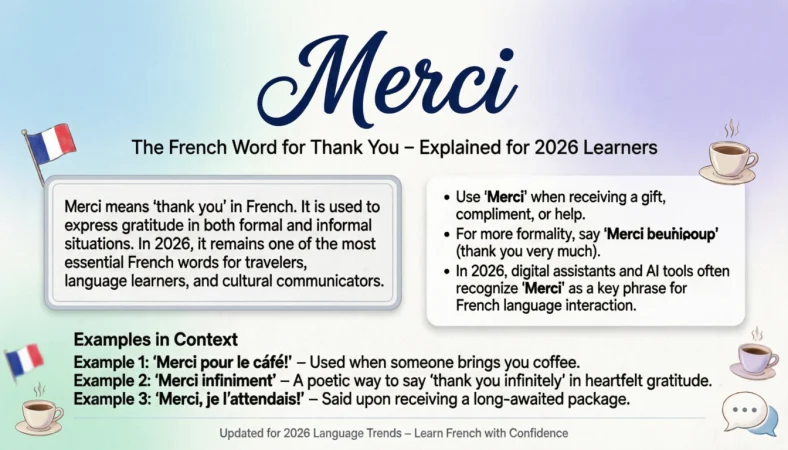
Merci is a French word that means thank you or thanks in English. It is used to express gratitude in both casual and formal situations. Depending on tone and context, it can also mean thanks a lot, thank you very much, or even carry a slightly sarcastic tone.
If you’ve ever heard someone say merci in a movie, song, or while traveling in France, you already know it sounds polite and elegant. But what does merci really mean in French? When should you use it? And are there different ways to say thank you in French?
In this complete guide, we’ll break down the meaning, origin, pronunciation, real-world usage, tone differences, and alternatives to merci. Whether you’re learning French, traveling to France, or just curious about language, this article will give you everything you need to know.
What Does Merci Mean in French?
At its core, merci simply means thank you.
It is one of the most common and important French words. You’ll hear it everywhere in shops, restaurants, schools, offices, and daily conversations.
Basic Meaning:
- Merci = Thank you
- Merci beaucoup = Thank you very much
- Merci bien = Thanks a lot
Pronunciation:
- Pronounced: mehr-see
- The “r” sound is soft and comes from the back of the throat
- The “ci” sounds like “see”
Unlike English, where tone often depends on added words, French relies heavily on voice tone and context to shape meaning.
The Origin of the Word Merci
The word merci has an interesting history.
It comes from the Latin word merces, which meant wages, reward, or favor. Over time, in Old French, it evolved to mean mercy, favor, or kindness.
In fact, the English word mercy comes from the same root.
So originally, when someone said merci, it meant:
- I am in your favor
- I appreciate your kindness
- I acknowledge your help
Today, the meaning has simplified to thank you, but its roots show that gratitude in French culture is deeply connected to respect and acknowledgment.
How Merci Is Used in Real Life
You’ll hear merci constantly in French-speaking countries such as:
- France
- Canada (especially Quebec)
- Belgium
- Switzerland
Everyday Situations Where Merci Is Used:
• When someone holds the door
• When a cashier gives you change
• When someone gives you directions
• After receiving a gift 🎁
• When someone gives you a compliment
In French culture, saying merci is considered basic politeness. Not saying it can feel rude.
Different Tones of Merci (Friendly, Formal, Sarcastic)
Just like “thanks” in English, merci can change meaning depending on tone.
1. Friendly Tone 😊
Used with a smile or warm voice.
- Merci !
- Merci beaucoup !
Example:
A friend gives you coffee.
You say: Merci !
Meaning: Genuine gratitude.
2. Formal or Professional Tone 👔
Often used in workplaces, emails, or official settings.
- Merci beaucoup de votre aide.
- Merci pour votre temps.
Meaning: Thank you very much for your help.
3. Sarcastic or Dismissive Tone 😒
Tone changes everything.
Example:
Someone makes a mess and says “Here you go.”
You respond flatly: Merci…
Meaning: Yeah, thanks a lot (not really).
Just like English, tone and facial expression matter.
Common Variations of Merci
Here are popular versions you’ll often hear:
| French Phrase | English Meaning | Tone | When to Use |
| Merci | Thank you | Neutral | Everyday use |
| Merci beaucoup | Thank you very much | Warm | Strong gratitude |
| Merci bien | Thanks a lot | Neutral / Slightly formal | Polite |
| Un grand merci | A big thank you | Friendly | Appreciation |
| Merci mille fois | Thanks a thousand times | Emotional | Deep gratitude |
| Non merci | No thank you | Polite refusal | Declining something |
Important Note:
Non merci is very useful when refusing politely.
Example:
Waiter: More bread?
You: Non merci.
Merci vs Other French Thank You Expressions
French has multiple ways to say thank you. Here’s how merci compares.
| Expression | Meaning | Formality Level | When to Use |
| Merci | Thank you | Neutral | Most situations |
| Je vous remercie | I thank you | Formal | Professional settings |
| Je te remercie | I thank you | Informal | Friends |
| Merci d’avance | Thanks in advance | Professional | Emails |
| Merci infiniment | Thank you infinitely | Very warm | Deep appreciation |
Key Difference:
- Merci works almost everywhere.
- Je vous remercie sounds more official and respectful.
Cultural Importance of Saying Merci
In French-speaking cultures, politeness is extremely important.
In Paris especially, small courtesy words matter.
When entering a shop, it’s common to say:
- Bonjour
And when leaving: - Merci, au revoir
Not saying merci may make you appear impolite.
French etiquette emphasizes:
- Respect
- Gratitude
- Formal language in public
Using merci correctly shows cultural awareness.
Alternate Meanings of Merci
In modern French, merci almost always means thank you.
However, historically, it also meant:
- Mercy
- Pardon
- Compassion
In older texts, you might see:
- Demander merci = To beg for mercy
Today, this meaning is rare in daily conversation.
How to Use Merci in Emails and Professional Settings
If you’re writing in French, using the correct tone is important.
Professional Email Examples:
- Merci pour votre réponse.
- Merci de votre collaboration.
- Merci d’avance pour votre aide.
In business environments in France and Canada, politeness formulas are expected.
Polite Email Structure:
• Greeting
• Message
• Thank you line with merci
• Closing
Example closing:
Merci pour votre attention.
Cordialement.
Common Mistakes When Using Merci
Here are frequent beginner mistakes:
• Saying merci without greeting in formal places
• Overusing merci beaucoup in casual chats
• Forgetting tone can change meaning
• Mispronouncing the “r”
Pronunciation Tip:
Practice saying:
- Mehr-see
Keep it smooth and soft.
Merci in Pop Culture
The word merci appears frequently in:
• French films
• Fashion branding
• Restaurant names
• Travel content
You might even see it used in English conversations for style or elegance.
Example:
“Merci for the invite!”
In English, this adds a classy or playful tone.
FAQ:
1. Does merci always mean thank you?
Yes, in modern French, merci almost always means thank you.
2. Is merci formal or informal?
It works in both casual and formal situations.
3. What does merci beaucoup mean?
It means thank you very much.
4. How do you pronounce merci?
Mehr-see, with a soft French r.
5. What does non merci mean?
It means no thank you.
6. Is merci used in Canada?
Yes, especially in French-speaking parts of Canada.
7. Can merci be sarcastic?
Yes, depending on tone and facial expression.
8. What is the most formal way to say thank you in French?
Je vous remercie is more formal than just merci.
Conclusion:
So, what does merci mean in French?
It means thank you, but it carries more than just simple gratitude. It reflects politeness, cultural respect, and acknowledgment.
Here’s what to remember:
• Merci = thank you
• Works in almost all situations
• Tone changes meaning
• Can be formal or casual
• Essential for politeness in French culture
Whether you’re traveling to France, learning French, or just expanding your vocabulary, mastering merci is one of the most important first steps.
And now merci for reading! 😊

Rachel King is a seasoned content expert with extensive experience in creating engaging, high-quality, and better content across multiple niches. She specializes in content strategy, digital storytelling, and content optimization for websites, blogs, and social media platforms. With a keen eye for detail and a deep understanding of audience behavior, Rachel crafts content that not only informs but also converts and drives engagement.