
Definition:
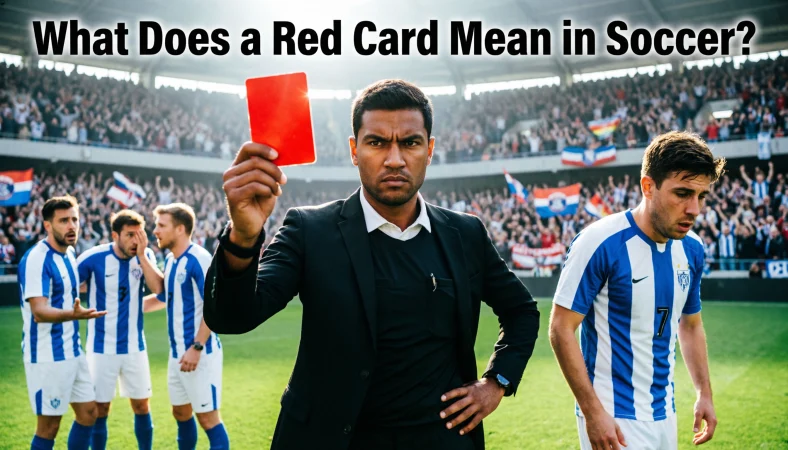
A red card in soccer is a disciplinary action shown by the referee to immediately eject a player from the game for serious misconduct. When a player receives a red card, they must leave the field at once, and their team continues playing with one fewer player for the remainder of the match.
Imagine watching a thrilling soccer match. The crowd is loud, the score is tight, and suddenly the referee reaches into their pocket and pulls out a bright red card. The stadium gasps. One player walks off the field. The entire game changes in seconds.
So, what does a red card mean in soccer, and why does it have such a dramatic impact?
In this comprehensive guide, we’ll break down everything you need to know from the official rules and real-world examples to comparisons with yellow cards, FAQs, and even alternate meanings. Whether you’re new to the sport or brushing up on the rules, this article will give you a clear and complete understanding.
What Does a Red Card Mean in Soccer?
A red card in soccer is the most serious punishment a referee can give during a match. It signals that a player has committed a major offense and must:
- Immediately leave the field
- Take no further part in the match
- Leave their team with one fewer player
- Possibly face additional suspension for future games
Unlike minor fouls, a red card isn’t a warning—it’s a final decision.
Key Points at a Glance
- 🔴 Immediate ejection
- 👥 Team plays short-handed
- 📅 Often leads to suspension
- ⚖️ Given for serious misconduct
In professional leagues, international tournaments, and even youth soccer, the red card rule applies under FIFA’s Laws of the Game.
Origin of the Red Card Rule in Soccer
You might wonder: why red? Why not another color?
The red and yellow card system was introduced after confusion during the 1966 FIFA World Cup. Players sometimes didn’t understand referees’ verbal warnings due to language barriers. English referee Ken Aston came up with the idea of using traffic-light colors:
- 🟡 Yellow = Warning
- 🔴 Red = Stop
The system officially debuted in the 1970 FIFA World Cup and has been part of the game ever since.
Why It Became Popular
- Clear visual communication
- Universal understanding across languages
- Easy for fans, players, and coaches to interpret
Today, the red card is one of the most recognizable symbols in global sports.
When Is a Red Card Given in Soccer?
A red card is issued for serious foul play or misconduct. According to the Laws of the Game, common reasons include:
1. Serious Foul Play
Dangerous tackles that endanger another player’s safety.
2. Violent Conduct
Punching, kicking, or aggressive behavior—even off the ball.
3. Denying an Obvious Goal-Scoring Opportunity (DOGSO)
If a player intentionally stops a clear goal chance, especially with a handball or last-man foul.
4. Spitting at an Opponent
Considered highly disrespectful and serious.
5. Offensive or Abusive Language
Using insulting or discriminatory language toward players or officials.
6. Two Yellow Cards = One Red Card
If a player receives two yellow cards in the same match, they automatically receive a red card.
What Happens After a Red Card?
Getting a red card changes everything.
Immediate Consequences
- The player must leave the field instantly.
- The team cannot replace them.
- The team plays with 10 players (or fewer if multiple red cards occur).
Post-Match Consequences
- Automatic suspension (usually 1–3 matches)
- Possible fines
- League review for additional punishment
In major tournaments, a red card can affect a team’s entire strategy moving forward.
Red Card vs Yellow Card: What’s the Difference?
Here’s a clear comparison:
| Feature | Yellow Card | Red Card |
|---|---|---|
| Purpose | Warning | Ejection |
| Player Stays in Game? | Yes | No |
| Accumulation Effect | Two = Red | Immediate removal |
| Severity | Moderate offense | Serious misconduct |
| Team Impact | No change in player count | Team plays short-handed |
A yellow card says: “Be careful.”
A red card says: “You’re done.”
Real-World Examples of Red Cards in Soccer
Friendly Context
A defender mistimes a tackle during a youth match and accidentally injures an opponent. If the tackle is reckless but not intentional, the referee might issue a red card to protect player safety.
Neutral Context
A professional player deliberately handles the ball on the goal line to stop a sure goal. The referee shows a red card and awards a penalty kick.
Negative or Heated Context
A frustrated player punches an opponent after a foul. The referee immediately shows a red card for violent conduct.
In every case, the red card sends a strong message about fairness and discipline.
Tactical Impact of a Red Card
When a team loses a player, the match dynamic shifts.
Teams Often:
- Switch to defensive formations
- Remove a forward and add a defender
- Focus on counterattacks
Playing with 10 players requires stamina, discipline, and smart tactics.
In high-level matches, a red card can completely change the outcome.
Red Cards in Major Tournaments
In tournaments like:
- FIFA World Cup
- UEFA Champions League
- Copa America
- English Premier League
Red cards often lead to:
- Automatic one-match suspension
- Review committees for violent conduct
- Tournament bans in extreme cases
Some famous matches have been defined by a single red card moment.
Alternate Meanings of “Red Card”
While most commonly used in soccer, the phrase “red card” can have other meanings:
- 🏏 In some sports discussions, metaphorically meaning removal
- 💳 In finance, informally meaning account restriction
- 🗳️ In politics, used figuratively to indicate strong disapproval
However, in sports context, it almost always refers to soccer (football).
Professional and Polite Alternatives (When Discussing Discipline)
In formal sports reporting, instead of saying:
- “He got kicked out,”
You might say:
- “He was shown a red card.”
- “He was sent off.”
- “He received an immediate dismissal.”
These phrases sound more professional and neutral.
FAQs
1. What does a red card mean in soccer?
A red card means a player is immediately removed from the match for serious misconduct.
2. Does a red card mean suspension?
Yes, most red cards result in at least a one-match suspension.
3. Can a red card be overturned?
In some leagues, teams can appeal if they believe the decision was incorrect.
4. What happens if a goalkeeper gets a red card?
The team must substitute a field player or use a backup goalkeeper, but they still play with one fewer player.
5. How many red cards can a team get?
There’s no strict limit, but if a team falls below 7 players, the match may be abandoned.
6. Is a red card worse than two yellow cards?
Two yellow cards equal one red card. However, direct red cards are usually for more serious offenses.
7. Do red cards carry over between competitions?
Usually no. Suspensions apply within the same competition unless specified.
8. Can a substitute receive a red card?
Yes. Even substitutes or coaches can be shown red cards for misconduct.
Conclusion
So, what does a red card mean in soccer?
It means immediate ejection, serious consequences, and a dramatic turning point in the match. More than just a colored card, it represents authority, discipline, and the enforcement of fair play.
From its origins in the 1970 World Cup to modern-day professional leagues, the red card remains one of the most powerful symbols in sports. It ensures that the game stays safe, competitive, and respectful.
Next time you see a referee raise that red card, you’ll know exactly what it means—and why it matters so much.

Matthew Nelson is a professional content writer and blogger with a strong focus on creating high-quality and reader-centric content. He specializes in writing informative articles that help websites grow their online visibility while delivering real value to readers.