
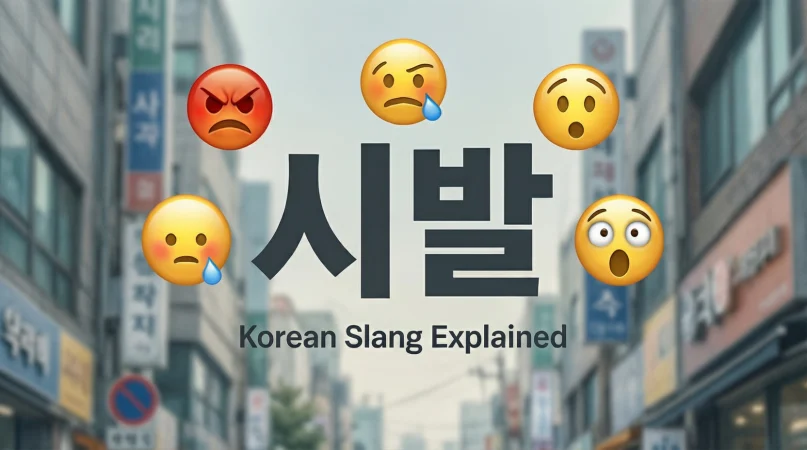
Definition:
Shibal (시발) is a Korean swear word commonly used to express anger, frustration, shock, or emphasis. It is roughly equivalent to strong English curse words like damn, fuck, or shit, depending on context and tone. While extremely common in casual speech and online slang, shibal is considered vulgar and inappropriate in polite or professional settings.
If you’ve watched K-dramas, Korean movies, or spent time on Korean social media, you’ve probably heard shibal shouted in emotional moments. It’s one of the most recognizable Korean curse words and also one of the most misunderstood by non-native speakers.
This guide breaks it all down clearly and honestly: what shibal really means, where it comes from, how Koreans actually use it, what tone it carries, and what you should say instead if you want to stay respectful.
Origin and Meaning of Shibal (시발)
Literal Meaning
The word 시발 (shibal) originally comes from a verb meaning to start or to originate, but over time, its modern usage shifted completely.
In contemporary Korean, shibal has no polite or literal meaning it functions purely as a profanity.
What It Expresses Emotionally
Rather than pointing to a specific object or action, shibal expresses emotion, such as:
- Anger 😡
- Frustration 😤
- Shock 😲
- Pain 😣
- Intense emphasis 🔥
Think of it as an emotional outlet rather than a descriptive word.
Is Shibal a Bad Word in Korean?
Yes very much so.
While it is widely used in movies, games, and among friends, shibal is still considered a strong curse word.
How Offensive Is It?
- More offensive than “damn”
- Comparable to “fuck” in intensity
- Not something you say casually to strangers
When It’s Especially Inappropriate
- Talking to elders
- At work or school
- In customer service
- In formal conversations
- Around children
Using shibal in the wrong situation can make you seem rude, immature, or aggressive.
How Shibal Is Used in Real Life
Despite being vulgar, shibal is extremely common in spoken Korean especially among younger people and in emotional situations.
Common Usage Scenarios
- Losing a game 🎮
- Dropping your phone 📱
- Getting angry at traffic 🚗
- Expressing disbelief 😮
- Venting frustration 😤
It’s often said without directly insulting someone, similar to shouting a curse word under your breath.
Tone Variations: What Shibal Can Sound Like
Tone matters a lot in Korean. The same word can feel very different depending on how it’s said.
Negative / Aggressive Tone
Used when angry or confronting someone.
- Loud
- Sharp
- Often directed at a situation or person
😡 Shibal! (yelled)
Frustrated / Emotional Tone
Used when something goes wrong.
- Muted
- Said to oneself
😤 Ah… shibal…
Emphatic / Casual Tone (Among Close Friends)
Still vulgar, but less aggressive.
- Quick
- Casual
- Among peers only
😅 Shibal, that was close.
⚠️ Even in this case, it’s never polite just socially tolerated in certain groups.
Shibal in K-Dramas, Movies, and K-Pop
Why You Hear It So Often
- Korean media reflects real speech
- Used to show raw emotion
- Makes dialogue feel realistic
Censorship Workarounds
You may hear softened versions like:
- Shib (cut off)
- Ssi… (implied)
Subtitles often translate shibal as:
- Damn
- Shit
- Fuck
- Hell
The exact English translation depends on the emotional weight of the scene.
Example Sentences with Context
Here’s how shibal appears in real conversations.
Example Table: Shibal Usage by Tone
| Korean Sentence | English Meaning | Tone |
| 시발, 또 늦었어 | Damn it, I’m late again | Frustrated |
| 아 시발… | Oh shit… | Shock |
| 시발 뭐야 이게 | What the hell is this | Angry |
| 시발 진짜 웃기네 | This is freaking hilarious | Emphatic |
| 시발하지 마 | Don’t swear like that | Corrective |
⚠️ These examples are for understanding only, not recommendation.
Is Shibal Used Online or in Text?
Yes very often.
Common Online Forms
- 시발
- ㅅㅂ (abbreviated to avoid censorship)
- shibal (romanized)
Where You’ll See It
- Gaming chats 🎮
- Korean Twitter / X
- YouTube comments
- Online forums
- Text messages between friends
The abbreviation ㅅㅂ is especially popular because it avoids filters while still being understood.
Related Korean Curse Words (Comparison)
Here’s how shibal compares to other common Korean swear words:
| Word | Meaning | Strength |
| 시발 (shibal) | Fuck / Shit | Strong |
| 개새끼 (gaesaekki) | Son of a bitch | Very strong |
| 병신 (byeongsin) | Idiot / slur | Offensive |
| 젠장 (jenjang) | Damn it | Mild |
| 아이씨 (aissi) | Ugh / damn | Soft |
👉 Shibal sits in the “strong but common” category.
Alternate Meanings of Shibal
In modern Korean, there are no polite or neutral alternate meanings.
Any non-swear explanation you may see online is historical or outdated and not used in everyday speech.
So if you hear shibal, assume:
- Strong emotion
- Informal setting
- Vulgar tone
Polite and Professional Alternatives to Shibal
If you want to express frustration without being rude, here are better options:
Polite Alternatives
- 아이고 (aigo) – Oh no
- 어휴 (eohu) – Sigh / goodness
- 젠장 (jenjang) – Darn it
- 아이구 (aigu) – Oh dear
Professional or Safe Expressions
- 문제가 있네요 – There’s a problem
- 속상하네요 – That’s upsetting
- 당황했어요 – I’m embarrassed/confused
These are safe in:
- Workplaces
- Schools
- Public settings
- Conversations with elders
Should Foreigners Use Shibal?
Short answer: No.
Even though you may hear it often, using shibal as a non-native speaker can:
- Sound disrespectful
- Come across as aggressive
- Create awkward situations
Koreans understand cultural nuance. Foreigners using strong curse words can feel jarring or offensive, even if unintended.
Understanding it = good.
Using it = risky.
FAQs
1. What does shibal literally mean in English?
It doesn’t have a clean literal translation. It’s closest to fuck, shit, or damn, depending on tone.
2. Is shibal worse than “damn”?
Yes. It’s significantly stronger and more vulgar.
3. Can shibal be used jokingly?
Among close friends, sometimes but it’s still crude.
4. Is shibal censored in Korea?
Often yes, especially on TV, radio, and online platforms.
5. What does ㅅㅂ mean in Korean slang?
It’s an abbreviation for shibal, used to avoid filters.
6. Do K-dramas exaggerate its use?
Not really. It reflects real emotional speech, though frequency may vary.
7. Can shibal be used positively?
Not truly. Even when expressing excitement, it’s still vulgar.
8. What should I say instead of shibal?
Use 젠장, 아이고, or neutral expressions like 문제가 있네요.
Conclusion:
Shibal (시발) is one of the most common and powerful Korean swear words, used to express intense emotion especially anger, frustration, or shock. While it appears frequently in media and casual conversation, it remains vulgar and inappropriate in polite settings.
Remember This:
- It’s a strong curse word, not slang
- Tone and context matter but it’s never polite
- Foreigners should understand it, not use it
- There are many safer alternatives
Knowing what shibal means helps you understand Korean culture and media better just be smart about how (and if) you ever say it.

Michael Johnson is a seasoned Content Expert and digital communication specialist with a proven track record in content creation, strategy, and audience engagement. His work goes beyond writing he crafts meaningful, results driven content that helps businesses achieve growth, brand visibility, and audience trust.