Definition:
“Sí” in Spanish means “yes.” It is used to express agreement, affirmation, confirmation, or permission. When written without an accent mark (si), it can also mean “if” or function in musical or grammatical contexts. The accent mark changes the meaning completely.
Have you ever seen the word si in Spanish and wondered what it really means? At first glance, it looks simple. Just two letters. But this tiny word can completely change meaning depending on whether it has an accent mark or not.
In this guide, we’ll break down what does si mean in Spanish, explain how it’s used in real life, compare it with similar words, and show you exactly how to use it correctly whether you’re learning Spanish for school, travel, business, or casual conversation.
Let’s dive in 👇
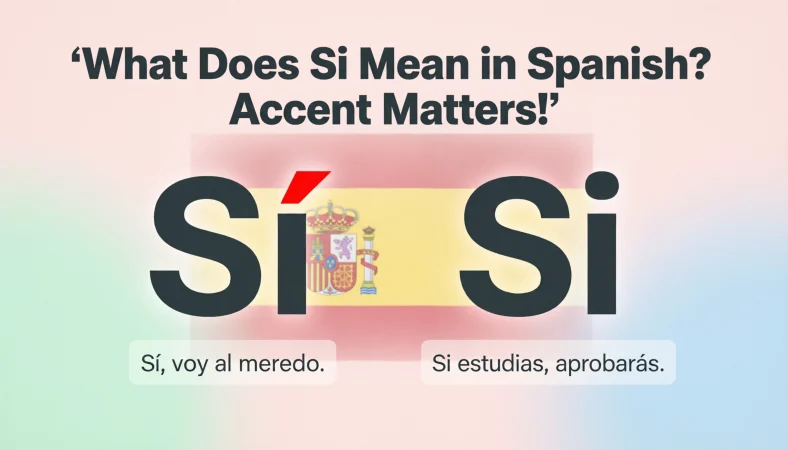
Understanding “Sí” vs “Si” (Accent Matters!)
One of the most important things to know about this word is that the accent mark changes everything.
| Word | Accent | Meaning | Example | English Translation |
| Sí | With accent | Yes | Sí, quiero café. | Yes, I want coffee. |
| Si | No accent | If | Si llueve, no salimos. | If it rains, we won’t go out. |
Why the Accent Is Important
Spanish uses accent marks to change pronunciation and meaning.
- Sí (with accent) = affirmation
- Si (without accent) = conditional word (if)
For example:
- ¿Vienes?
Sí. 😊 (Yes.) - Si vienes, te llamo.
If you come, I’ll call you.
One tiny mark big difference!
Origin of “Sí” in Spanish
The word sí comes from Latin. It evolved from the Latin word sic, which meant “thus” or “so.” Over time, it became a simple affirmation word in Spanish, just like “yes” in English.
Spanish is a Romance language, meaning it developed from Latin the same origin as Italian, French, Portuguese, and Romanian.
Interestingly:
- In Italian, “yes” is sì
- In Portuguese, “yes” is sim
So if you’re learning multiple languages, you might notice similarities!
How “Sí” Is Used in Everyday Spanish
The most common meaning of sí is simply “yes.” But its tone can change depending on context, voice, and punctuation.
1. Basic Affirmation
Used to answer questions:
- ¿Te gusta la música?
Sí. 🎵 - Do you like music?
Yes.
2. Enthusiastic Yes
Adding excitement:
- ¡Sí! 😄
- Yes!
Tone: Friendly, excited
3. Polite Confirmation
- Sí, claro.
Yes, of course. - Sí, por favor.
Yes, please.
Tone: Respectful, professional
4. Strong Agreement
- Sí, tienes razón.
Yes, you’re right.
Tone: Affirming, supportive
When “Si” Means “If” (Without Accent)
Without the accent, si becomes a conditional word meaning “if.”
It introduces a condition or possibility.
Common Structure
Si + present tense + future/command
Examples:
- Si estudias, pasarás el examen.
If you study, you’ll pass the exam. - Si tienes tiempo, llámame.
If you have time, call me.
Tone: Neutral, logical
This is extremely common in conversations, writing, and formal settings.
Other Meanings of “Si” in Spanish
While most learners focus on “yes” and “if,” there are a few additional meanings.
1. Reflexive Emphasis (Sí mismo)
When written with accent and used with reflexive pronouns:
- Lo hizo por sí mismo.
He did it by himself.
Here, sí mismo means “himself” or “herself.”
2. Musical Note
In Spanish music terminology, si is the note “B.”
In English music scale:
Do – Re – Mi – Fa – Sol – La – Ti
In Spanish:
Do – Re – Mi – Fa – Sol – La – Si
Tone Differences: Friendly, Neutral, or Dismissive?
Just like in English, tone matters.
Friendly Tone 😊
- Síiiiii! (drawn out)
- Sí, claro.
- ¡Sí, me encanta!
Neutral Tone
- Sí.
- Si es posible.
Slightly Dismissive or Defensive Tone
- Sí, sí… (can imply impatience)
- Sí, ya sé. (Yes, I already know.)
Context and voice make all the difference.
Comparison: “Sí” vs Similar Spanish Words
Spanish has other words that express agreement. Let’s compare:
| Word | Meaning | Usage |
| Sí | Yes | Direct affirmation |
| Claro | Of course | Confident agreement |
| Exacto | Exactly | Strong confirmation |
| Vale | Okay | Informal approval |
| De acuerdo | Agreed | Formal agreement |
Example Differences
- ¿Quieres ir?
Sí. (Simple yes.) - ¿Estás seguro?
Exacto. (Exactly.) - ¿Podemos empezar?
Vale. (Okay.)
Professional & Polite Alternatives
In professional Spanish conversations, instead of just saying “sí,” you might use:
- Sí, con gusto. (Yes, gladly.)
- Sí, estaré presente. (Yes, I will attend.)
- Sí, lo confirmaré por correo. (Yes, I’ll confirm by email.)
- De acuerdo. (Agreed.)
- Perfecto. (Perfect.)
These sound more polished and appropriate in business settings.
Real-World Usage Examples (With Context)
Casual Conversation
Friend: ¿Vas a la fiesta?
You: Sí 🎉
Tone: Friendly
Workplace
Boss: ¿Terminaste el informe?
You: Sí, ya está listo.
Tone: Professional
Conditional Situation
Si llueve mañana, cancelamos la reunión.
If it rains tomorrow, we cancel the meeting.
Tone: Neutral
Common Mistakes to Avoid
1. Forgetting the Accent
Writing “si” instead of “sí” changes the meaning.
Wrong:
Si, quiero café.
(This reads as “If, I want coffee.”)
Correct:
Sí, quiero café.
2. Overusing “Sí”
In Spanish conversations, repeating yes repeatedly sounds unnatural.
Instead of:
Sí. Sí. Sí.
Use:
Claro.
Exacto.
Correcto.
FAQs
1. What does “si” mean in Spanish without an accent?
It means “if.” It introduces a condition.
2. What does “sí” with an accent mean?
It means “yes.” It expresses affirmation or agreement.
3. How do you pronounce “sí”?
It’s pronounced like “see” in English.
4. Is “si” ever used to mean yes?
No. Without the accent, it does not mean yes.
5. Why does Spanish use an accent mark?
Accent marks change pronunciation and meaning. In this case, they distinguish between “yes” and “if.”
6. Can “sí” mean “himself”?
Yes, in phrases like “sí mismo,” it can mean himself or herself.
7. Is “sí” formal or informal?
It works in both. It’s neutral and universally accepted.
8. Is “si” used in other languages?
Yes. Italian uses “sì,” and Portuguese uses “sim.”
Conclusion
Now you fully understand what does si mean in Spanish and more importantly, how to use it correctly.
Remember:
- If you mean “yes,” use the accent: sí.
- If you mean “if,” leave it without the accent: si.
Paying attention to this tiny detail will instantly make your Spanish look more polished and accurate.
Whether you’re texting a friend, writing an email, or speaking in a business meeting, knowing the difference helps you sound confident and fluent.
Language learning is often about mastering small but powerful words and “sí” is definitely one of them.

Justin Young is a passionate Digital Creator and Content Writer who specializes in crafting engaging, informative, and results-driven content. He focuses on creating high-quality, blog posts, and digital content that capture attention and deliver real value to readers. With a strong interest in storytelling, trends, and online growth, Justin helps brands and individuals connect with their audiences through clear, impactful, and creative writing.