
Definition:
Taka in Swahili primarily means trash, waste, rubbish, or garbage. It refers to unwanted, discarded, or useless material and is commonly used in everyday conversation, public signage, environmental discussions, and formal writing across Swahili-speaking regions.
At first glance, taka may seem like a simple word but in Swahili culture and language, it carries practical, emotional, and even metaphorical weight. From street signs to casual jokes, environmental campaigns to mild insults, taka is a word you’ll hear often if you spend any time around Swahili speakers.
Let’s break it down clearly, naturally, and completely so by the end of this guide, you’ll know exactly what taka means in Swahili, how to use it, and when not to use it.
What Does “Taka” Mean in Swahili?
In everyday Swahili, taka means:
- Trash
- Garbage
- Waste
- Rubbish
- Unwanted or useless material
It’s used both literally (physical waste) and figuratively (to describe something as worthless or poor quality).
Basic sentence example:
- Hizi ni taka.
→ These are trash.
Origin and Linguistic Background of “Taka”
Swahili (Kiswahili) is a Bantu language influenced by Arabic, Persian, Portuguese, and English due to centuries of trade along the East African coast. However, taka is of Bantu origin, not borrowed from Arabic or European languages.
Linguistic notes:
- Root word: taka
- Noun class: Class 9/10 (common for objects and materials)
- Singular & plural: Often the same form (taka) depending on context
Because Swahili relies heavily on noun classes rather than plural endings, taka can refer to both one type of waste or waste in general.
Where Is “Taka” Commonly Used?
You’ll hear or see taka in many real-world contexts, including:
- 🇰🇪 Kenya
- 🇹🇿 Tanzania
- 🇺🇬 Uganda
- 🇨🇩 Eastern Congo
- 🇷🇼 Rwanda
- 🇧🇮 Burundi
- 🇲🇿 Mozambique (coastal areas)
It’s used by:
- Native speakers
- Students
- Government agencies
- Environmental organizations
- Media outlets
Common Real-World Uses of “Taka”
1. Environmental & Public Use
This is the most common and neutral usage.
Examples:
- Usitupe taka hapa.
→ Do not throw trash here. - Tafadhali tupa taka kwenye pipa.
→ Please throw trash in the bin.
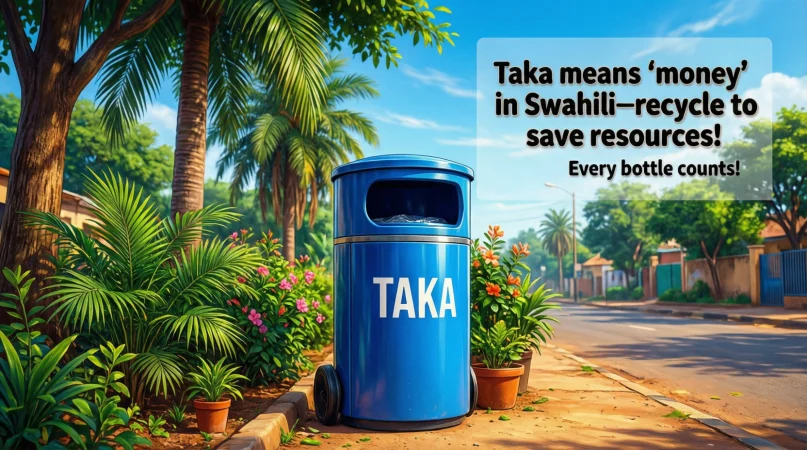
You’ll often see taka on:
- Street signs
- Recycling bins
- Schools and hospitals
- Government notices
2. Everyday Casual Conversation
Used informally among friends or family.
Example:
- Nyumba yangu imejaa taka.
→ My house is full of trash.
Tone here is neutral and practical.
3. Figurative or Insulting Use
Like the English word “trash,” taka can be mildly insulting when used about ideas, actions, or people (context matters).
Example:
- Mpango huu ni taka.
→ This plan is trash.
⚠️ This usage can sound:
- Dismissive
- Harsh
- Disrespectful
Use carefully, especially in formal or cross-cultural settings.
Tone Variations: How “Taka” Can Sound
| Tone | Example Sentence | Meaning |
| Neutral | Tupa taka. | Throw away the trash |
| Friendly | Ondoa taka kidogo 🙂 | Clear some trash |
| Critical | Hii kazi ni taka. | This work is trash |
| Harsh | Wewe ni taka. | You are trash (very rude) |
Important: Calling a person taka is considered highly disrespectful and should be avoided.
Example Sentences with Context
Neutral / Informative
- Taka za plastiki ni hatari kwa mazingira.
Plastic waste is dangerous to the environment.
Friendly / Casual
- Usijali, nitaondoa taka baadaye 😄
Don’t worry, I’ll take out the trash later.
Negative / Dismissive
- Huo ni muziki wa taka.
That’s trash music.
Related Words and Comparisons
Swahili has several related words that overlap with taka depending on context.
Comparison Table: Taka vs Similar Words
| Word | Meaning | Usage |
| Taka | Trash / waste | General, common |
| Uchafu | Dirt / filth | More about dirtiness |
| Mabaki | Leftovers / remains | Neutral, often food |
| Vifusi | Debris | Construction or rubble |
| Takataka | Garbage (emphasized) | Stronger, informal |
Takataka is an intensified form and often sounds more negative or dramatic.
Alternate Meanings of “Taka”
Unlike many slang terms, taka does not have many alternate meanings in Swahili. However:
- In contextual speech, it can imply:
- Worthlessness
- Poor quality
- Lack of value
- Worthlessness
This mirrors how English speakers use “trash” metaphorically.
Polite or Professional Alternatives to “Taka”
In formal writing, workplaces, or respectful conversation, consider alternatives:
- Mabaki – leftovers
- Nyenzo zisizohitajika – unwanted materials
- Taka ngumu – solid waste (official term)
- Uchafu wa mazingira – environmental waste
These sound more professional and less harsh.
Cultural Notes: Why “Taka” Matters
In many East African cities, waste management is a major public issue. Because of this, taka often appears in:
- Environmental education
- School curriculums
- Community clean-up campaigns
- NGO messaging
So while the word is simple, its social importance is significant.
FAQs:
1. What does taka mean in Swahili?
Taka means trash, garbage, or waste in Swahili.
2. Is taka a bad word?
No, but it can sound rude if used to describe a person or their work.
3. Can taka be used in formal writing?
Yes, especially in environmental or governmental contexts.
4. What is takataka?
Takataka is an emphasized form meaning garbage or junk, often more informal.
5. How do you say throw away trash in Swahili?
Tupa taka.
6. Is taka singular or plural?
It can function as both, depending on context.
7. Can taka mean worthless?
Yes, figuratively it can describe something of low value.
8. What’s a polite alternative to taka?
Mabaki or taka ngumu are more polite and formal.
Conclusion
In Swahili, taka is a simple but powerful word that primarily means trash, waste, or garbage. While it’s most often used in a neutral, practical way especially in homes, public places, and environmental discussions it can also take on a negative or dismissive tone when used figuratively. That’s why context matters so much.
Understanding how and when to use taka helps you communicate more naturally and respectfully in Swahili. Stick to neutral or descriptive situations, choose more polite alternatives in professional settings, and avoid using it to describe people. With that awareness, taka becomes an easy, useful word that reflects real-life Swahili as it’s spoken every day.
Read More Articles About:
- What Does Tren de Aragua Mean in English? Definition, Origin & Real-World Usage (2026)
- What Does IIRC Mean in Text? (Definition, Usage, Examples & Alternatives)

Megan Lewis is a passionate and experienced content writer specializing in creating engaging and well-researched content. She excels at producing clear, informative, and reader-focused content that not only ranks well on search engines but also delivers real value to audiences.