
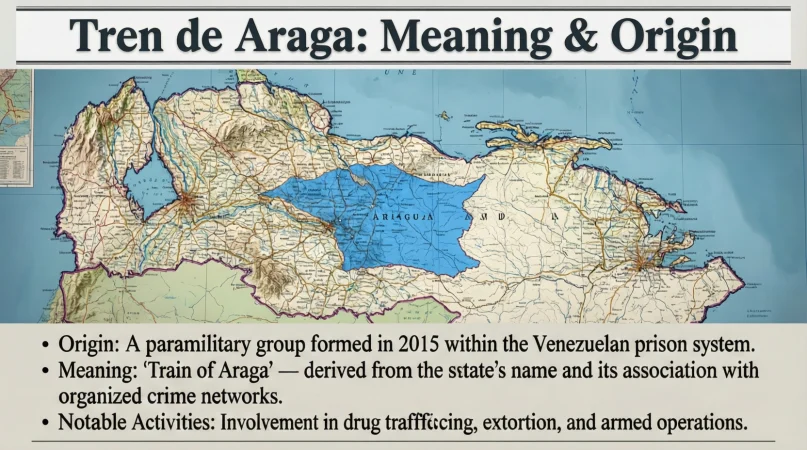
Definition: Tren de Aragua literally translates from Spanish to “Aragua Train” in English.
However, in real-world usage, it refers to a notorious Venezuelan criminal organization that originated in the state of Aragua not an actual train or transportation system.
Tren de Aragua is a phrase you may have seen recently in news headlines, documentaries, or online discussions and if you paused to wonder what it actually means in English, you’re not alone.
This term has surged in global searches due to its connection with crime reporting, migration news, and international law enforcement stories. But its meaning is often misunderstood, oversimplified, or taken out of cultural context.
Let’s break it down clearly, accurately, and responsibly.
Why This Phrase Matters Today
Searches for what does tren de aragua mean in English have increased sharply due to:
- International crime investigations
- News coverage about transnational gangs
- Discussions around migration and security
- Social media and viral headlines
Understanding the literal meaning and the contextual meaning is essential to avoid confusion or misinformation.
Literal Translation Explained (Word by Word)
Let’s start with the basic language breakdown.
| Spanish Word | English Meaning | Notes |
|---|---|---|
| Tren | Train | Can be literal or metaphorical |
| de | of / from | Common Spanish preposition |
| Aragua | Aragua | A state in central Venezuela |
➡️ Literal translation: Train of Aragua or Aragua Train
But this literal translation does not explain how the term is actually used today.
What Does Tren de Aragua Really Refer To?
In modern usage, Tren de Aragua refers to a criminal gang that originated in Venezuela’s Aragua state, particularly around the Tocorón prison.
It is widely described as:
- A transnational organized crime group
- Involved in activities such as:
- Extortion
- Human trafficking
- Drug trafficking
- Kidnapping
- Money laundering
The name is symbolic, not literal.
Origin of the Name “Tren de Aragua”
How Did the Name Start?
The word tren (train) is believed to be used metaphorically, suggesting:
- A network of connected operations
- A chain of criminal activities
- A group that “moves together” with coordination
Some reports suggest the name originated from:
- Railway construction corruption schemes
- Prison slang implying organized movement
There is no evidence that the group operated actual trains.
Geographic Roots: Aragua, Venezuela
Aragua is a state in central Venezuela known for:
- Its capital city, Maracay
- Industrial and agricultural activity
- The Tocorón prison, which has been widely reported as the gang’s base of power
Over time, the group expanded beyond Aragua and even beyond Venezuela.
Why Is Tren de Aragua in the News?
The term appears frequently in:
- International crime reports
- Immigration-related discussions
- Law enforcement briefings
- Investigative journalism
Reasons for increased attention include:
- Alleged expansion into other Latin American countries
- Reports linking the group to cross-border crime
- Global concern about organized crime networks
This exposure has led many English speakers to search for the meaning of the name, not just the group itself.
How Tren de Aragua Is Used in Real Life
Unlike slang or texting abbreviations, Tren de Aragua is almost always used in formal or serious contexts.
Common Usage Contexts
- News articles 📰
- Academic or policy discussions
- Law enforcement statements
- Documentary reporting
It is not used casually in conversation.
Tone & Context: How the Term Is Perceived
| Tone Type | Is It Common? | Explanation |
|---|---|---|
| Neutral | Rare | Mostly factual reporting |
| Serious | Very common | Crime, investigations, news |
| Negative | Almost always | Due to criminal association |
| Casual/Friendly | ❌ No | Not appropriate |
⚠️ Because of its strong negative association, using the term casually can be inappropriate or misleading.
Examples of Tren de Aragua in Context
Neutral / Informational
- Authorities released a report on the expansion of Tren de Aragua across borders.
Serious / News Reporting
- Law enforcement agencies are investigating alleged ties between Tren de Aragua and regional trafficking networks.
Academic / Policy Context
- The study examines how Tren de Aragua evolved from a prison-based group into a transnational organization.
🚫 Not suitable for jokes, memes, or casual slang use
Is Tren de Aragua a Slang Term?
No.
Tren de Aragua is not slang, an acronym, or internet shorthand.
It is:
- A proper noun
- A named organization
- A term tied to real-world criminal cases
Treat it as you would the name of any known group or organization.
Common Misunderstandings About Tren de Aragua
Let’s clear up a few frequent misconceptions:
- ❌ It does NOT mean a public train line
- ❌ It is NOT a Venezuelan government entity
- ❌ It is NOT a general Spanish phrase
- ❌ It is NOT a meme or online joke
✅ It is a specific name with serious implications
Comparison: Tren de Aragua vs Similar Terms
| Term | Meaning | Difference |
|---|---|---|
| Tren de Aragua | Named criminal group | Proper noun |
| Cartel | General term for crime syndicate | Broader category |
| Gang | Informal criminal group | Less structured |
| Mafia | Organized crime network | Different cultural origin |
While it may be compared to other organized crime groups, Tren de Aragua refers to a specific entity, not a generic type.
Are There Alternate Meanings?
Literal Meaning (Rarely Used)
- In a purely linguistic sense, Tren de Aragua could mean a train from Aragua
- This usage is theoretical and not common in real Spanish conversations
Practical Meaning (Widely Used)
- Refers to the criminal organization
In nearly all modern contexts, the second meaning applies.
Polite or Professional Alternatives (When Writing)
If you’re writing in a sensitive or professional context and want to avoid repeating the name:
- the organization
- the group
- the criminal network
- the Aragua-based gang (contextual use)
These alternatives can help maintain tone without overusing the name.
Usage Tips for Writers & Researchers
✔️ Capitalize it (proper noun)
✔️ Use it only in factual contexts
✔️ Provide context on first mention
✔️ Avoid sensational or casual tone
✔️ Be culturally and socially aware
Frequently Asked Questions (FAQ)
1. What does Tren de Aragua literally mean in English?
It literally translates to Aragua Train, but that is not how it’s used today.
2. Is Tren de Aragua an actual train?
No. The word train is symbolic, not literal.
3. Where did Tren de Aragua originate?
It originated in Aragua state, Venezuela, reportedly within a prison system.
4. Why is Tren de Aragua mentioned in the news?
Due to its alleged involvement in organized crime and international investigations.
5. Is Tren de Aragua a slang term?
No. It is a formal name for a specific organization.
6. Can the phrase have a neutral meaning?
Only in a purely literal translation, which is rarely used in practice.
7. Should I use Tren de Aragua in casual conversation?
No. It is best reserved for serious, factual discussions.
8. Is the phrase offensive?
The phrase itself is not a slur, but it is associated with crime, so it should be used carefully and respectfully.
Conclusion
So, what does Tren de Aragua mean in English?
Literally, it translates to Aragua Train, but in real-world usage, it refers to a specific criminal organization that originated in Venezuela’s Aragua state not an actual train or transport system.
The key takeaway is that context matters more than literal translation. While the words themselves sound neutral, the phrase carries a serious and widely recognized meaning in news, law enforcement, and academic discussions. Because of its strong association with organized crime, it’s not a casual term and should always be used carefully, factually, and respectfully.

Rachel King is a seasoned content expert with extensive experience in creating engaging, high-quality, and better content across multiple niches. She specializes in content strategy, digital storytelling, and content optimization for websites, blogs, and social media platforms. With a keen eye for detail and a deep understanding of audience behavior, Rachel crafts content that not only informs but also converts and drives engagement.