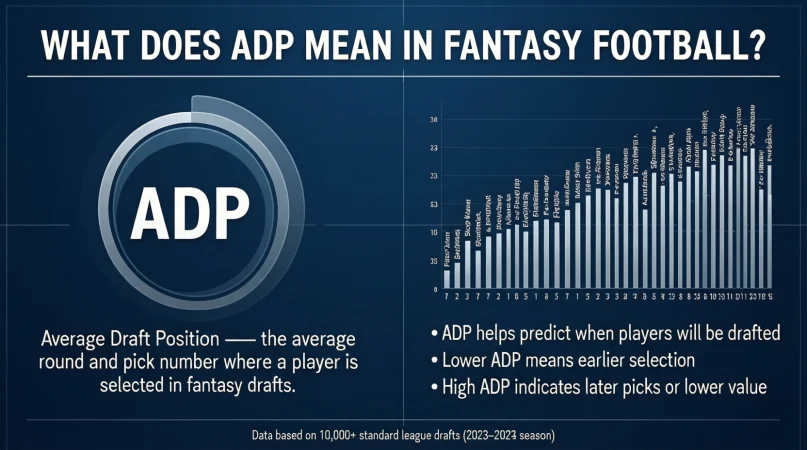
ADP in fantasy football stands for Average Draft Position.
It shows the average spot where a player is selected across thousands of fantasy drafts, helping managers understand a player’s typical draft value and timing.
Fantasy football drafts can feel chaotic timers ticking, names flying off the board, and panic setting in when your sleeper pick disappears. That’s where ADP becomes your calm in the storm. Whether you’re a first-time fantasy manager or a seasoned league veteran, understanding what ADP means in fantasy football can dramatically improve your draft decisions, confidence, and overall strategy.
In this complete guide, we’ll break down ADP in plain English, explore where it comes from, how to use it properly, common mistakes to avoid, and how smart fantasy players turn ADP into a competitive edge.
What Is ADP in Fantasy Football?
ADP (Average Draft Position) represents the average pick number at which a fantasy football player is drafted across multiple leagues and platforms.
In simple terms:
- If a player has an ADP of 15, they are usually drafted around the 15th pick overall
- Lower ADP = player is drafted earlier
- Higher ADP = player is drafted later
ADP acts as a crowd-sourced ranking system, reflecting how fantasy managers collectively value players at a given time.
How ADP Is Calculated
ADP isn’t created by one expert, it’s based on real draft data.
Here’s how it works:
- Fantasy platforms track thousands of mock drafts and live drafts
- Each time a player is selected, that pick number is recorded
- The platform averages all those picks
- The result becomes the player’s ADP
Example:
If Christian McCaffrey is drafted at:
- Pick 1
- Pick 2
- Pick 3
- Pick 2
Average = ADP of 2.0
This constantly updates as more drafts occur.
The Origin of ADP in Fantasy Football
The concept of ADP emerged as fantasy sports grew online in the early 2000s.
Why ADP became popular:
- Fantasy drafts moved from paper lists to online platforms
- Massive data from user drafts became available
- Managers wanted a quick benchmark for player value
- ADP offered a data-backed alternative to expert-only rankings
Today, ADP is a core tool used by:
- Casual home leagues
- High-stakes fantasy contests
- DFS players
- Fantasy analysts and content creators
Why ADP Matters in Fantasy Football Drafts
ADP isn’t just a number it’s a decision-making guide.
Key benefits of using ADP:
- Helps predict when players will be drafted
- Prevents reaching too early for a player
- Identifies value picks and sleepers
- Keeps your draft balanced
- Reduces panic picks under time pressure
Think of ADP as the market price for fantasy players.
Example: How ADP Works During a Draft
Imagine this scenario:
- You’re drafting 10th in a 12-team league
- A wide receiver you love has an ADP of 18
- You’re currently at pick 10
Smart move:
- You wait
- There’s a strong chance he’ll still be available in Round 2
Risky move:
- Drafting him at 10 means you’re paying above market value
ADP helps you time your picks instead of guessing.
ADP Example Table
| Player Name | Position | ADP | Typical Draft Round |
| Christian McCaffrey | RB | 1.2 | Round 1 |
| Tyreek Hill | WR | 4.8 | Round 1 |
| Travis Kelce | TE | 15.3 | Round 2 |
| Joe Burrow | QB | 38.7 | Round 4 |
| Jaylen Warren | RB | 72.1 | Round 6 |
Note: ADP varies by platform, scoring format, and time of year.
ADP vs Rankings: What’s the Difference?
This is one of the most misunderstood areas in fantasy football.
ADP:
- Based on real draft behavior
- Reflects public sentiment
- Changes frequently
Rankings:
- Created by analysts or algorithms
- Based on projections and opinions
- Often more aggressive or predictive
Simple comparison:
| Feature | ADP | Rankings |
| Data source | Drafts | Experts |
| Updates | Constant | Periodic |
| Bias | Crowd-driven | Analyst-driven |
| Best use | Draft timing | Player evaluation |
Pro tip: The best fantasy managers use both together.
ADP by Format: Why It Changes
ADP is not universal. It shifts depending on league settings.
Common ADP variations:
- PPR vs Standard – Pass-catching RBs rise in PPR
- Superflex leagues – QBs have much lower ADPs
- Best Ball – Boom-or-bust players rise
- Keeper leagues – Younger players gain value
Always check ADP specific to your league format.
Real-World Usage of ADP in Fantasy Football
Fantasy managers use ADP in several practical ways:
Before the draft:
- Build draft boards
- Identify tier breaks
- Spot undervalued players
During the draft:
- Decide when to wait or reach
- Predict positional runs
- Manage draft anxiety 😅
After the draft:
- Review draft value
- Analyze steals vs reaches
ADP becomes your draft GPS not a rulebook, but a guide.
Tone & Context Examples of ADP Usage
Friendly tone:
- “His ADP is climbing fast I might grab him early!”
Neutral/analytical tone:
- “Based on current ADP trends, he’s a late Round 4 pick.”
Dismissive or cautious tone:
- “I’m avoiding him at that ADP. It’s too risky.”
While ADP isn’t slang, it’s commonly used in casual fantasy chats and expert breakdowns.
Common ADP Mistakes to Avoid
Many fantasy managers misuse ADP. Here’s what to watch out for:
❌ Treating ADP as a rule
ADP is a guide, not a commandment.
❌ Ignoring league format
Always match ADP to your scoring system.
❌ Drafting scared
Don’t pass on your guy just because his ADP is slightly higher.
❌ Not adjusting late-season ADP
Injuries, depth chart changes, and preseason news shift ADP fast.
How to Use ADP Like a Pro
Smart ADP strategies:
- Target players 5–10 picks below ADP
- Let value fall to you
- Prepare for positional runs
- Pair ADP with tiers
- Exploit overhyped players
Elite fantasy players don’t blindly follow ADP; they bend it to their advantage.
ADP vs Other Fantasy Football Terms
ADP vs ECR (Expert Consensus Ranking)
- ADP = Draft behavior
- ECR = Expert opinion
ADP vs Projections
- ADP = Market value
- Projections = Expected points
ADP vs Sleeper Picks
- ADP shows average value
- Sleepers outperform their ADP
Using all three together creates a complete draft strategy.
Alternate Meanings of ADP
While this article focuses on fantasy football, ADP can mean other things:
- ADP (Payroll) – Automatic Data Processing
- ADP (Business) – Workforce management company
- ADP (Military) – Automated Data Processing
In fantasy football discussions, ADP almost always means Average Draft Position.
Polite & Professional Alternatives to ADP
If you’re writing or speaking formally, you can say:
- Average draft value
- Typical draft position
- Market draft range
- Consensus draft spot
These alternatives are useful in articles, reports, or presentations.
FAQs
1. What does ADP stand for in fantasy football?
ADP stands for Average Draft Position, showing when a player is typically drafted.
2. Is a lower ADP better in fantasy football?
Yes. A lower ADP means the player is drafted earlier and viewed as more valuable.
3. Does ADP guarantee player performance?
No. ADP reflects draft behavior, not future results.
4. Why does ADP change so often?
Injuries, news, preseason games, and hype all influence draft trends.
5. Should I always draft based on ADP?
No. ADP should guide you, not control your decisions.
6. Is ADP the same across all platforms?
No. ESPN, Yahoo, Sleeper, and Underdog all have different ADPs.
7. How late is too late compared to ADP?
Falling 5–10 picks past ADP often represents good value.
8. Can ADP help beginners?
Absolutely. ADP is one of the best tools for new fantasy managers.
Conclusion:
ADP is one of the most powerful tools in fantasy football, simple on the surface, but incredibly strategic when used correctly.
Remember this:
- ADP = Average Draft Position
- It reflects real draft behavior
- It helps with timing, value, and confidence
- It changes based on format and news
- It works best when combined with rankings and projections
Master ADP, and you’ll draft smarter, calmer, and more competitively every single season.

Matthew Nelson is a professional content writer and blogger with a strong focus on creating high-quality and reader-centric content. He specializes in writing informative articles that help websites grow their online visibility while delivering real value to readers.