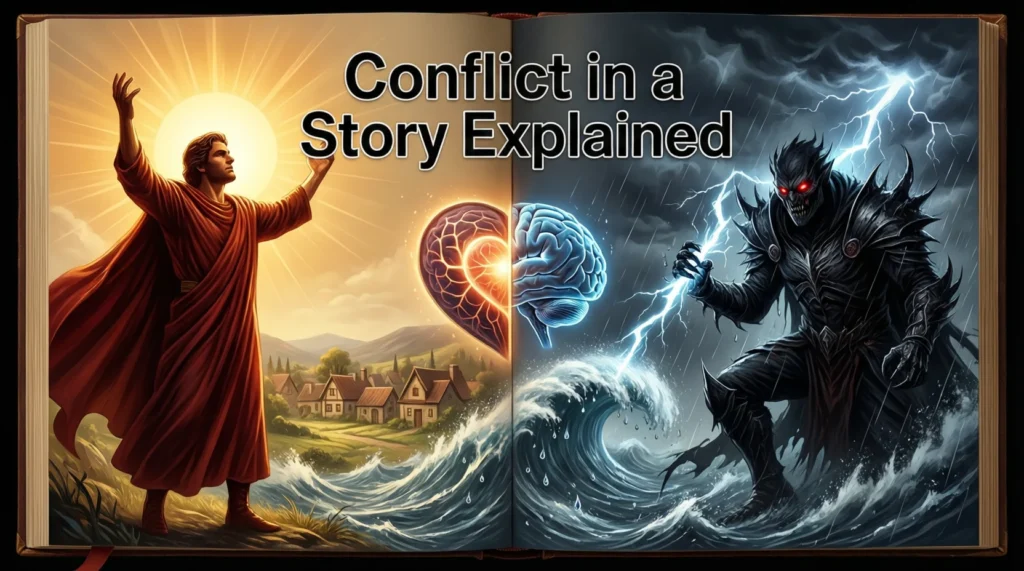
In a story, conflict means the main problem, struggle, or tension that drives the plot forward by challenging the characters and forcing them to act, change, or make decision
Conflict is the heartbeat of storytelling. Without it, a story feels flat no stakes, no tension, no reason to keep reading. Whether it’s a hero battling a villain, a character wrestling with self-doubt, or a family torn apart by secrets, conflict is what makes stories meaningful, memorable, and emotionally engaging.
This guide breaks down what conflict means in a story, why it matters, the different types of conflict, and how writers use it to create powerful narratives. You’ll also see clear examples, comparisons with related terms, a helpful table, FAQs, and practical tips everything you need to fully understand conflict in storytelling.
What Is Conflict in a Story?
At its core, conflict in a story is a struggle between opposing forces. These forces can be:
- Two characters
- A character and society
- A character and nature
- A character and their own thoughts or emotions
Conflict creates tension, raises questions, and keeps readers curious. It answers the silent question every reader asks:
👉 What will happen next?
Without conflict:
- There’s no plot movement
- Characters don’t grow
- The story lacks purpose
With conflict:
- The plot develops
- Characters face challenges
- The story feels alive
Why Conflict Is So Important in Storytelling
Conflict is not optional—it’s essential. Every successful story, from fairy tales to blockbuster movies, is built around conflict.
Key Reasons Conflict Matters
- Drives the plot forward
- Reveals character traits
- Creates emotional engagement
- Builds suspense and tension
- Leads to growth or change
Think of conflict as the engine of a story. The characters are the car, the plot is the road, but conflict is the fuel.
Origin of the Term “Conflict” in Literature
The word conflict comes from the Latin term conflictus, meaning to strike together or clash. Over time, the word evolved to describe struggles, disagreements, and opposition.
Conflict in Literary History
- Ancient Greek drama focused on fate vs free will
- Shakespearean plays explored internal and external conflicts
- Modern fiction blends emotional, social, and psychological struggles
As storytelling evolved, conflict became more layered—moving beyond simple good vs evil to include complex emotional and moral struggles.
Popularity and Real-World Usage of Conflict in Stories
Conflict isn’t just a literary concept—it mirrors real life.
Where We See Story Conflict Today
- Novels and short stories
- Movies and TV shows
- Video games
- Comics and graphic novels
- Personal narratives and memoirs
Even reality shows rely on conflict to stay interesting. Humans naturally connect with stories that reflect real struggles, choices, and consequences.
The Main Types of Conflict in a Story
Most stories use one main conflict, but many combine several. Below are the most common types taught in literature and creative writing.
1. Character vs Character
A struggle between two people or groups.
- Hero vs villain
- Rivalries
- Family disputes
Example:
Harry Potter vs Voldemort 🪄
2. Character vs Self
A struggle within a character’s mind or heart.
- Fear
- Guilt
- Doubt
- Moral dilemmas
Example:
A character choosing between ambition and honesty 💭
3. Character vs Society
A character challenges social rules, laws, or traditions.
- Discrimination
- Injustice
- Cultural pressure
Example:
A rebel fighting against an unfair government ⚖️
4. Character vs Nature
A character faces natural forces.
- Storms
- Wilderness
- Illness
Example:
Surviving alone in the wild 🌲
5. Character vs Technology or Supernatural Forces
A modern and popular type of conflict.
- AI or machines
- Monsters
- Magic
- Supernatural beings
Example:
Humans vs artificial intelligence 🤖
Labeled Example Table: Types of Conflict in Stories
| Type of Conflict | Description | Example |
|---|---|---|
| Character vs Character | One character opposes another | Hero vs villain |
| Character vs Self | Internal emotional struggle | Fear of failure |
| Character vs Society | Clash with social rules or norms | Standing up to injustice |
| Character vs Nature | Battle against natural forces | Surviving a storm |
| Character vs Supernatural | Facing unreal or magical forces | Fighting a monster |
Conflict vs Plot vs Theme
These terms are often confused, but they play different roles in a story.
Conflict vs Plot
- Conflict: The problem or struggle
- Plot: The sequence of events caused by the conflict
👉 Conflict creates the plot.
Conflict vs Theme
- Conflict: What happens
- Theme: What the story is about (message or lesson)
👉 Conflict helps reveal the theme.
Examples of Conflict in Context
While conflict itself isn’t a tone-based word, how it’s described can feel different depending on context.
Friendly or Neutral Example 😊
- The story’s conflict centers on a young girl learning to believe in herself.
Academic or Professional Example 📘
- The novel explores internal conflict as a driving force behind character development.
Negative or Dismissive Example 😒
- The conflict feels forced and lacks emotional depth.
Alternate Meanings of Conflict
Outside of storytelling, conflict can also mean:
- A disagreement between people
- A political or military struggle
- A workplace dispute
However, in literature and storytelling, conflict always refers to narrative tension and struggle, not just arguments.
Polite and Professional Alternatives to the Word “Conflict”
In formal writing or analysis, you may want alternatives depending on tone.
Professional or Academic Alternatives
- Central struggle
- Narrative tension
- Core challenge
- Dramatic opposition
Creative Writing Alternatives
- The problem
- The obstacle
- The challenge
- The clash
How Writers Effectively Use Conflict
Good writers don’t just add conflict—they develop it carefully.
Tips for Using Conflict Well
- Make it meaningful, not random
- Tie it closely to the character’s goals
- Raise the stakes gradually
- Allow consequences
- Resolve it in a satisfying way
A strong conflict should feel necessary, not forced.
Common Mistakes Writers Make with Conflict
Avoid these pitfalls:
- Conflict that resolves too quickly
- Stakes that feel too small
- Repetitive conflicts with no growth
- Conflict unrelated to character goals
Great conflict always pushes the story forward.
FAQs:
1. What is conflict in a story in simple words?
Conflict is the main problem or struggle that characters face, which makes the story interesting.
2. Can a story have more than one conflict?
Yes. Many stories have a main conflict and several smaller ones.
3. Is conflict always negative?
No. Conflict creates growth, change, and learning in stories.
4. What is internal conflict in a story?
Internal conflict happens inside a character’s mind or emotions.
5. Why is conflict important in literature?
Conflict drives the plot, develops characters, and keeps readers engaged.
6. Can a story exist without conflict?
Not effectively. Without conflict, there is no tension or purpose.
7. How do you identify conflict in a story?
Look for the main problem the character is trying to solve.
8. What is the most common type of conflict?
Character vs character is the most common, but internal conflict is equally powerful.
Conclusion:
In storytelling, conflict is the central struggle that gives a story its purpose and power. It is the problem that characters must face, the challenge that pushes them to make choices, and the tension that keeps readers turning pages. Without conflict, a story feels empty but with it, the plot moves forward, emotions deepen, and characters grow.
Whether the conflict is internal (within a character) or external (against another character, society, nature, or forces beyond control), it shapes the entire narrative. Understanding conflict helps readers analyze stories more clearly and helps writers create stronger, more engaging plots.
Discover More Articles About:
- What Does “Qué” Mean in Spanish? Definition, Uses, Examples & Tips 2026
- What Does Love Mean in Tennis? Definition, Origin And Examples 2026

Justin Young is a passionate Digital Creator and Content Writer who specializes in crafting engaging, informative, and results-driven content. He focuses on creating high-quality, blog posts, and digital content that capture attention and deliver real value to readers. With a strong interest in storytelling, trends, and online growth, Justin helps brands and individuals connect with their audiences through clear, impactful, and creative writing.