
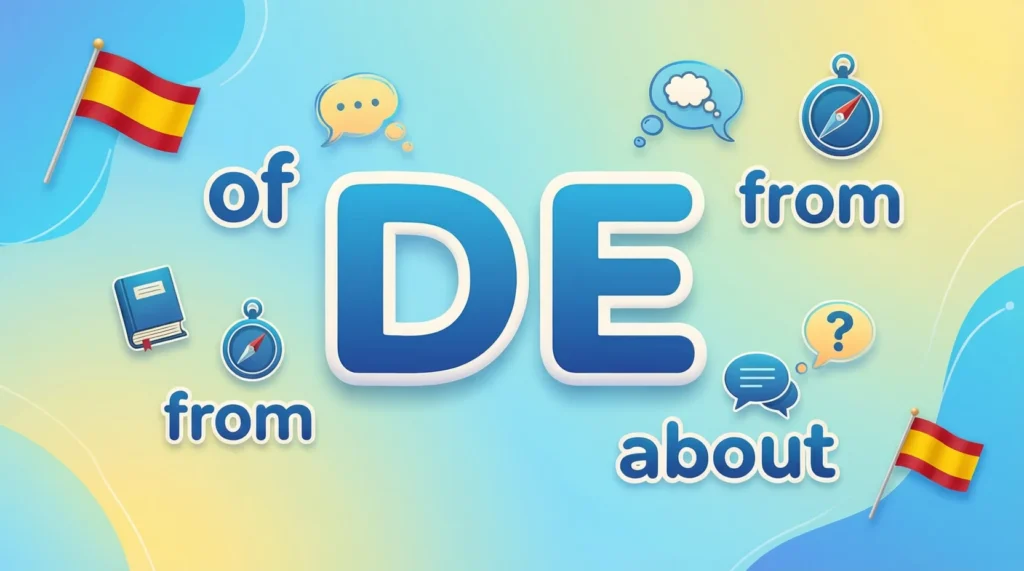
Definition: “De” in Spanish is a preposition that commonly means “of,” “from,” or “about,” depending on the context.
It is used to show possession, origin, material, cause, topic, and relationships between words.
If you’ve started learning Spanish or even just glanced at Spanish text you’ve probably seen the tiny word “de” everywhere. It may look simple, but “de” is one of the most powerful and flexible words in the Spanish language.
This small word does a lot of heavy lifting. In fact, native speakers use “de” hundreds of times a day, often without realizing how essential it is. In this guide, you’ll learn exactly what “de” means, how to use it naturally, when not to use it, and how it compares to similar Spanish words.
Let’s break it down in a friendly, practical way no confusion, no grammar overload 😊
Why “De” Matters So Much in Spanish
Spanish relies heavily on prepositions to connect ideas, and “de” is the most common one. Without it, sentences often sound broken or unclear.
Think of “de” as a connector word that explains:
- Who something belongs to
- Where something comes from
- What something is made of
- What someone is talking about
Mastering “de” early will instantly improve your Spanish fluency.
Origin of the Word “De”
The Spanish “de” comes from the Latin word “dē”, meaning:
- Down from
- Away from
- Concerning
Over centuries, Spanish kept the word but expanded its meaning. Today, “de” appears in nearly every type of sentence, from casual conversations to legal documents.
Fun fact:
“De” is among the top 5 most frequently used words in Spanish, alongside el, la, y, and que.
Core Meanings of “De” in Spanish
Although “de” has many uses, most fall into these core meanings:
| Meaning | English Equivalent |
|---|---|
| Possession | of |
| Origin | from |
| Material | made of |
| Topic | about |
| Cause | because of |
| Relationship | belonging to |
Let’s explore each one with clear examples.
1. “De” to Show Possession
One of the most common uses of “de” is to show ownership or belonging.
Examples
- El libro de María → The book of María
- La casa de mi amigo → My friend’s house
- El color del coche → The color of the car
🔹 Spanish does not use apostrophe-s like English.
Instead of María’s book, Spanish says el libro de María.
Tone: Neutral and natural
Used in: Everyday speech, writing, formal contexts
2. “De” to Show Origin
When talking about where someone or something comes from, “de” means “from.”
Examples
- Soy de España → I’m from Spain
- Este vino es de Chile → This wine is from Chile
- Vengo de la oficina → I’m coming from the office
🌍 This is extremely common when discussing nationality or location.
Tone: Friendly or neutral
Context: Introductions, travel, background info
3. “De” to Describe Material
Use “de” to describe what something is made from.
Examples
- Una mesa de madera → A wooden table
- Un anillo de oro → A gold ring
- Una camisa de algodón → A cotton shirt
This works for physical materials and even abstract qualities.
Tone: Neutral
Context: Shopping, descriptions, product details
4. “De” to Talk About Topics
When discussing a subject, “de” often means “about.”
Examples
- Hablamos de música → We talked about music
- Un libro de historia → A history book
- Estoy pensando de ti ❌ (Incorrect)
- Estoy pensando en ti ✅ (Correct)
⚠️ Tip: Not all verbs use “de” for “about.” Some use “en” instead.
5. “De” to Explain Cause or Reason
“De” can show why something happened.
Examples
- Murió de hambre → He died of hunger
- Estoy cansado de trabajar → I’m tired of working
- Lloró de alegría → She cried from happiness
❤️ Emotional and physical causes often use “de.”
6. “De” in Descriptions & Relationships
Spanish frequently uses “de” to connect descriptions.
Examples
- Un hombre de palabra → A man of his word
- Una persona de confianza → A trustworthy person
- Gente de aquí → People from here
This use feels very natural and idiomatic.
Common Fixed Expressions with “De”
Spanish has many set phrases using “de” that you’ll hear constantly.
| Expression | Meaning |
|---|---|
| De acuerdo | Agreed / Okay |
| De nada | You’re welcome |
| De repente | Suddenly |
| De verdad | Really / Truly |
| De hecho | In fact |
💡 These phrases should be memorized as complete units.
Tone Differences When Using “De”
“De” itself is neutral, but the surrounding words affect tone.
Friendly Tone 😊
- De verdad, gracias → Truly, thank you
- Un amigo de confianza → A trusted friend
Neutral Tone
- Libro de texto → Textbook
- Mesa de trabajo → Work table
Negative or Dismissive Tone 😒
- Estoy harto de esto → I’m sick of this
- Cansado de tus excusas → Tired of your excuses
Tone comes from context—not from “de” alone.
Comparison: “De” vs Similar Spanish Words
“De” vs “Desde”
| Word | Meaning | Example |
|---|---|---|
| De | From (general) | Soy de México |
| Desde | From (starting point) | Desde ayer |
Desde emphasizes a starting time or place.
“De” vs “En”
| Word | Meaning | Example |
|---|---|---|
| De | Origin / possession | Soy de Perú |
| En | Location | Estoy en Perú |
“De” vs “Por”
| Word | Meaning | Example |
|---|---|---|
| De | Cause / origin | Murió de frío |
| Por | Reason / exchange | Lo hice por ti |
These two confuse learners the most—but context always decides.
Alternate Meanings of “De”
While “de” is mainly a preposition, it can also appear:
- In names (e.g., Miguel de Cervantes)
- In titles (Rey de España)
- In poetic or formal writing
It does not change form and is never plural.
Polite & Professional Alternatives (When Applicable)
Sometimes, Spanish speakers avoid repeating “de” by rephrasing:
- El coche de Juan → El coche que es de Juan (formal emphasis)
- Hablamos de eso → Tratamos ese tema (professional tone)
Useful in writing, presentations, or formal speech.
Common Mistakes with “De” (And How to Avoid Them)
❌ Incorrect: Pienso de ti
✅ Correct: Pienso en ti
❌ Incorrect: Depende en el clima
✅ Correct: Depende del clima
💡 Many verbs require specific prepositions—always learn verbs with their preposition.
Example Table: “De” in Real-Life Sentences
| Sentence | Meaning | Use |
|---|---|---|
| El café es de Colombia | The coffee is from Colombia | Origin |
| Una taza de vidrio | A glass cup | Material |
| Hablamos de trabajo | We talked about work | Topic |
| Estoy cansado de correr | I’m tired of running | Cause |
| El hijo de Ana | Ana’s son | Possession |
Conclusion
The Spanish word “de” may be short, but its impact on the language is huge. It plays a key role in expressing possession, origin, material, cause, and topics, making it one of the most frequently used and essential prepositions in Spanish. While it often translates to “of,” “from,” or “about,” its true meaning always depends on context.
By understanding how “de” works in real life sentences and by learning which verbs naturally pair with it you can avoid common mistakes and sound far more natural when speaking or writing Spanish. The best approach is regular exposure: read, listen, and practice using “de” in everyday phrases rather than translating word-for-word from English.
FAQs
1. What does “de” usually mean in Spanish?
It usually means of, from, or about, depending on context.
2. Is “de” always translated the same way?
No. Its meaning changes based on how it’s used in the sentence.
3. Is “de” formal or informal?
It’s neutral and used in all levels of speech.
4. How do I know when to use “de” or “en”?
Use de for origin or possession; en for location or position.
5. Can a sentence have more than one “de”?
Yes! Spanish often repeats “de” naturally.
6. What verbs commonly use “de”?
Depender de, hablar de, cansarse de, tratar de.
7. Does “de” ever change form?
No. It never changes for gender or number.
8. Is “del” the same as “de”?
Del = de + el. It’s a contraction used before masculine nouns.
Discover More Articles About:
- What Does Conflict Mean in a Story? Definition, Examples, and Types 2026
- What Does PO Mean in Baseball? Definition, Usage And Examples 2026

Justin Young is a passionate Digital Creator and Content Writer who specializes in crafting engaging, informative, and results-driven content. He focuses on creating high-quality, blog posts, and digital content that capture attention and deliver real value to readers. With a strong interest in storytelling, trends, and online growth, Justin helps brands and individuals connect with their audiences through clear, impactful, and creative writing.