ERA (Earned Run Average) is a pitching statistic in baseball that measures the average number of earned runs a pitcher allows per nine innings. It shows how effective a pitcher is at preventing runs that are not caused by fielding errors or passed balls.
ERA is one of the first baseball stats fans hear and one of the most misunderstood. You’ll see it on TV graphics, player cards, fantasy rankings, and Hall of Fame debates. But what does it really tell you about a pitcher?
Below is a clear, friendly, and complete guide to what ERA means in baseball, how it’s calculated, why it matters, when it can mislead you, and how it compares to newer pitching stats.
Simple definition:
👉 ERA tells you how many runs a pitcher typically gives up in a full game.
Why ERA Matters in Baseball
ERA is popular because it’s:
- Easy to understand
- Quick to compare pitchers
- Deeply tied to scoring and winning
- Used historically across all eras of baseball
However, like any stat, ERA tells part of the story not the whole story.
What Does ERA Stand For?
ERA = Earned Run Average
- Earned run: A run that scores without help from defensive errors or passed balls
- Average: Calculated over nine innings (a full game)
Unearned runs do not count toward ERA.
How Is ERA Calculated? (Formula Explained)
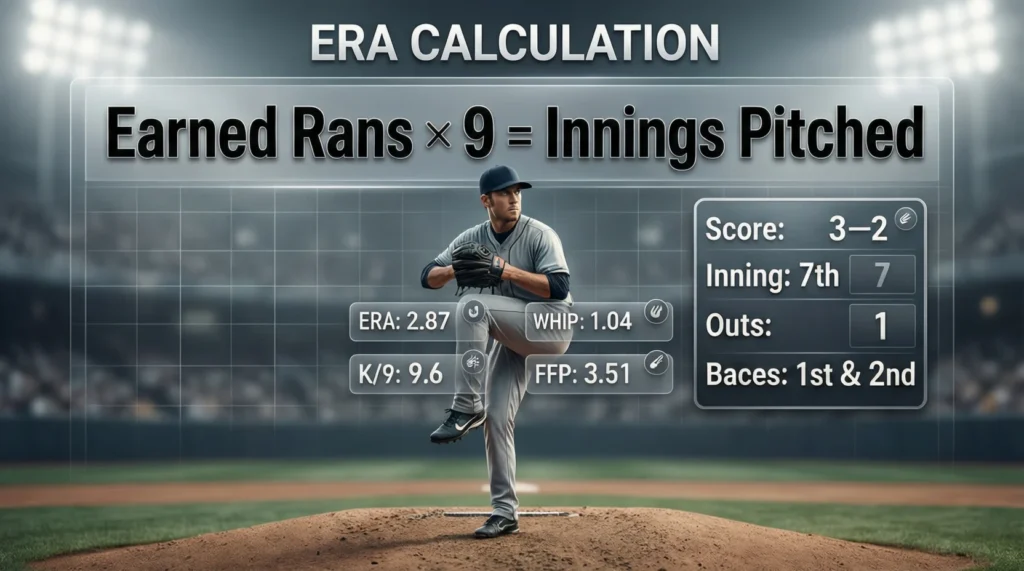
ERA Formula
ERA=Earned Runs Allowed×9Innings Pitched\text{ERA} = \frac{\text{Earned Runs Allowed} \times 9}{\text{Innings Pitched}}ERA=Innings PitchedEarned Runs Allowed×9
Simple Example
- Earned runs allowed: 20
- Innings pitched: 100
(20×9)÷100=1.80ERA(20 × 9) ÷ 100 = 1.80 ERA(20×9)÷100=1.80ERA
👉 This pitcher allows 1.8 earned runs per nine innings, which is elite.
ERA Example Table (Labeled for Easy Understanding)
| Pitcher | Earned Runs | Innings Pitched | ERA | What It Means |
| Pitcher A | 12 | 60 | 1.80 | Dominant |
| Pitcher B | 30 | 90 | 3.00 | Very good |
| Pitcher C | 45 | 90 | 4.50 | League average |
| Pitcher D | 60 | 90 | 6.00 | Struggling |
What Is a “Good” ERA in Baseball?
ERA standards change slightly by era, league, and ballpark, but here’s a modern general guide:
ERA Scale (MLB)
- Below 2.50 → Elite / Cy Young level
- 2.50–3.50 → Excellent
- 3.50–4.20 → Above average
- 4.20–4.80 → Average
- 5.00+ → Below average
📌 Context matters: A 3.80 ERA in Coors Field can be more impressive than a 3.20 ERA in a pitcher-friendly park.
Origin of ERA: Where Did It Come From?
ERA dates back to the early 20th century, gaining widespread use in the 1910s and 1920s.
Why ERA Was Created
Before ERA, pitchers were judged mainly by:
- Wins and losses
- Reputation
- Team success
ERA helped separate pitching performance from team offense and defense, at least partially.
Why ERA Became So Popular
ERA became baseball’s go-to pitching stat because:
- It connects directly to runs (the goal of the game)
- It’s easy for fans to understand
- It allows comparisons across pitchers and seasons
- It fits neatly into box scores and broadcasts
Even today, ERA remains one of the first stats mentioned when discussing pitchers.
Real-World Usage of ERA
You’ll see ERA used in:
- TV broadcasts and score bugs
- Baseball cards and player profiles
- Fantasy baseball rankings
- Award voting (Cy Young)
- Contract negotiations
- Hall of Fame debates
Example Commentary (Neutral Tone)
He’s carrying a 2.95 ERA into tonight’s start.
Example Commentary (Positive Tone)
A sub-2.50 ERA puts him firmly in Cy Young contention 🔥
Example Commentary (Critical Tone)
His ERA ballooned after a rough stretch of outings.
Earned Runs vs Unearned Runs (Important Distinction)
Not all runs count toward ERA.
Earned Runs (Count Toward ERA)
- Home runs
- RBI singles and doubles
- Sacrifice flies
- Walks with bases loaded
Unearned Runs (Do NOT Count)
- Runs after fielding errors
- Runs after passed balls
- Runs scored due to catcher interference
👉 This is why ERA can sometimes hide defensive problems behind a pitcher.
Starter ERA vs Reliever ERA
ERA works differently depending on role.
Starting Pitchers
- Pitch longer outings
- ERA stabilizes over time
- Influenced by defense and bullpen
Relief Pitchers
- Smaller sample sizes
- One bad outing can spike ERA
- Often lower ERAs due to shorter stints
📌 Always consider innings pitched alongside ERA.
ERA by Baseball Era (Historical Context)
ERA numbers change based on:
- Ball composition
- Strike zone rules
- Offensive trends
- Pitching usage
Example Eras
- Dead-ball era: ERAs under 2.00 were common
- Steroid era: 4.50 ERA could still be impressive
- Modern era: League average ~4.20
This is why raw ERA comparisons across decades can be misleading.
Limitations of ERA (What It Doesn’t Tell You)
ERA is useful but imperfect.
Major Limitations
- Depends on team defense
- Affected by ballpark size
- Doesn’t account for luck
- Penalizes pitchers for inherited runners
- Treats all hits the same
Because of this, analysts often pair ERA with advanced stats.
ERA vs Similar Baseball Stats (Comparison Table)
| Stat | What It Measures | How It Differs from ERA |
| WHIP | Walks + hits per inning | Focuses on baserunners, not runs |
| FIP | Pitcher-only outcomes | Removes defense and luck |
| xERA | Expected ERA | Based on contact quality |
| ERA+ | League-adjusted ERA | Accounts for era and ballpark |
| RA/9 | Runs allowed per 9 innings | Includes unearned runs |
ERA vs FIP: Which Is Better?
ERA
- Shows actual results
- Easy to understand
- Influenced by defense and luck
FIP (Fielding Independent Pitching)
- Uses strikeouts, walks, HRs
- More predictive
- Less intuitive for casual fans
👉 Best practice: Use ERA for results, FIP for evaluation.
Alternate Meanings of ERA
Outside baseball, ERA can also mean:
- Historical era (e.g., modern era)
- Equal Rights Amendment
- Economic Recovery Act
📌 In baseball contexts, ERA almost always means Earned Run Average.
Polite or Professional Alternatives When Discussing Pitching
Instead of focusing only on ERA, analysts may say:
- Run prevention ability
- Overall pitching effectiveness
- Scoring suppression
- Performance per nine innings
These phrases sound more analytical and less stat-focused.
Usage Tips: How to Read ERA Like a Pro
- Compare ERA to league average
- Check innings pitched
- Consider ballpark factors
- Pair ERA with WHIP or FIP
- Look at trends, not just one number
📊 A falling ERA often signals improvement even if wins don’t show it yet.
FAQs
What does ERA stand for in baseball?
ERA stands for Earned Run Average, a stat that measures how many earned runs a pitcher allows per nine innings.
How is ERA calculated?
ERA is calculated by multiplying earned runs by nine and dividing by innings pitched.
What is considered a good ERA?
In modern MLB, an ERA under 3.50 is considered very good, while anything below 2.50 is elite.
Does ERA include unearned runs?
No. ERA only counts earned runs, not runs caused by defensive errors or passed balls.
Is a lower ERA always better?
Yes. A lower ERA means the pitcher allows fewer runs on average.
Why do relief pitchers often have lower ERAs?
Relievers pitch fewer innings, often face fewer batters, and can benefit from smaller sample sizes.
Is ERA still relevant today?
Yes, but it’s best used alongside advanced stats like FIP, WHIP, and ERA+.
Can ERA be misleading?
Yes. ERA can be affected by defense, luck, ballparks, and bullpen support.
Conclusion:
ERA remains one of baseball’s most trusted and recognizable pitching stats because it connects directly to the game’s ultimate goal preventing runs.

Justin Young is a passionate Digital Creator and Content Writer who specializes in crafting engaging, informative, and results-driven content. He focuses on creating high-quality, blog posts, and digital content that capture attention and deliver real value to readers. With a strong interest in storytelling, trends, and online growth, Justin helps brands and individuals connect with their audiences through clear, impactful, and creative writing.