
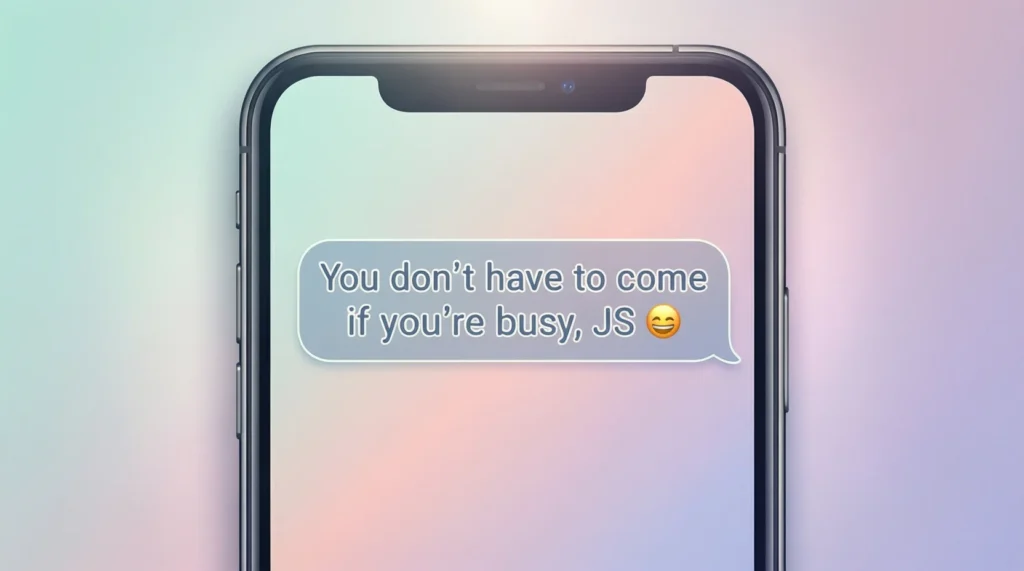
JS in text messaging most commonly means just saying.
It’s used to add a casual tone, soften an opinion, or show that the sender is sharing a thought without pressure, judgment, or argument.
JS is one of those tiny text abbreviations that can completely change the tone of a message depending on how it’s used. You might see it at the end of a sentence, dropped casually in a chat, or added to soften something that could otherwise sound blunt.
So, what does JS mean in text?
Short definition:
JS = Just saying
Why “JS” Matters in Modern Texting
Texting doesn’t have a tone of voice or facial expressions. That’s why people rely on short abbreviations like JS to signal intent.
Adding JS helps the sender say:
- I’m not trying to argue
- Don’t take this too seriously
- I’m sharing an opinion, not making a demand
- No pressure do what you want
In short, JS is a tone softener.
Origin of “JS” in Text and Online Chat
Where did JS come from?
- Originated from early SMS texting and online chatrooms
- Became popular on platforms like:
- SMS and instant messaging
- Facebook Messenger
- WhatsApp
- Instagram DMs
- Snapchat
- Discord
- SMS and instant messaging
Why abbreviations like JS became popular
- Character limits in early texting
- Faster typing on small keyboards
- Casual, conversational online culture
- Need to express tone quickly
Just saying became JS because it’s short, intuitive, and easy to recognize.
How JS Is Commonly Used in Text Messages
General Usage Pattern
JS usually appears:
- At the end of a sentence
- Occasionally in the middle for emphasis
- Rarely at the beginning
It works like a disclaimer or emotional cushion.
Real-World Examples of JS in Text
Friendly / Casual Tone 😊
- You’d probably like that movie, JS
- That shirt looks great on you, JS
- You could come with us if you want, JS
👉 Meaning: A relaxed suggestion with no pressure.
Neutral / Informational Tone 😐
- The meeting usually starts at 9, JS
- Traffic gets bad after 5, JS
👉 Meaning: Sharing information, not telling someone what to do.
Slightly Blunt but Softened 😅
- That plan might not work, JS
- You’ve been late a lot this week, JS
👉 Meaning: Honest feedback, softened to avoid sounding harsh.
Passive-Aggressive (Context Matters) 😬
- Must be nice to have free time, JS
- Guess I’ll do it myself again, JS
👉 Meaning: Can sound sarcastic depending on tone and relationship.
Labeled Example Table: JS in Text Messages
| Message Example | Tone | What JS Is Doing |
| You don’t have to reply now, JS | Friendly | Removes pressure |
| That deadline is today, JS | Neutral | States a fact casually |
| You could help too, JS | Slightly blunt | Softens criticism |
| Must be nice, JS | Sarcastic | Adds passive tone |
When You Should (and Shouldn’t) Use JS
Good Times to Use JS ✅
- Casual conversations with friends
- Sharing opinions
- Making suggestions
- Giving light feedback
- Ending a message gently
Times to Avoid JS ❌
- Professional emails
- Work reports
- Customer service replies
- Serious or emotional conversations
- Apologies or conflict resolution
In formal settings, JS can sound unprofessional or dismissive.
Is JS Rude or Polite? Tone Breakdown
JS itself is not rudebut tone depends on:
- Message content
- Relationship between sender and receiver
- Emojis or punctuation
- Context of the conversation
Compare these two:
- You’re wrong, JS 😬
- You might be mistaken, JS 😊
Same abbreviation, very different impact.
Comparison: JS vs Similar Text Abbreviations
JS vs IMO
| Abbreviation | Meaning | Tone |
| JS | Just saying | Casual, soft |
| IMO | In my opinion | Slightly more formal |
JS vs FYI
| Abbreviation | Meaning | Tone |
| JS | Just saying | Friendly |
| FYI | For your information | Direct, sometimes blunt |
JS vs TBH
| Abbreviation | Meaning | Tone |
| JS | Just saying | Light |
| TBH | To be honest | More serious |
Alternate Meanings of JS
While just saying is by far the most common meaning, JS can also stand for other things depending on context:
Possible Alternate Meanings
- JavaScript (mostly in tech or coding conversations)
- Jokingly serious (rare, informal use)
- John Smith (as initials)
- Junior/Senior (very context-specific)
⚠️ In texting and social media, just saying is almost always the intended meaning.
Polite and Professional Alternatives to JS
If you’re writing something more formal or professional, consider these instead:
Better Alternatives
- Just a suggestion
- For your awareness
- In case it helps
- I wanted to mention
- From my perspective
- Kindly note
These maintain clarity without sounding casual or dismissive.
How JS Is Used Across Platforms
Text Messages & WhatsApp
Very common and casual
Snapchat & Instagram DMs
Often paired with emojis 😅🙂
Twitter / X
Used for commentary or opinions
Workplace Chat Apps (Slack, Teams)
Use cautiously can sound passive-aggressive
FAQs:
1. What does JS stand for in texting?
JS stands for just saying in casual text messages.
2. Is JS rude in text messages?
Not by itself. It depends on tone, context, and wording.
3. Can JS be sarcastic?
Yes. In some situations, JS can sound sarcastic or passive-aggressive.
4. Is JS used by younger people?
Yes. Teens and young adults use it frequently, but all age groups understand it.
5. Does JS mean JavaScript in text?
Only in tech-related conversations. In normal texting, it means just saying.
6. Should I use JS at work?
It’s better to avoid it in professional or formal communication.
7. Is JS the same as IMO?
No. JS softens a statement, while IMO clearly marks an opinion.
8. Can JS be used with emojis?
Yes. Emojis often help clarify tone when using JS.
Practical Tips for Using JS Correctly
- Use JS to soften, not to insult
- Avoid JS when emotions are high
- Add emojis if tone could be unclear
- Skip JS in professional writing
- Read the message out loud before sending
Conclusion:
JS means just saying, and it plays an important role in modern digital communication. It helps soften opinions, reduce pressure, and keep conversations casual and friendly. However, tone and context mattera lot.
Used correctly, JS makes your message feel relaxed and approachable. Used poorly, it can sound sarcastic or dismissive. Understanding when and how to use it is the key.
If you’re ever unsure, choosing a clearer or more polite alternative is always a safe move.

Michael Johnson is a seasoned Content Expert and digital communication specialist with a proven track record in content creation, strategy, and audience engagement. His work goes beyond writing he crafts meaningful, results driven content that helps businesses achieve growth, brand visibility, and audience trust.