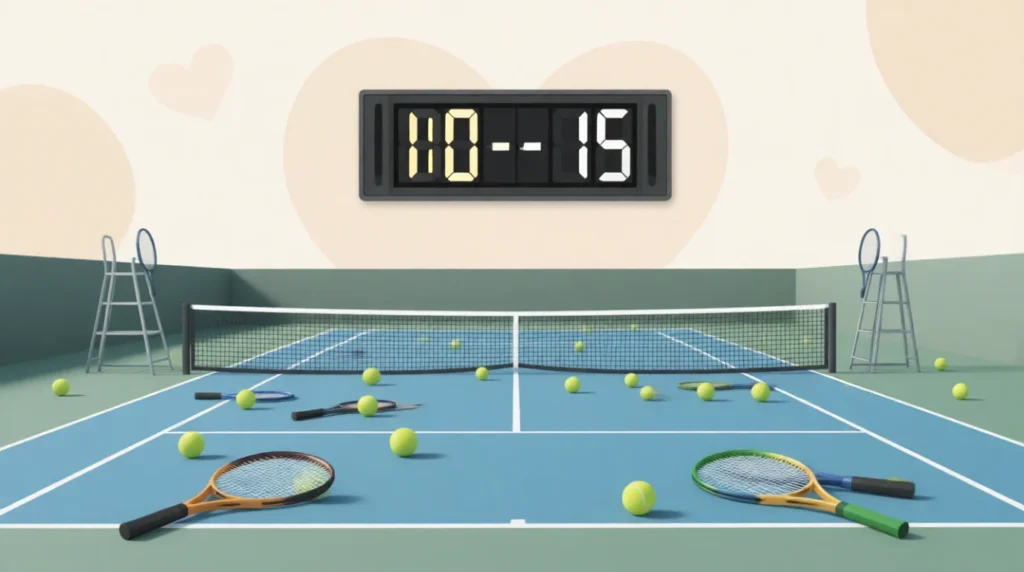
In tennis, “love” means zero points.
When a player has not scored any points in a game, their score is called love. For example, a score of 15–love means one player has 15 points while the other has zero.
If you’re new to tennis or even if you’ve watched it for years you’ve probably wondered: what does love mean in tennis, and why does zero sound so romantic? ❤️🎾
Unlike most sports that simply say zero, tennis uses the unique term love to represent no points at all. This quirky word has sparked curiosity, debates, and even myths among fans, players, and commentators worldwide.
In this indepth guide, we’ll break down:
- The exact meaning of love in tennis
- Where the term came from
- How it’s used in real matches
- Examples with tone and context
- Comparisons with similar tennis scoring terms
- Common FAQs people search online
By the end, you’ll fully understand why love = zero in tennis and you’ll never hear a tennis score the same way again.
What Does Love Mean in Tennis?
In tennis scoring:
- Love = 0 points
- It applies to games, not sets or matches directly
Basic Tennis Scoring Refresher
A standard tennis game goes like this:
- Love (0)
- 15
- 30
- 40
- Game
So when you hear:
- Love–love → both players have 0 points
- 30–love → one player has 30 points, the other has 0
- Love–40 → one player has no points, the other is one point away from winning the game
The Origin of “Love” in Tennis
Theory 1: French Origin (Most Accepted) 🇫🇷
The most widely accepted explanation is that love comes from the French word l’œuf, meaning egg.
Why an egg?
- An egg looks like a zero (0)
- Tennis has strong French roots
- Early tennis (jeu de paume) was played in France
Over time:
- L’œuf → pronounced similarly to love
- English speakers adopted the word as love
Theory 2:
Playing for the Love of the Game
Another popular (but less likely) theory suggests:
- Players with zero points were said to be playing for love, not money or reward
While romantic, historians consider this explanation more folklore than fact.
Which Theory Is Correct?
Most tennis historians and linguists agree:
- ✅ French “l’œuf” theory is the most credible
Why Is “Love” Still Used Today?
Tennis traditions run deep, and scoring terminology is rarely changed.
Reasons love remains part of tennis:
- It’s globally recognized
- It preserves the sport’s history
- It adds character and uniqueness
- Fans instantly understand it
Unlike many sports that modernize language, tennis proudly keeps its classic terms love, deuce, advantage, and break.
How Love Is Used in Real Tennis Matches
Live Match Commentary Examples
- Love–love, game just started
- Federer leads 40–love
- She’s down love–30 but fighting back
Scoreboard Usage
On professional scoreboards:
- Love may be shown as 0
- Commentators still say love out loud
Coaching & Casual Play
- Coaches often say zero in practice
- Referees always say love in official matches
Tone & Context of “Love” in Tennis
Unlike everyday language, love in tennis is neutral, but tone can change based on context.
Neutral Tone
- Love–15, early in the game
- Love–love at the start of a set
Negative or Dismissive Tone
- Won the game 40–love 😬
- Lost the set six games to love
Here, love highlights dominance or imbalance.
Friendly or Lighthearted Tone
- I got bageled six games to love 😂
- He served love–love aces all match
Examples of “Love” in Tennis
Casual Conversation
- He beat me 6–0. Total love set.
- We started love–love, but it got intense fast.
Professional Commentary
- Nadal holds serve at love.
- She breaks back after being down love–40.
Social Media
- Love games hit different 😅🎾
- Another love hold pure dominance 💪
Example Table: Love in Tennis Scoring
| Score Call | Meaning | Match Situation |
| Love–love | 0–0 | Start of a game |
| 15–love | 15–0 | One point won |
| Love–30 | 0–30 | Player struggling |
| 40–love | 40–0 | Near game win |
| Six games to love | 6–0 | Complete set dominance |
Love vs Other Tennis Scoring Terms
Comparison Table
| Term | Meaning | Used When |
| Love | 0 points | Any game |
| Deuce | 40–40 | Tied game |
| Advantage | One-point lead after deuce | Close games |
| Break | Winning opponent’s serve | Strategic moment |
| Bagel | 6–0 set | Slang (informal) |
Related Terms & Slang You Might Hear
- Bagel – winning a set 6–0
- Double bagel – winning 6–0, 6–0
- Golden love – winning a game without losing a point
- Love hold – holding serve without conceding points
Does “Love” Have Alternate Meanings?
Outside tennis, love usually means:
- Affection ❤️
- Care
- Strong liking
But in tennis:
- ❌ No emotional meaning
- ✅ Purely numerical (zero)
This contrast is why the term feels confusing but also memorable.
Polite or Professional Alternatives to Saying Love
In formal tennis:
- Love is standard and correct
In casual or instructional settings:
- Zero
- No points
Examples:
- The score is zero–15 (training context)
- Start at zero–zero (practice match)
Why Beginners Find Tennis Scoring Confusing
Common reasons:
- Love means zero (not intuitive)
- Numbers skip (15, 30, 40)
- Deuce and advantage add complexity
Tip for beginners:
Think of tennis scoring as language-based, not math-based.
Conclusion
So, what does love mean in tennis?
It simply means zero points, wrapped in centuries of tradition and linguistic history. While it sounds romantic, love in tennis is purely technical and that contrast is exactly why it stands out.
Whether you’re watching Wimbledon, playing with friends, or learning the rules for the first time, understanding love makes tennis scoring far less mysterious and far more enjoyable.
Once you know it, you’ll hear it everywhere and it’ll finally make perfect sense 🎾
FAQs
1. Why is zero called love in tennis?
Because it likely comes from the French word l’œuf, meaning egg, which looks like zero.
2. Does love mean anything else in tennis?
No. It strictly means zero points.
3. Is love used in other sports?
No. Love is unique to tennis scoring.
4. What does love–40 mean?
One player has zero points; the other has 40 and is close to winning the game.
5. Is love still used in modern tennis?
Yes. It’s used at all levels, from amateur to Grand Slam finals.
6. What is a love set?
A set won 6–0, where the opponent wins no games.
7. Do referees ever say zero instead of love?
In official matches, referees always say love.
8. Is love used in doubles tennis?
Yes. Scoring rules are the same in singles and doubles.
Discover More Related Articles:

Megan Lewis is a passionate and experienced content writer specializing in creating engaging and well-researched content. She excels at producing clear, informative, and reader-focused content that not only ranks well on search engines but also delivers real value to audiences.