
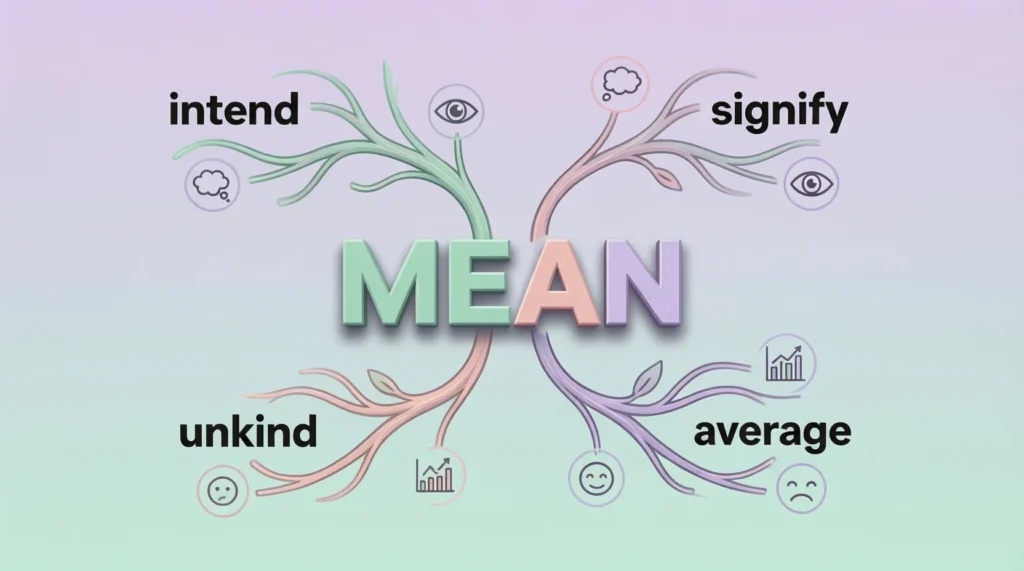
Mean in English is a versatile word that most commonly means to intend, to signify, or to be unkind, depending on context. It can function as a verb, adjective, or noun, and its meaning changes based on how and where it’s used in a sentence.
If you’ve ever asked yourself, “What does mean mean in English?” you’re not alone. 😊
The word mean is short, common, and deceptively tricky. Native speakers use it every day in casual conversation, professional settings, math classes, and even emotional situations. Yet for learners and even fluent speakers, mean can feel confusing because it carries multiple meanings, tones, and grammatical roles.
Sometimes mean is neutral and informative.
Sometimes it’s emotional or negative.
Sometimes it’s purely mathematical.
In this guide, we’ll break everything down clearly and conversationally with examples, tables, comparisons, tone explanations, and practical tips so by the end, you’ll fully understand how mean works in real English.
What Does “Mean” Mean in English?
At its core, mean answers one of these questions:
- What does something signify?
- What does someone intend?
- What kind of person is someone?
- What is the average of numbers?
The Four Main Meanings of “Mean”
- To signify or indicate
👉 What does this word mean? - To intend or plan
👉 I didn’t mean to hurt you. - Unkind or cruel (adjective)
👉 He was mean to his sister. - Average (noun, mathematics)
👉 The mean score was 75.
Grammatical Roles of “Mean”
| Form | Part of Speech | Example |
|---|---|---|
| Mean | Verb | What do you mean? |
| Mean | Adjective | That was a mean comment |
| Mean | Noun | The mean of the numbers |
Understanding the role of the word in a sentence is the key to understanding its meaning.
Origin and History of the Word “Mean”
The word mean comes from Old English “mænan”, meaning to intend, signify, or complain. Over centuries, it evolved through Middle English and absorbed multiple related meanings.
Why Does “Mean” Have So Many Meanings?
Because English often reuses words across:
- Emotion
- Intention
- Logic
- Mathematics
That’s how mean became a multi-purpose word instead of several separate ones.
Popularity and Real-World Usage
The word mean is:
- Among the top 1,000 most-used English words
- Common in daily speech, texting, school, and work
- Frequently searched by ESL learners
You’ll hear it in:
- Conversations
- Emails
- Classrooms
- Movies
- Arguments 😅
It’s unavoidable—so mastering it really matters.
Using “Mean” as a Verb
1. Mean = To Signify or Represent
This is the most neutral and common use.
Examples:
- What does this emoji mean? 🤔
- Red lights mean stop.
- This word means something different in British English.
Tone: Neutral, informative
2. Mean = To Intend or Plan
This use is about purpose, not outcome.
Examples:
- I didn’t mean to offend you.
- She means well, even if she sounds rude.
- Do you mean to leave early?
Tone: Often apologetic or explanatory
Using “Mean” as an Adjective
When mean describes a person or behavior, it usually means unkind, rude, or cruel.
Examples by Tone
Friendly / Light
- Don’t be mean, share the snacks 😄
Neutral
- His tone sounded mean.
Negative / Emotional
- She was really mean to me today.
- That comment was unnecessarily mean.
⚠️ Important:
Calling someone “mean” can feel personal or insulting, so use it carefully.
Using “Mean” as a Noun (Math & Statistics)
In mathematics, mean refers to the average.
Simple Definition:
Mean = Total ÷ Number of items
Example:
- Numbers: 10, 20, 30
- Mean: (10 + 20 + 30) ÷ 3 = 20
Common Contexts:
- Test scores
- Statistics
- Data analysis
Labeled Example Table: “Mean” in Different Contexts
| Context | Sentence | Meaning |
|---|---|---|
| Language | What does this mean? | Signify |
| Apology | I didn’t mean it | Intend |
| Personality | He is mean | Unkind |
| Math | The mean score is 80 | Average |
Tone Matters: How “Mean” Can Change Emotion
The same word can feel very different depending on tone and context.
- “What do you mean?” 😐 (neutral curiosity)
- “What do you mean?” 😠 (confusion or frustration)
- “I didn’t mean it” 😔 (regret)
Pro tip:
Tone often matters more than grammar when using “mean.”
Comparison With Similar Words
| Word | Meaning | Difference |
|---|---|---|
| Mean | Intend / signify | Broad, casual |
| Intend | Plan deliberately | More formal |
| Imply | Suggest indirectly | Subtle meaning |
| Average | Mathematical mean | Technical |
| Rude | Impolite behavior | Stronger than mean |
Alternate Meanings of “Mean”
- Mean street → Dangerous or tough
- Mean skill → Extremely good (slang)
- Mean business → Be serious
Example:
- He’s a mean guitarist 🎸 (positive slang)
Polite and Professional Alternatives to “Mean”
If “mean” sounds too emotional or harsh, try these:
For Intention
- Intend
- Plan
- Aim
For Unkind Behavior
- Insensitive
- Unprofessional
- Inconsiderate
For Clarification
- Could you clarify?
- What are you referring to?
- Could you explain?
Common Mistakes to Avoid
- ❌ Using “mean” without context
- ❌ Calling someone “mean” in professional emails
- ❌ Confusing mean (average) with median
FAQs
1. What does “mean” mean in simple English?
It usually means to intend, to signify, or to be unkind, depending on context.
2. Is “mean” always negative?
No. It can be neutral, positive, or negative.
3. What does “I didn’t mean it” mean?
It means I didn’t intend what happened or how it felt.
4. Is “mean” rude to say?
It can be, especially when describing a person.
5. What is mean in math?
It means average.
6. What does “mean well” mean?
It means having good intentions.
7. Can “mean” be slang?
Yes. It can mean excellent or impressive in casual speech.
8. How do I use “mean” politely?
Use it with explanations or choose softer alternatives.
Conclusion
The word mean may look simple, but it carries a wide range of meanings in English. Depending on how it’s used, mean can explain intention, describe unkind behavior, clarify meaning, or represent an average in mathematics. This flexibility is exactly why the word is so common and sometimes confusing.
The key to using mean correctly is paying attention to context, tone, and sentence structure. In casual conversations, it often expresses feelings or intentions. In professional or academic settings, it usually explains meaning or data.
Choosing the right context and knowing when to use polite alternatives helps avoid misunderstandings and makes your communication clearer and more natural.

Megan Lewis is a passionate and experienced content writer specializing in creating engaging and well-researched content. She excels at producing clear, informative, and reader-focused content that not only ranks well on search engines but also delivers real value to audiences.