
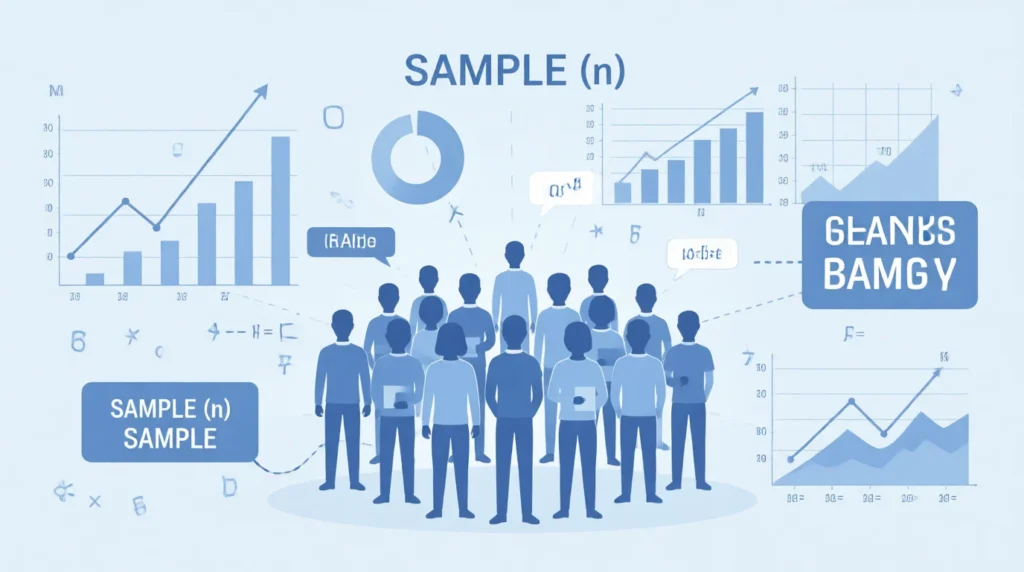
If you’ve ever taken a statistics class, read a research paper, or analyzed survey data, you’ve probably seen the letter n everywhere. It may look small and harmless, but n plays a massive role in how reliable, accurate, and trustworthy statistical results are.
Whether you’re:
- A student learning statistics 📚
- A researcher analyzing data 🔬
- A business owner reviewing surveys 📊
- Or just curious about numbers 🤔
Understanding what n means in statistics helps you interpret data correctly and avoid common mistakes.
This guide explains n from the ground up, using plain language, clear examples, tables, and real-world context no confusing math jargon required.
Definition:
In statistics, “n” represents the sample size, meaning the total number of observations, data points, or individuals included in a study or calculation.
In simple words, n tells you how much data you’re working with. The bigger the n, the more information you have.
What Does N Mean in Statistics?
In statistics:
- n = number of observations
- It can represent:
- Number of people surveyed
- Number of measurements taken
- Number of data values in a dataset
- Number of people surveyed
Simple Example
If you survey 50 students about their favorite subject:
- n = 50
If you record 120 daily temperatures:
- n = 120
👉 No data analysis can happen without knowing n first.
Origin and Meaning of “n” in Statistics
The use of n comes from mathematical notation, where letters are used to represent quantities.
Why the Letter “n”?
- Comes from words like:
- Number
- Numerus (Latin for number)
- Number
- Easy to recognize
- Universally accepted in mathematics and statistics
Over time, n became the standard symbol for sample size, while other letters took on specific roles (mean, variance, population size, etc.).
Why Is “n” So Important in Statistics?
The value of n directly affects the quality of your results.
Key Reasons n Matters
- ✅ Determines accuracy of results
- ✅ Impacts reliability and confidence
- ✅ Influences margin of error
- ✅ Affects statistical power
Bigger n vs Smaller n
- Large n → More reliable, stable results
- Small n → Higher risk of error or bias
📌 In most studies, increasing n improves confidence in conclusions.
How “n” Is Used in Real-World Statistics
You’ll see n used across many fields:
1. Academic Research
- Psychology experiments
- Medical trials
- Social science surveys
2. Business & Marketing
- Customer satisfaction surveys
- Product testing
- Market research
3. Healthcare & Medicine
- Clinical studies
- Drug trials
- Patient data analysis
4. Sports & Performance Analytics
- Player stats
- Game outcomes
- Training performance
5. Everyday Data Analysis
- Polls
- School test scores
- Fitness tracking
Examples of “n” in Statistics (With Context)
Friendly / Neutral Examples 😊
- The study included n = 300 participants.
- The average test score was calculated using n = 25 students.
- Survey results are based on n = 1,200 responses.
Professional / Academic Tone 📄
- Results were statistically significant with n = 500.
- The regression analysis used n = 82 observations.
Negative or Cautionary Context ⚠️
- The findings are unreliable due to a small n = 5.
- Conclusions may be biased because n is too low.
👉 Tone depends on context, but the meaning of n stays the same.
Sample Size (n) vs Population Size (N)
One of the most common sources of confusion is n vs N.
Key Difference Explained Simply
| Symbol | Meaning | Example |
| n | Sample size | Surveyed 100 people |
| N | Population size | Total population of 10,000 |
Example Scenario
- City population = N = 10,000
- Surveyed residents = n = 250
📌 n is always part of N, never bigger than it.
Labeled Example Table: Understanding n in Practice
| Scenario | Description | Value of n |
| Classroom quiz | Students who took the quiz | n = 30 |
| Online poll | Total responses received | n = 1,200 |
| Medical trial | Patients tested | n = 75 |
| Weather study | Days measured | n = 365 |
n in Common Statistical Formulas
You’ll see n in many formulas, including:
Mean (Average)
Mean=Sum of valuesn\text{Mean} = \frac{\text{Sum of values}}{n}Mean=nSum of values
Standard Deviation
- n affects how spread out the data appears
Standard Error
- Smaller n → larger error
- Larger n → smaller error
📌 Almost every statistical calculation depends on n.
What Is a “Good” Sample Size (n)?
There’s no universal perfect number, but here are general guidelines:
General Rules of Thumb
- n < 30 → Small sample
- n = 30–100 → Moderate sample
- n > 100 → Strong sample
- n > 1,000 → Very reliable (for surveys)
What Affects Ideal n?
- Type of study
- Desired accuracy
- Population size
- Available resources
Common Mistakes People Make With n
Avoid these common misunderstandings:
❌ Confusing n with N
❌ Ignoring small sample size warnings
❌ Assuming small n gives reliable results
❌ Comparing studies with very different n values
✔️ Always check n before trusting conclusions
Alternate Meanings of “n”
Although n in statistics almost always means sample size, it can have other meanings in different contexts:
In Mathematics
- n may represent any number or variable
In Programming
- n can mean number of iterations or elements
In Text or Slang
- “n” may mean and (informal writing)
👉 Context tells you the meaning but in statistics, n = sample size.
Professional or Polite Alternatives to Saying “n”
In formal writing, instead of just writing n, you might see:
- Sample size
- Number of observations
- Total responses
- Participants included
Example
Instead of:
n = 50
You could write:
The sample size consisted of 50 participants.
Comparison With Related Statistical Terms
| Term | Meaning | How It’s Different |
| n | Sample size | Subset of data |
| N | Population size | Entire group |
| Mean | Average | Depends on n |
| Median | Middle value | Less sensitive to n |
| Standard deviation | Data spread | Influenced by n |
How to Use “n” Correctly in Writing and Analysis
Best Practices
- Always state n clearly
- Mention n early in reports
- Compare results only when n values are similar
- Be cautious with conclusions from small n
📌 Transparency about n builds trust.
Conclusion:
To sum it up:
- n means sample size
- It tells you how much data was used
- Larger n generally means more reliable results
- Small n requires caution and transparency
- Understanding n helps you interpret statistics correctly
Whether you’re reading research, running surveys, or learning statistics for the first time, never overlook n it’s the foundation of meaningful data analysis.
FAQ:
1. What does n stand for in statistics?
n stands for the number of observations or sample size in a dataset.
2. Is n the same as population size?
No. n is the sample, while N is the total population.
3. Why is n important in statistics?
Because it affects accuracy, reliability, and confidence in results.
4. What is considered a small n?
Typically, n less than 30 is considered small.
5. Can n change during a study?
Yes. If data is added or removed, n changes accordingly.
6. What happens if n is too small?
Results may be unreliable, biased, or misleading.
7. Does a bigger n always mean better results?
Usually yes but only if data quality is good.
8. Where is n usually written in reports?
Often in the methods section, tables, or next to results.

Matthew Nelson is a professional content writer and blogger with a strong focus on creating high-quality and reader-centric content. He specializes in writing informative articles that help websites grow their online visibility while delivering real value to readers.