
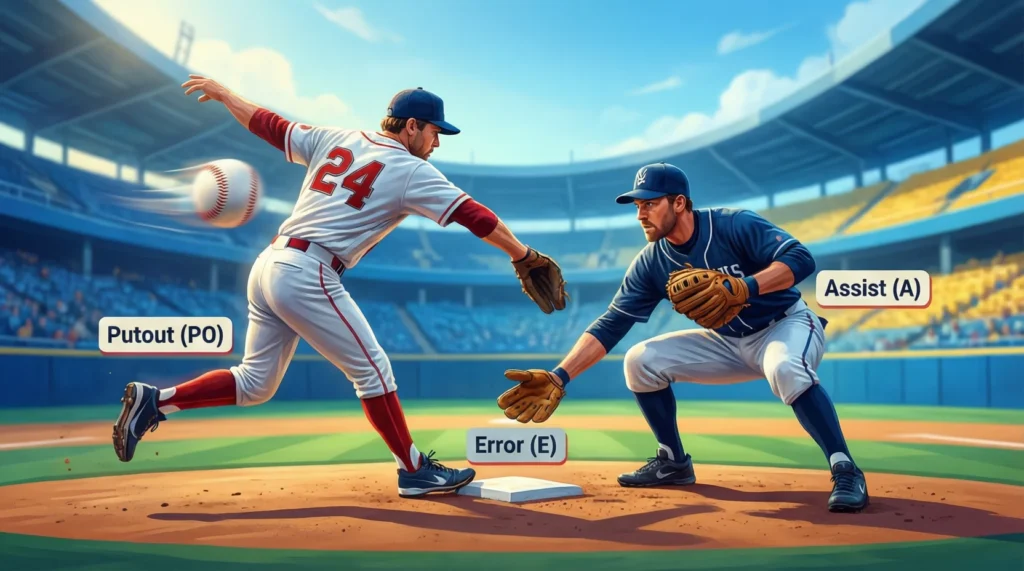
PO in baseball means Putout, a defensive statistic credited to a fielder who records an out by catching the ball, tagging a runner, or forcing a runner out.
It is one of the most fundamental defensive stats used in scorekeeping and baseball analytics.
If you’ve ever looked at a baseball box score or a player’s defensive stats and wondered, What does PO mean in baseball? you’re not alone.
PO is short, simple, and easy to miss, yet it plays a huge role in how defensive performance is tracked, evaluated, and remembered. From a first baseman snagging throws to an outfielder making a diving catch, putouts tell the story of outs recorded the heart of defense in baseball.
Whether you’re:
- A new baseball fan
- A youth player learning scorekeeping
- A fantasy baseball manager
- Or just curious about baseball stats
This guide breaks down PO meaning in baseball in a clear, friendly, and complete way — no jargon overload, no confusion.
📘 What Is a Putout in Baseball?
A putout is officially recorded when a defensive player is responsible for completing an out.
A player earns a PO when they:
- Catch a fly ball
- Step on a base for a force out
- Tag a runner with the ball
- Catch a strikeout pitch as a catcher
Putouts are tracked at every level of baseball, from Little League to MLB.
🧾 How Putouts Are Recorded (Official Scoring)
Scorekeepers award one PO per out, meaning:
- Every out equals one putout
- A standard 9-inning game has 27 total putouts per team
Putouts often work alongside assists (A) and errors (E) to describe defensive plays.
🧠 Common Ways a Putout Happens
Here are the most frequent scenarios where PO is credited:
✔️ Fly Ball Catch
Outfielder catches a fly ball → 1 PO
✔️ Force Out
First baseman catches throw while stepping on first → 1 PO
✔️ Tag Play
Fielder tags runner → 1 PO
✔️ Strikeout
Catcher catches third strike → 1 PO
✔️ Unassisted Play
Shortstop fields ball and steps on second → 1 PO
📊 Example Table: Putouts by Position
| Position | Typical PO Count | Why |
|---|---|---|
| First Baseman (1B) | 8–12 | Receives most throws |
| Catcher (C) | 7–10 | Strikeouts & foul tips |
| Outfielders (OF) | 2–5 | Fly balls |
| Shortstop (SS) | 1–4 | Force outs & tags |
| Pitcher (P) | 0–2 | Covering bases |
| Third Baseman (3B) | 1–3 | Force plays |
| Second Baseman (2B) | 2–4 | Force outs |
📌 Note: Higher PO totals do not always mean better defense — position matters.
📜 Origin of the Term “Putout”
The term put out dates back to baseball’s early days in the mid-1800s, when scoring systems needed a clear way to track:
- Who completed the out
- How defensive plays were finished
As scorekeeping evolved, “putout” became standardized and abbreviated as PO in box scores and stat sheets.
📈 Why Putouts Are Important in Baseball
Putouts help:
- Track defensive involvement
- Measure positional responsibilities
- Support advanced metrics like fielding percentage
Fielding Percentage Formula:
(Putouts + Assists) ÷ (Putouts + Assists + Errors)
Without PO, defensive stats would be incomplete.
🧩 PO vs Assists (A): What’s the Difference?
| Stat | Meaning | Example |
|---|---|---|
| PO | Final out recorded | First baseman catching throw |
| A | Helps make the out | Shortstop throwing to first |
👉 One out = one PO, but it may include multiple assists.
🧮 PO vs Other Baseball Abbreviations
| Abbreviation | Meaning | Category |
|---|---|---|
| PO | Putout | Defense |
| A | Assist | Defense |
| E | Error | Defense |
| DP | Double Play | Team Defense |
| K | Strikeout | Pitching/Batting |
| IP | Innings Pitched | Pitching |
🗣️ Real-World Usage of PO
Neutral / Informational
- “The first baseman finished the game with 11 PO.”
Friendly / Casual
- “That outfielder racked up three easy POs today 😄”
Analytical / Professional
- “Despite low PO totals, his range metrics remain elite.”
Slightly Critical
- “Few POs today — balls weren’t coming his way.”
🔁 Does a High PO Mean Better Defense?
Not always.
Why?
- Some positions naturally earn more putouts
- A great shortstop may prevent hits that never become outs
- Pitchers and third basemen often have low PO totals
📌 Context matters more than raw numbers.
🧠 Alternate Meanings of “PO”
Outside baseball, PO can mean:
- Post Office
- Purchase Order
- Power Outage
- Parole Officer
⚠️ In baseball discussions, PO almost always means Putout.
🧑💼 Professional Alternatives to Saying “PO”
In writing or commentary, you can say:
- Recorded the out
- Completed the defensive out
- Finished the play
- Credited with the out
These are useful in formal articles or broadcasts.
📚 Usage Tips for Fans, Players & Scorekeepers
- Always check position context before judging PO totals
- Use PO with assists and errors for full evaluation
- Remember: Every out equals one PO
❓ FAQs:
1. What does PO stand for in baseball?
PO stands for Putout, a defensive stat credited to the player who records an out.
2. Is PO a pitching stat?
No. PO is a defensive stat for fielders, not pitchers (except rare cases).
3. Who usually gets the most putouts?
First basemen and catchers typically lead in PO totals.
4. Does a strikeout count as a PO?
Yes. The catcher receives the PO on a strikeout.
5. Can one play have more than one PO?
No. Each out results in only one PO, regardless of assists.
6. Is PO important for evaluating defense?
Yes, but it should be used with other stats, not alone.
7. Why do outfielders have fewer POs?
They see fewer chances compared to infielders.
8. Does PO affect fielding percentage?
Yes. PO is part of the fielding percentage calculation.
🧾 Example Breakdown: One Play, Multiple Stats
Play: Ground ball to shortstop → throw to first → runner out
- Shortstop: 1 Assist (A)
- First Baseman: 1 Putout (PO)
- Team: 1 Out Recorded
🏁 Conclusion:
So, what does PO mean in baseball? Simply put, PO stands for Putout, a core defensive statistic that credits the fielder who officially records an out. Whether it’s a first baseman catching a throw, an outfielder securing a fly ball, or a catcher finishing a strikeout, every defensive out ends with a putout.
While PO numbers are easy to spot in box scores, they’re most meaningful when viewed in context. Different positions naturally collect different totals, and a high PO doesn’t always equal better defense. That’s why putouts work best alongside assists, errors, and advanced fielding metrics to give a complete picture of a player’s defensive impact.
Discover More Articles About:
- What Does Love Mean in Tennis? Definition, Origin And Examples 2026
- What Does “Qué” Mean in Spanish? Definition, Uses, Examples & Tips 2026

Matthew Nelson is a professional content writer and blogger with a strong focus on creating high-quality and reader-centric content. He specializes in writing informative articles that help websites grow their online visibility while delivering real value to readers.