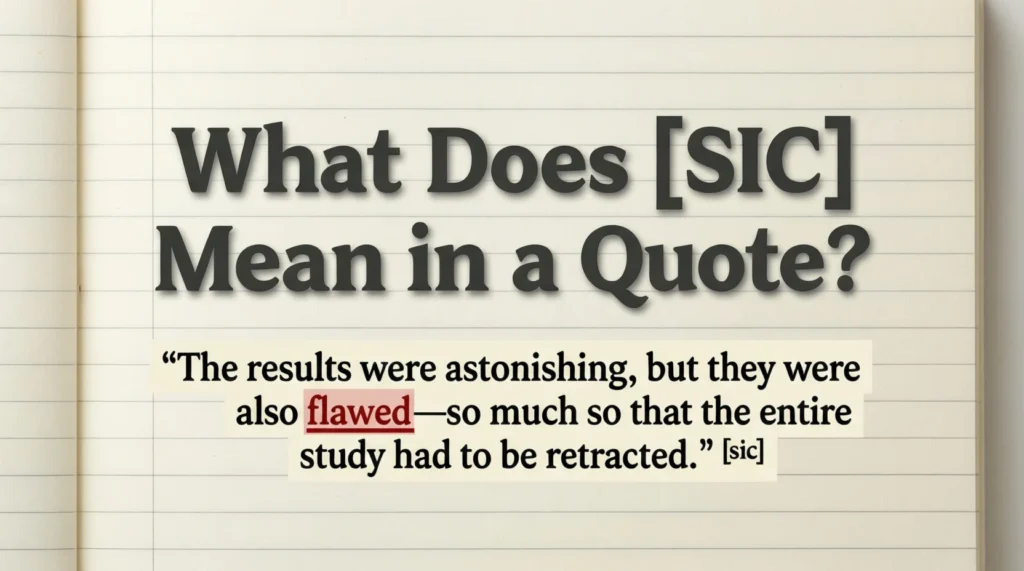
Sic (written as [sic]) is a Latin term meaning thus or so.
When used in a quote, it shows that the quoted text is reproduced exactly as it appeared in the original source, including any spelling, grammar, or factual errors.
In short: [sic] tells readers, This mistake was in the original, not added by me.
Sic is one of those tiny words you’ll often see tucked into brackets inside quotes—yet it carries a surprisingly powerful meaning. If you’ve ever read a quote with a strange spelling or grammar mistake followed by [sic], you may have wondered: Is that sarcasm? A correction? An insult?
Let’s clear it up once and for all.
In writing—especially journalism, academic work, legal writing, documentation, and court transcripts—accuracy is everything. Using [sic] protects the writer from blame while preserving the authenticity of the source.
But context matters. Depending on how it’s used, [sic] can feel neutral, clarifying, or even subtly judgmental.
Let’s break it down properly.
What Does Sic Mean in a Quote?
When you see [sic] in a quote, it signals three key things:
• The quote is word-for-word accurate
• Any errors were present in the original text or speech
• The person quoting it is not correcting or altering the mistake
Simple Example
The company announced, We are commited [sic] to customer satisfaction.
Here, [sic] tells the reader that commited was misspelled in the original announcement.
This is exactly what people are asking when they search what does sic mean in a quote or what does sic mean in text.
The Origin of Sic
Sic comes from Latin, where it literally means:
• Thus
• So
• In this manner
Historically, scribes used sic in handwritten manuscripts to confirm that something odd-looking was intentional, not a copying error.
How It Entered Modern English
• Adopted into academic writing
• Widely used in journalism and law
• Became standard in formal quotations and documentation
Despite its ancient roots, [sic] is still very much alive today.
How Sic Is Used in Real Life
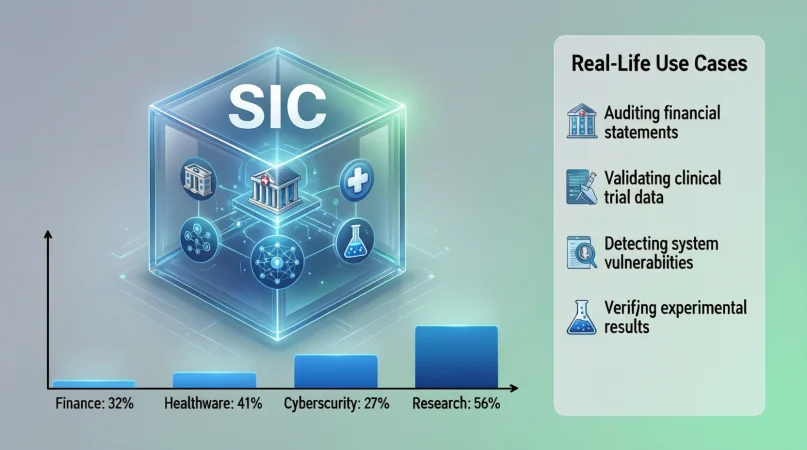
You’ll most commonly see [sic] in:
• 📰 News articles
• 📚 Academic papers
• ⚖️ Legal writing and court transcripts
• 📖 Nonfiction books
• 🧾 Official documentation and reports
It’s far less common in casual writing, texts, or social media—unless someone is intentionally highlighting an error.
This answers common searches like what does sic mean in documentation and what does sic mean in text.
How [sic] Works: Clear Examples
| Original Text | Quoted Version | Why [sic] Is Used |
|---|---|---|
| We will loose profits | We will loose [sic] profits | Shows original spelling error |
| Their going to win | Their [sic] going to win | Confirms grammar mistake |
| The meeting is on Febuary | Febuary [sic] | Preserves original typo |
| He said your welcome | your [sic] welcome | Indicates original misuse |
Different Tones of Sic in Quotes
Although [sic] is meant to be neutral, tone depends heavily on context.
Neutral / Professional Tone
Used to maintain accuracy without judgment.
The report stated, The data was analyse [sic] carefully.
Common in academic papers, legal writing, and official documentation.
Clarifying Tone
Used to prevent confusion when an error could mislead readers.
She described herself as a pubic [sic] speaker.
This helps readers understand the mistake without embarrassment.
Critical or Dismissive Tone ⚠️
Sometimes [sic] is used to subtly highlight incompetence.
The politician tweeted, We will defiantly [sic] win this election.
This usage often fuels searches like is sic rude or what does sic mean in text messages.
Is Sic Rude or Insulting?
By definition: No
In practice: Sometimes, yes
When It’s Appropriate
• Factual accuracy matters
• Errors change meaning
• Academic, legal, or journalistic contexts
When It Can Feel Rude
• Social media call-outs
• Repeated use on tiny typos
• Highlighting harmless mistakes
Rule of thumb: Use [sic] only when the error is relevant or potentially misleading.
How to Properly Use Sic in Legal Writing
In legal writing, precision is critical. [sic] is used to:
• Preserve exact wording in contracts and testimony
• Protect attorneys from altering evidence
• Clarify errors in affidavits or official statements
Example from legal writing:
The witness stated, I seen [sic] the defendant leave.
This also answers how to properly use sic in legal writing.
What Does Sic Mean in Law Enforcement and Court Transcripts?
In law enforcement reports and court transcripts, [sic] indicates:
• Verbatim speech from suspects or witnesses
• Errors spoken aloud, not corrected by the transcriber
• Exact preservation of testimony
This explains searches like:
• What does sic mean in law enforcement?
• What does sic mean in a court transcript?
Common Mistakes People Make with Sic
Avoid these errors:
• Using sic without brackets
• Correcting the mistake and adding [sic]
• Overusing it for tiny typos
• Using it sarcastically in professional writing
Correct format:
[sic] ← lowercase, in brackets, italicized optional
Sic vs Similar Terms
| Term | Meaning | Usage |
| [sic] | Original text is exact, errors included | Quotes |
| [emphasis added] | Emphasis not in original | Academic writing |
| [brackets] | Writer-added clarification | Quotes |
| (editor’s note) | Explanation outside quote | Articles |
| verbatim | Exact wording | Transcripts |
Are There Alternate Meanings of Sic?
Yes—but not in quotes.
Other Meanings
• Sic! – Command to attack (archaic)
• SIC – Acronym (Standard Industrial Classification)
These meanings do not apply when [sic] appears in a quote.
Polite or Professional Alternatives to Sic
If you want to avoid sounding harsh:
• Correct the error silently (if allowed)
• Add a footnote explanation
• Use (original wording)
• Paraphrase instead of quoting
Example:
Instead of Welcom [sic] home, write:
The sign contained a spelling error in the word welcome.
When Should You Use Sic?
Use [sic] if:
• Accuracy is critical
• The error affects meaning
• You’re quoting officially
Avoid [sic] if:
• The error is minor
• It feels unnecessary
• You’re writing casually or informally
FAQs
What does [sic] literally mean?
It’s Latin for thus or so, meaning the text appears exactly as written.
Why do writers use [sic]?
To show that any errors were in the original source.
Is [sic] always negative?
No. It’s usually neutral, but context can make it feel critical.
Should sic be italicized?
Italicizing is optional; brackets are required.
Can I use [sic] in academic writing?
Yes. It’s common in academic, legal, and journalistic work.
Is [sic] rude in texts or emails?
It can feel sarcastic in informal communication.
Can I correct the error instead of using [sic]?
Yes, when accuracy isn’t legally or academically required.
What’s the difference between [sic] and brackets?
[sic] explains an error; brackets add clarification.
Conclusion
Understanding what sic means in a quote helps you read and write with greater clarity and confidence. [sic] simply tells readers that a quoted passage appears exactly as it did in the original source—even if it contains mistakes. Its purpose isn’t to mock or correct, but to preserve authenticity and protect the credibility of the writer.
Used thoughtfully and sparingly, [sic] strengthens professional writing. Overused or misused, it can distract or feel dismissive. Knowing when to use it—and when to choose a softer alternative—makes your writing clearer, more accurate, and more respectful.

Michael Johnson is a seasoned Content Expert and digital communication specialist with a proven track record in content creation, strategy, and audience engagement. His work goes beyond writing he crafts meaningful, results driven content that helps businesses achieve growth, brand visibility, and audience trust.