
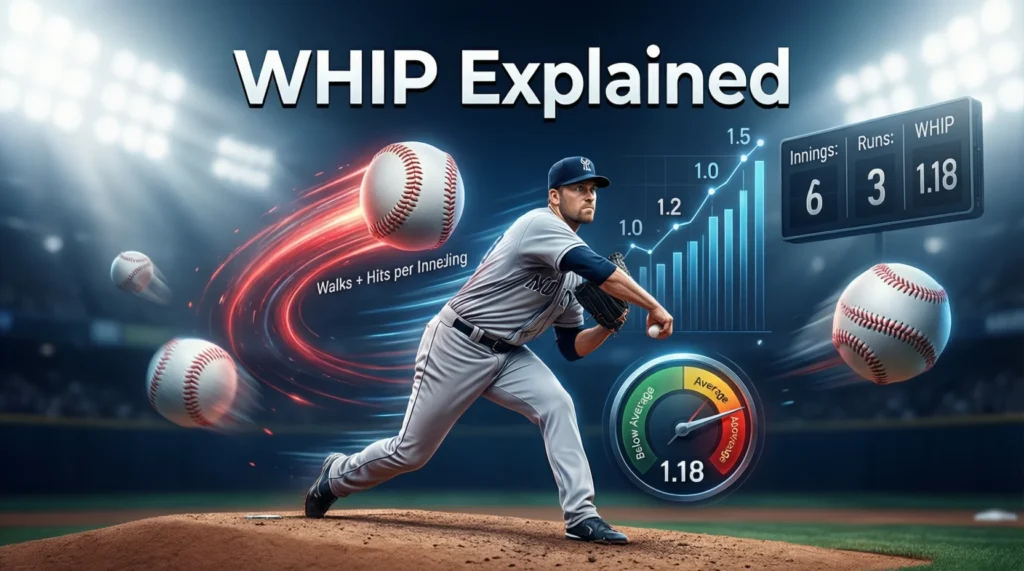
WHIP in baseball stands for Walks plus Hits per Inning Pitched. It is a pitching statistic that measures how many baserunners a pitcher allows per inning. A lower WHIP means the pitcher is better at keeping runners off base, while a higher WHIP suggests more traffic and potential trouble.
Baseball is a game of numbers, but not all stats are created equal. Some feel old-school, others are flashy, and a few quietly tell you everything you need to know. WHIP belongs to that last category.
If you’ve ever heard a commentator say, “His WHIP this season is elite,” or seen fantasy baseball players obsess over it, you might have wondered what makes this stat so important. The answer is simple: WHIP cuts through the noise and shows how effective a pitcher really is at preventing baserunners.
In this guide, we’ll break down what WHIP means in baseball, where it came from, how it’s calculated, why it matters, and how to use it like a pro—whether you’re a fan, fantasy player, coach, or just baseball-curious ⚾
What Is WHIP in Baseball?
WHIP = Walks + Hits ÷ Innings Pitched
It measures how many batters reach base against a pitcher per inning, excluding errors and hit-by-pitches.
In plain English:
- Fewer baserunners = less danger
- Less danger = fewer runs
- Fewer runs = better pitching
That’s why WHIP is considered one of the cleanest indicators of pitcher efficiency.
How Is WHIP Calculated? (Formula & Breakdown)
WHIP Formula
WHIP = (Walks Allowed + Hits Allowed) ÷ Innings Pitched
What Counts
- ✅ Base on Balls (BB)
- ✅ Hits (H)
- ❌ Errors
- ❌ Hit by Pitch (HBP)
- ❌ Reached on Fielder’s Choice
Example Calculation
| Pitcher Stats | Value |
|---|---|
| Walks Allowed | 30 |
| Hits Allowed | 120 |
| Innings Pitched | 150 |
WHIP = (30 + 120) ÷ 150 = 1.00
➡️ This pitcher allows 1 baserunner per inning, which is excellent.
What Is a Good WHIP in Baseball?
WHIP values vary by era, league, and role, but here’s a general guide:
WHIP Rating Scale
| WHIP | Performance Level |
|---|---|
| Below 1.00 | Elite |
| 1.00 – 1.10 | Excellent |
| 1.10 – 1.25 | Very Good |
| 1.25 – 1.35 | Average |
| 1.35 – 1.50 | Below Average |
| Above 1.50 | Poor |
💡 Rule of thumb:
If a pitcher’s WHIP starts with a 1 or lower, they’re doing something right.
Why WHIP Matters So Much in Baseball
WHIP matters because it answers one crucial question:
👉 How often does a pitcher let hitters reach base?
Why Coaches & Analysts Love WHIP
- It ignores defense-related noise
- It focuses on pitcher-controlled outcomes
- It predicts run prevention better than wins
- It highlights control and command
Unlike ERA, which can be inflated by one bad inning, WHIP stays stable and honest.
WHIP vs ERA: What’s the Difference?
These two stats often get compared—and for good reason.
WHIP vs ERA Comparison Table
| Stat | What It Measures | Best Use |
|---|---|---|
| WHIP | Baserunners per inning | Pitcher efficiency |
| ERA | Earned runs per 9 innings | Run prevention |
| WHIP reacts | Immediately | Slowly |
| ERA affected by defense | Yes | Less |
| WHIP affected by defense | No | No |
📌 Bottom line:
- WHIP tells you how often trouble starts
- ERA tells you how often trouble scores
The best pitchers dominate both.
Origin and History of WHIP
WHIP became popular in the late 20th century, especially as sabermetrics (advanced baseball analytics) gained traction.
- First widely tracked in the 1980s–1990s
- Adopted heavily by fantasy baseball leagues
- Now standard on MLB stat pages and broadcasts
It rose in popularity because:
- It’s easy to calculate
- It’s intuitive
- It predicts future performance better than wins
Today, WHIP is considered a core pitching metric, not an advanced one.
Real-World Usage of WHIP (MLB, Fantasy & Commentary)
In MLB Analysis
- Used to compare pitchers across teams
- Helps identify breakout seasons
- Highlights control pitchers vs power pitchers
In Fantasy Baseball
- Often a category in roto leagues
- Rewards consistent control
- Punishes wild pitchers
In Broadcasts
- Used during Cy Young discussions
- Mentioned during playoff matchups
- Often paired with ERA and strikeouts
WHIP Examples with Context
Neutral/Informative
- His WHIP this season is 1.08, which puts him among the league’s best starters.
Positive/Friendly
- A WHIP under 1.00? That’s pure dominance 😤⚾
Negative/Dismissive
- His WHIP jumped to 1.55, and it’s showing—too many free passes.
WHIP for Different Types of Pitchers
Starting Pitchers
- Lower WHIP = longer outings
- Efficiency matters more than velocity
Relief Pitchers
- Often have lower WHIPs due to fewer innings
- One bad outing can skew stats
Closers
- WHIP is critical under pressure
- Baserunners = blown saves risk
Advanced Context: What WHIP Does NOT Show
While WHIP is powerful, it’s not perfect.
Limitations of WHIP
- Doesn’t account for hit quality
- Treats singles and home runs equally
- Ignores double plays
- Doesn’t include hit-by-pitch
That’s why analysts often pair WHIP with:
- FIP
- xERA
- BABIP
- Strikeout-to-walk ratio (K/BB)
Alternate Meanings of “WHIP”
Outside baseball, “whip” can mean:
- A slang term for a car
- A cooking tool
- A fast throwing motion
- A leadership role in politics
⚠️ In baseball stats, WHIP always refers to Walks + Hits per Inning Pitched.
Polite or Professional Alternatives to Saying WHIP
If you want to explain WHIP without using jargon:
- Baserunners allowed per inning
- Pitching efficiency metric
- Control-based pitching stat
- On-base prevention rate
These alternatives work well in:
- Coaching
- Youth baseball
- Beginner explanations
Labeled Example Table:
Pitcher Comparison Example
| Pitcher | WHIP | ERA | Takeaway |
|---|---|---|---|
| Pitcher A | 0.98 | 2.40 | Elite control |
| Pitcher B | 1.22 | 3.10 | Solid starter |
| Pitcher C | 1.48 | 4.80 | Struggles with traffic |
FAQs
1. What does WHIP stand for in baseball?
WHIP stands for Walks plus Hits per Inning Pitched.
2. Is a lower WHIP always better?
Yes. Lower WHIP means fewer baserunners and better pitching efficiency.
3. What is an elite WHIP in MLB?
Anything below 1.00 is considered elite.
4. Does WHIP include hit by pitch?
No. Hit-by-pitch is not included in WHIP calculations.
5. Is WHIP better than ERA?
They serve different purposes. WHIP measures baserunners; ERA measures runs allowed.
6. Can WHIP predict future performance?
Often yes. WHIP is more stable than ERA and can signal regression or improvement.
7. Do relief pitchers usually have lower WHIP?
Yes, because they face fewer batters, but small sample sizes matter.
8. Why do fantasy baseball players care so much about WHIP?
Because it directly reflects pitcher control and consistency over time.
Conclusion:
WHIP may not be flashy, but it’s brutally honest.
It tells you:
- How often a pitcher puts himself in danger
- How much control he truly has
- How sustainable his performance is
Whether you’re watching an MLB game, drafting a fantasy team, or learning baseball stats for the first time, understanding what WHIP means in baseball gives you instant insight into pitching quality.

Matthew Nelson is a professional content writer and blogger with a strong focus on creating high-quality and reader-centric content. He specializes in writing informative articles that help websites grow their online visibility while delivering real value to readers.