
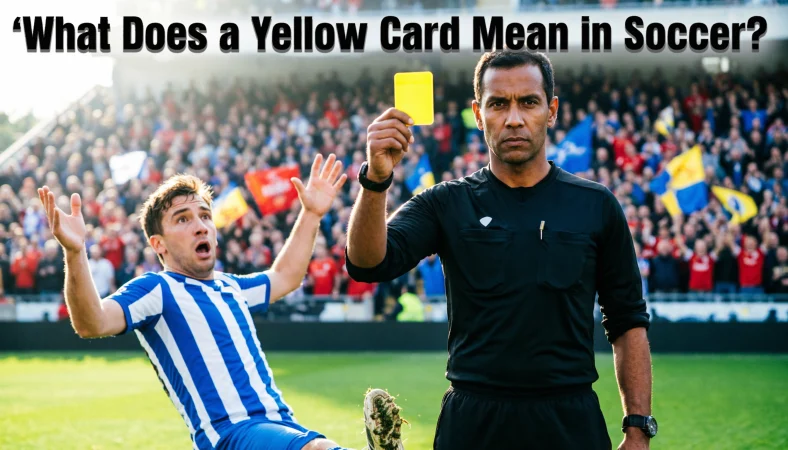
Definition:
A yellow card in soccer is an official caution given by the referee to a player for breaking the rules. It serves as a warning for misconduct or unsporting behavior. If a player receives two yellow cards in the same match, it results in a red card and the player is sent off.
Have you ever watched a soccer match and suddenly seen the referee pull out a bright yellow card from their pocket? The crowd reacts. Players protest. Commentators raise their voices. ⚽
But what does a yellow card mean in soccer, really?
Is it just a warning? Does it lead to suspension? How serious is it compared to a red card?
In this comprehensive guide, we’ll break down everything you need to know from the origin of yellow cards to real match examples, comparisons with red cards, and frequently asked questions fans search for online.
Let’s dive in.
What Does a Yellow Card Mean in Soccer?
In soccer (also known as football worldwide), a yellow card is a formal caution issued by the referee to a player who violates the Laws of the Game.
It signals:
- ⚠️ A serious warning
- 📋 Official record of misconduct
- 🚨 Risk of stronger punishment if repeated
The rules governing yellow cards are established by the FIFA and maintained globally through the Laws of the Game by International Football Association Board.
A yellow card does not immediately remove a player from the game but it puts them on thin ice.
Origin of the Yellow Card System
Interestingly, yellow and red cards weren’t always part of soccer.
How Did Yellow Cards Start?
The system was introduced after confusion during the 1966 FIFA World Cup in England. Referees struggled to communicate disciplinary decisions to players who spoke different languages.
English referee Ken Aston came up with the idea of using color-coded cards inspired by traffic lights:
- 🟡 Yellow = Caution (Slow down!)
- 🔴 Red = Stop (You’re out!)
The system was officially introduced at the 1970 FIFA World Cup in Mexico.
Since then, yellow cards have become a universal symbol in soccer.
When Does a Player Receive a Yellow Card?
A referee can issue a yellow card for several types of misconduct. These typically fall under unsporting behavior or rule violations.
Common Reasons for a Yellow Card
- Reckless tackles
- Deliberate handball (non-goal-scoring)
- Dissent toward the referee
- Delaying the restart of play
- Repeated fouls
- Removing shirt during celebration
- Entering or leaving the field without permission
Official Law Reference
According to the Laws of the Game, yellow cards are shown for:
- Unsporting behavior
- Dissent by word or action
- Persistent infringement
- Delaying restart
- Failure to respect required distance (e.g., free kicks)
It’s essentially a formal “this is your warning” moment.
What Happens After a Yellow Card?
Many new fans wonder: Is a yellow card a big deal?
Yes and no.
Immediate Impact
- The player stays on the field.
- The referee records the caution.
- The player must adjust their behavior.
If a Player Gets Two Yellow Cards
- Second yellow = Automatic red card.
- The player is sent off.
- The team plays with one fewer player.
- Suspension likely for next match.
This is sometimes called a “double yellow.”
Yellow Card vs Red Card: What’s the Difference?
Understanding the difference between yellow and red cards is essential.
| Feature | Yellow Card | Red Card |
| Meaning | Warning | Immediate dismissal |
| Does the player stay on the field? | Yes | No |
| Two in one match? | Equals red | Not applicable |
| Suspension risk? | Possible (accumulation) | Almost certain |
| Severity level | Moderate | Severe |
Quick Summary
- 🟡 Yellow = Caution
- 🔴 Red = Ejection
A red card is more serious and can be given directly without a prior yellow.
Real-Game Examples of Yellow Cards
Let’s explore how yellow cards appear in different match situations.
Friendly Tone Example ⚽
A defender mistimes a slide tackle but doesn’t injure the opponent.
The referee shows a yellow card, a firm but fair warning.
Commentator tone: That’s a bit reckless, and he’s lucky it’s only yellow.
Neutral Professional Example
A midfielder repeatedly fouls opponents to break up play.
The referee issues a caution for persistent infringement.
Commentary tone: The referee had no choice there.
Negative/Dismissive Example 😠
A player argues aggressively with the referee.
Referee shows yellow for dissent.
Commentator tone: Completely unnecessary. He’s only hurting his team.
Accumulated Yellow Cards and Suspensions
In many tournaments and leagues, yellow cards accumulate over time.
For example:
- In international tournaments like the UEFA Champions League
- In domestic leagues like the English Premier League
If a player collects a certain number of yellow cards across matches, they may face:
- One-match suspension
- Fine
- Additional disciplinary review
This encourages players to maintain discipline throughout the season.
Tactical Yellow Cards: Smart or Unsporting?
Sometimes players intentionally commit a foul to stop a dangerous counterattack. This is called a tactical foul.
Example:
An attacker is sprinting toward the goal. A defender pulls their shirt slightly stopping the attack but earning a yellow.
Is it smart strategy or bad sportsmanship?
It depends on perspective:
- Coaches may see it as “game management.”
- Fans may see it as cynical.
- Referees must enforce the rules consistently.
Alternate Meanings of Yellow Card
While primarily associated with soccer, “yellow card” can also appear in:
- Workplace warnings (informal metaphor)
- Political debates (warning systems)
- School discipline systems
However, in sports context, it almost always refers to soccer/football.
How Players Avoid Getting Yellow Cards
Smart players know how to play aggressively without crossing the line.
Tips to Avoid a Yellow Card
- Stay calm under pressure
- Avoid arguing with officials
- Time tackles carefully
- Respect free-kick distance
- Control emotions during celebrations
Discipline is often what separates great players from reckless ones.
Common Misconceptions About Yellow Cards
Let’s clear up a few myths.
Myth 1:
Not immediately. It depends on accumulation rules.
Myth 2:
No coaches and bench staff can also be cautioned.
Myth 3:
Not necessarily. Sometimes it’s just a mistimed challenge.
FAQ:
1. What does a yellow card mean in soccer?
It is a formal warning issued by the referee for rule violations or unsporting behavior.
2. What happens if a player gets two yellow cards?
Two yellow cards in the same match equal a red card and ejection.
3. How many yellow cards lead to suspension?
It depends on league rules. Many competitions suspend players after a certain accumulation.
4. Can a goalkeeper receive a yellow card?
Yes. Goalkeepers are subject to the same disciplinary rules.
5. Can coaches get yellow cards?
Yes, referees can caution coaches and bench staff.
6. Do yellow cards reset in tournaments?
In some tournaments, yellow cards are cleared after certain rounds.
7. Is a yellow card serious?
Yes. It’s a strong warning and puts a player at risk of dismissal.
8. Why do referees write something after showing a yellow card?
They officially record the player’s name and offense.
Labeled Example Table: Yellow Card Situations
| Situation | Type of Offense | Card Given | Outcome |
| Reckless tackle | Unsporting behavior | Yellow | Player warned |
| Arguing referee | Dissent | Yellow | Caution recorded |
| Shirt removal | Unsporting conduct | Yellow | Warning |
| Second reckless foul | Second caution | Red (after yellow) | Player sent off |
Conclusion:
A yellow card in soccer is more than just a piece of colored plastic it’s an official warning that can change the momentum of a game.
Key points:
- 🟡 It signals caution, not ejection.
- 📋 It is officially recorded.
- 🚨 Two yellows in one match equal a red card.
- ⚽ Accumulation can lead to suspension.
- 🎯 Discipline is crucial for players at every level.
Understanding yellow cards helps fans appreciate the strategy, emotion, and discipline involved in the beautiful game.
Whether you’re a casual viewer or a serious football enthusiast, knowing what a yellow card means gives you deeper insight into match dynamics and referee decisions.

Michael Johnson is a seasoned Content Expert and digital communication specialist with a proven track record in content creation, strategy, and audience engagement. His work goes beyond writing he crafts meaningful, results driven content that helps businesses achieve growth, brand visibility, and audience trust.