
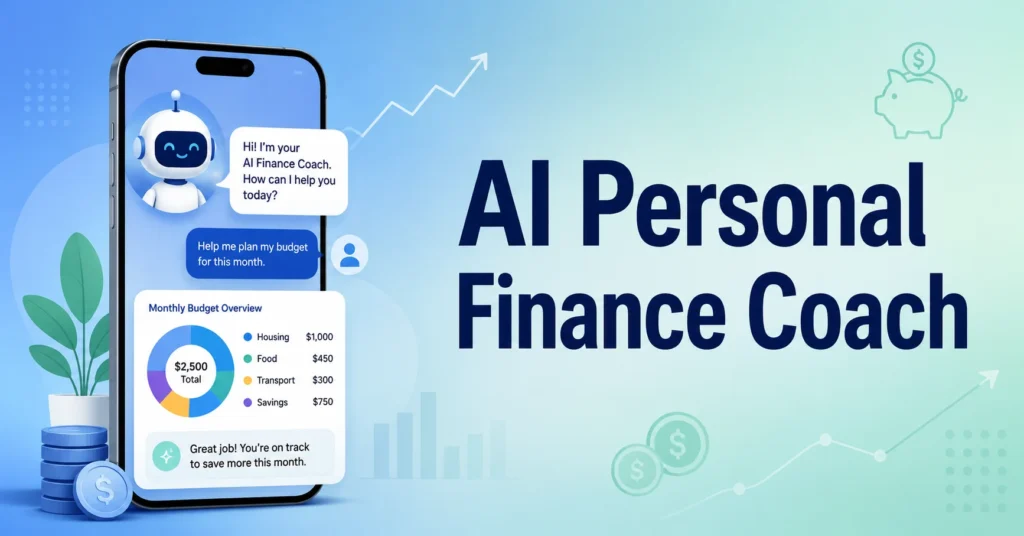

An AI personal finance coach is a software tool that uses artificial intelligence to help you track spending, build budgets, save money, and plan investments — offering personalized guidance the way a human financial advisor would, but automated and available 24/7.
Managing money used to mean spreadsheets, guesswork, and hoping your mental math was right. In 2026, AI has changed that. These tools don’t just record what you spent — they explain why you’re low on cash before payday, flag subscriptions you forgot about, and nudge you toward better habits in real time.
This guide breaks down what an AI personal finance coach actually is, why it matters, the different types available, real examples, a comparison table, FAQs, and practical tips — everything you need to understand this fast-growing category of tech.
What Is an AI Personal Finance Coach?
At its core, an AI personal finance coach is a system that connects to your financial accounts (or accepts manual entries) and uses machine learning to:
- Automatically categorize your transactions
- Detect spending patterns and unusual charges
- Forecast your cash flow days or weeks ahead
- Suggest budget adjustments or savings goals
- In some cases, offer investment guidance or portfolio rebalancing
Unlike a plain budgeting spreadsheet, the “AI” part means the tool learns from your corrections and gets smarter about your specific habits over time, rather than applying the same static rules to everyone.
Why AI Finance Coaches Matter
Money management is one of the most common sources of stress, and most people don’t have access to (or can’t afford) a human financial advisor. AI coaches matter because they:
- Lower the barrier to good financial habits — no finance degree required
- Catch problems early (overspending, forgotten subscriptions, low balances) before they become crises
- Make financial advice available on-demand, not just once a year
- Turn passive tracking into active, personalized suggestions
Think of a traditional budgeting app as a mirror — it just shows you your spending. An AI coach is more like a flashlight, pointing at the specific thing you should look at next.
Where the Category Came From
AI personal finance tools didn’t appear overnight — they evolved in stages:
- Early 2010s: Basic budgeting apps (like the original Mint) offered manual categorization and simple alerts
- Late 2010s: Robo-advisors (Betterment, Wealthfront) introduced automated investing based on risk profiles
- Early 2020s: Machine learning improved auto-categorization accuracy and added predictive spending insights
- 2024–2026: Conversational AI and LLMs enabled natural-language coaching — asking your app “how much did I spend on dining out last quarter?” and getting a real answer
How Popular Are AI Finance Coaches Right Now?
This category has moved from niche to mainstream fast. AI-powered budgeting and investing tools are now a standard part of many people’s financial routines, showing up everywhere from app store top charts to workplace benefits packages. The trend is being driven by two things: rising interest in financial literacy content online, and AI becoming cheap and capable enough to run real-time analysis on everyday transactions.
Types of AI Personal Finance Coaches
Not all AI finance tools do the same job. Here are the main categories:
1. AI Budgeting & Spending Trackers
Focus on categorizing transactions, flagging unusual spending, and building budgets automatically.
Example: You can See a complete guide Copilot Money
2. Conversational / Chatbot Coaches
Let you ask questions in plain language and get direct, sometimes blunt, feedback on your habits.
Example: You can See a complete guide Cleo
3. Robo-Advisors (Investment Coaches)
Automate investing, portfolio rebalancing, and tax-loss harvesting based on your goals and risk tolerance.
Example: Wealthfront
4. Household / Collaborative Finance Coaches
Built for couples or families managing shared money, with joint dashboards and permissions.
Example: Monarch Money
5. Subscription & Bill Management Coaches
Specialize in finding and canceling unused subscriptions, and negotiating lower bills.
Example: Rocket Money
Types at a Glance:
| Type | What It Does | Example |
|---|---|---|
| Budgeting & Spending Tracker | Auto-categorizes spending, builds budgets | Copilot Money |
| Conversational Coach | Chat-based feedback and Q&A on your money | Cleo |
| Robo-Advisor | Automated investing and rebalancing | Wealthfront |
| Household Coach | Shared budgeting for couples/families | Monarch Money |
| Subscription Manager | Finds and cancels unused subscriptions | Rocket Money |
AI Finance Coach vs. Traditional Advisor vs. Basic Budgeting App
- AI Finance Coach: Automated, low-cost or free, available anytime, learns your habits — but works from data, not full life context
- Traditional Human Advisor: Understands nuanced life circumstances, offers accountability — but expensive, and usually meets a few times a year
- Basic Budgeting App/Spreadsheet: Full manual control and privacy — but requires discipline and gives no proactive insights
An AI coach sits in between: more proactive than a spreadsheet, more accessible than a human advisor.
Examples in Context
Friendly/Casual:
“My AI finance coach texted me that I’ve spent way too much on takeout this month — fair, honestly.”
Professional/Formal:
“AI-driven personal finance platforms provide automated transaction categorization and predictive cash-flow analysis to support user decision-making.”
Skeptical/Critical:
“It’s just pattern-matching on your bank statement — useful for awareness, but it’s not real financial advice.”
Is “AI Coach” Always About Money?
Not necessarily — “AI coach” is also used for fitness coaching, career coaching, and writing coaching apps. In this context, it specifically refers to tools focused on budgeting, saving, and investing. Always check what an app actually does before assuming “AI coach” means financial help.
Other Names for AI Personal Finance Coaches
Depending on the source, you might see this category called:
- AI financial assistant
- Smart budgeting app
- Robo-advisor (specifically for investment-focused tools)
- Digital money coach
- AI-powered money management app
Tips for Choosing and Using One Well
- Prioritize categorization accuracy — bad labels make every later insight less useful
- Check what data it needs access to, and how it’s stored or shared
- Compare fees carefully — some are free, others run $10–15/month
- Use it to build awareness and habits, not as your only source of investment advice
- Keep an export option available, in case you switch tools later
Common Mistakes to Avoid
- Blindly following every suggestion without understanding the “why”
- Ignoring how much financial data you’re sharing, and with whom
- Choosing a tool based on flashy features instead of your actual habits (e.g., picking an investing-heavy app when you really just need budgeting help)
- Assuming an AI coach replaces professional advice for big decisions (retirement, taxes, large investments)
FAQs
1. Are AI personal finance coaches free?
Many offer a free tier with core tracking, while advanced features (bill negotiation, deeper coaching, investment tools) are usually paywalled at $10–15/month.
2. Is it safe to link my bank account to an AI finance app?
Most reputable apps use secure, read-only connections through providers like Plaid. Still, review each app’s privacy policy before connecting accounts.
3. Can an AI finance coach replace a human financial advisor?
For everyday budgeting and habit-building, yes it can help a lot. For complex situations like retirement planning or tax strategy, a human advisor is still generally recommended.
4. Do these apps work with all banks?
Coverage varies by app. Most support major banks, but smaller or regional institutions may not always connect cleanly.
5. What’s the difference between a budgeting app and a robo-advisor?
A budgeting app focuses on spending and saving; a robo-advisor focuses on automated investing. Some apps now combine both.
Conclusion
AI personal finance coaches have moved from a nice-to-have to genuinely useful tools in just a few years. They won’t replace human judgment on big financial decisions, but for everyday budgeting, spotting bad habits, and staying on top of your money, they offer something spreadsheets and yearly advisor meetings never could: constant, personalized attention.
Whether you’re trying to stop overspending, build an emergency fund, or just understand where your paycheck actually goes, there’s likely an AI coach built for exactly that job.